5-Card Omaha Best Starting Hands & Chart
The best 5-Card Omaha starting hands are double-suited, connected, and high, with all five cards working together. Here's a tiered chart.
On this page · 6 sections
Here is the shape of a premium 5-Card Omaha hand at a glance, before the reasoning behind it:
| Tier | Hand shape | Example | Why it’s strong |
|---|---|---|---|
| 1 | A-A-K-K-Q (ds) | A♠ A♥ K♠ K♥ Q♦ | Two top pairs, nut flush draws, top straights |
| 2 | A-A-K-Q-J (ds) | A♣ A♦ K♣ Q♦ J♣ | Aces plus a Broadway rundown for nut everything |
| 3 | A-K-Q-J-10 (ds) | A♠ K♠ Q♥ J♥ 10♠ | The nut rundown: huge wraps, all nut-end draws |
| 4 | K-K-Q-Q-J (ds) | K♥ K♠ Q♥ Q♠ J♦ | Two big pairs with connectivity and strong sets |
| 5 | J-10-9-8-7 (ds) | J♠ 10♠ 9♥ 8♥ 7♦ | Massive connected rundown, enormous straight equity |
| 6 | A-A-x-x-x (rainbow) | A♠ A♦ 9♣ 6♥ 3♠ | Playable but weak: no flushes, few straights |
| 7 | Dangler hands | K♠ K♦ Q♠ J♦ 2♥ | The lone 2 is dead; downgrade or fold |
The best 5-Card Omaha starting hands are double-suited, connected, and high — five cards all pulling the same direction, like A-K-Q-J-10 with two suits. Tiers 1 through 5 are raise-or-reraise material. Aces rainbow is still a raise but needs care after the flop, since it makes no flushes and connects with fewer boards. Anything carrying a genuine dangler drops a full tier or more.
How the tiers stack up head-to-head
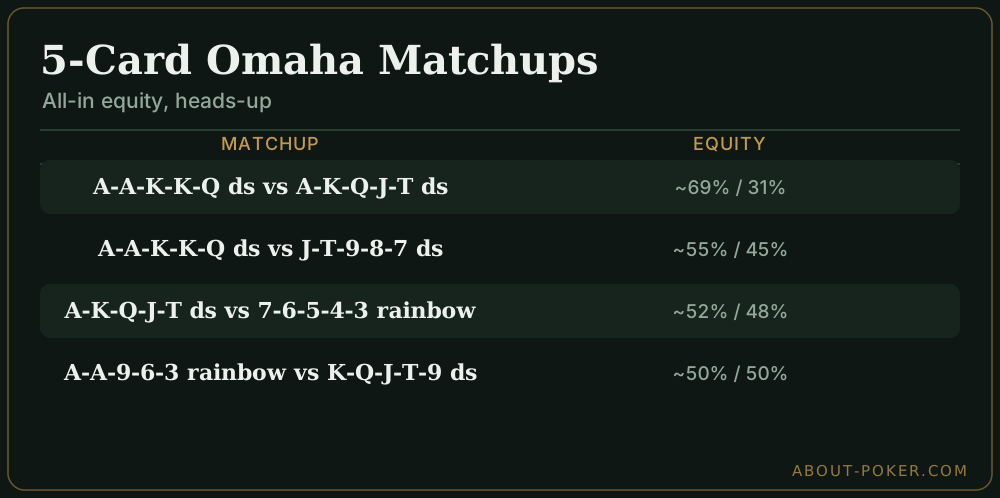
Because everyone holds ten combinations, 5-Card Omaha equities run close — even a big edge is rarely more than 55/45 all-in preflop. These figures come from all-in Monte Carlo simulations (heads-up, running the full board):
| Matchup | Result |
|---|---|
| A-A-K-K-Q (ds) vs A-K-Q-J-10 (ds) | ~69% / 31% |
| A-A-K-K-Q (ds) vs J-10-9-8-7 (ds) | ~55% / 45% |
| A-K-Q-J-10 (ds) vs 7-6-5-4-3 (rainbow) | ~52% / 48% |
| A-A-9-6-3 (rainbow) vs K-Q-J-10-9 (ds) | ~50% / 50% |
Two things jump out. A rundown you’d never open — 7-6-5-4-3 — is nearly a coin flip against the nut rundown, so raw equity edges are thin and nut potential is what wins pots. And that last row is the warning: a bare aces-rainbow hand only breaks even against a good double-suited rundown, which is why Tier 6 sits so far below the double-suited tiers despite holding a pair of aces.
Ranking within a tier
Single examples don’t show how variants sort, so use these rules of thumb:
- A-A-x-x-x hands rank by their side cards. A-A-K-Q-J (ds) is Tier 2; A-A-K-K-Q (ds) is Tier 1; A-A rainbow with disconnected low cards (A-A-9-6-3) is Tier 6. The aces are the same — the other three cards decide the tier.
- Rundowns rank by height and gaps. A-K-Q-J-10 (nut, no gaps) > K-Q-J-10-9 > J-10-9-8-7 > any rundown with a gap (K-Q-J-9-8) > a low rundown (7-6-5-4-3, which makes non-nut straights that get counterfeited).
- Double-suited beats single-suited beats rainbow at the same rank. Adding a second suit to a rundown is worth roughly a full tier.
The four traits that carry a hand
A card that helps on none of these dimensions is a dangler — dead weight that quietly drags a five-card hand back toward a four-card hand. Danglers are the number-one trap in the game, because a holding can look loaded and still have one card doing nothing. Rank every hand on:
- Connectedness. Tight cards like K-Q-J-10 make many straights, including wraps with 17-plus outs. Big gaps make few.
- Suits. Two or three suits represented lets you chase multiple flushes. Rainbow hands waste the flush dimension entirely.
- High cards. They make the nut end of straights and flushes — decisive when the board gets dangerous.
- Coordinated pairs. A-A or K-K that meshes with the rest is excellent; a low pair marooned next to dead cards is a liability.
What “17-plus outs” actually looks like: hold Q♣ J♦ 10♠ 7♥ 6♣ and flop 9♦ 8♠ 2♥. Your cards wrap the board’s 9-8 from both sides. Any 5, 6, 7, 10, J, or Q makes a straight — that’s a 19-out wrap (four 5s, plus three each of 6-7-10-J-Q after removing the copies you already hold). A four-card hand can’t hold both the top end (Q-J-10) and the bottom end (7-6) at once, which is exactly why the fifth card raises the ceiling on your draws.
Only two of your five ever play
This is the discipline the extra card demands. Say you hold A♠ K♠ Q♥ J♥ 10♠ and the flop is 9♠ 8♠ 2♦.
- Flush? You hold three spades and there is one spade on the flop. But a flush needs two spades in hand and three on the board — with a single board spade, there is no flush and no made flush draw yet. Two more spades would have to fall.
- Straight? Your J-10 alongside the board’s 9-8 is a straight draw — a 7 (for J-10-9-8-7) or a Q (for Q-J-10-9-8) completes a straight, using exactly two of your hole cards.
You have ten combinations, but only two of your five cards count on any given board. Count what your best two actually make, not what all five could make. The full deal is covered in the 5-Card Omaha rules.
Playing the tiers by position and stack depth
The chart tells you what’s strong; position and stack depth tell you how wide to go with it.
- Early position: open only Tiers 1–4. These make the nuts often enough to play a big pot out of position. Fold speculative low rundowns and any dangler hand.
- Cutoff / button: add Tier 5 rundowns and the better single-suited high hands. Position lets you realize the equity of a drawing hand you’d have to check-fold from up front.
- Facing a 3-bet: continue mostly with Tiers 1–2 and the nut rundown (Tier 3). Aces-rainbow (Tier 6) is a call at best, not a 4-bet — its equity edge is too thin (see the ~50% row above) to build a huge pot with.
- Stack depth: deeper stacks reward nut-heavy hands (Tiers 1–3), because domination gets paid off on later streets. Short-stacked (under ~40 big blinds), high pairs and raw equity matter more than draw ceilings, so Tiers 1, 4, and even a clean aces-rainbow gain value relative to speculative rundowns.
Every threshold from four-card PLO tightens
The framework matches our PLO starting hands guide, but the bar rises across the board: middling rundowns that are marginal in four-card PLO become folds here, non-nut flushes and low-end straights lose more often, and position is worth a premium because big draws are everywhere. Picking hands is only step one — pair this chart with the pot-limit Omaha strategy primer, or head back to the Omaha & PLO hub for the rest.
Frequently asked
What is the best starting hand in 5-Card Omaha?
A-A-K-K-Q double-suited and A-A-K-Q-J double-suited are the strongest. Both pair two premium pairs with connected, high, double-suited cards, so a large share of your ten two-card combinations can make the nuts.
How many two-card combinations does a 5-Card Omaha hand have?
Ten. Five hole cards form ten distinct two-card pairings, versus six in four-card Omaha. More combinations mean stronger made hands and bigger draws, so you play tighter and closer to the nuts.
Do you still use only two hole cards in 5-Card Omaha?
Yes. Even with five cards, your final hand must come from exactly two hole cards plus exactly three board cards. The fifth card just adds combinations to choose from, not extra cards you're allowed to play.