Can You Play the Board in Omaha Poker?
No — you can never play the board in Omaha. You must use exactly two of your four hole cards plus three community cards, even when the board looks unbeatable.
On this page · 3 sections
No, you cannot play the board in Omaha. Your final hand has to use exactly two of your four hole cards and exactly three of the five community cards. Since two of your own cards are always required, there is no legal way to make a hand out of the five community cards alone — the way you sometimes can in Hold’em.
That one requirement trips up almost everyone crossing over from Hold’em. In Hold’em you may use both hole cards, one, or neither, so when the board itself is the best five-card hand you can lean on it and at worst chop. Omaha closes that door. Use zero hole cards and you have no hand at all.
How to play double board Omaha, step by step
The two-card rule is also why people searching for “playing the board” often land on double board Omaha — a format built around two boards, not around the board playing itself. Here is how a hand runs from deal to showdown:
- Everyone antes. Double board is almost always dealt as a bomb pot: every player at the table posts an equal ante and there is no preflop betting. A common convention is an ante of one big blind (some rooms use 2 BB or a fixed chip amount); nobody folds before the flop, so every seat sees both boards.
- Cards are dealt. Each player gets four hole cards, exactly as in normal Omaha.
- Two boards are dealt side by side. The dealer runs out two separate five-card boards — call them Board 1 and Board 2 — each with its own flop, turn and river.
- Betting after the flop, turn and river. Action is pot-limit and happens once per street, with both flops, both turns and both rivers exposed together. You are betting your combined equity across the two boards at the same time.
- Showdown on each board separately. You make one hand on Board 1 and one hand on Board 2. Each hand must use exactly two hole cards and three cards from that board — the same rule, applied twice.
- The pot splits. Half goes to the best hand on Board 1 and half to the best hand on Board 2. Win both and you scoop the whole pot.
Worked example: one holding, two different hands
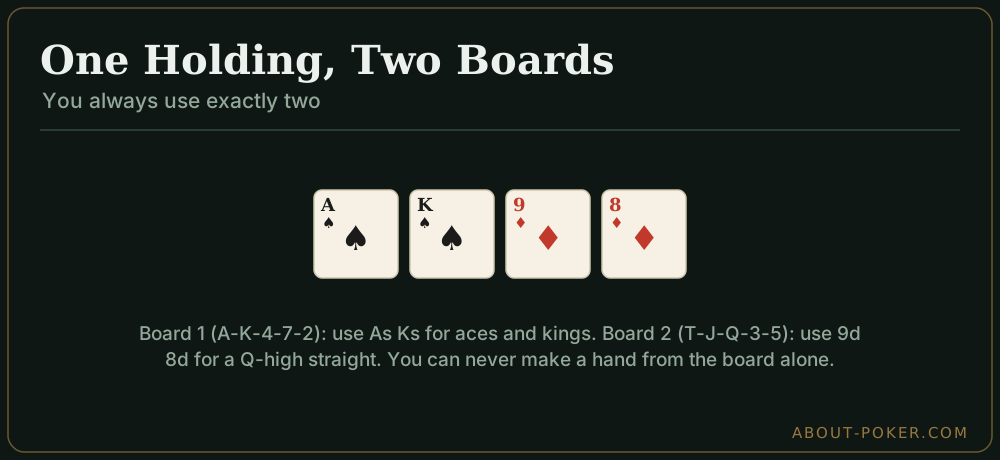
Say you hold A♠ K♠ 9♦ 8♦ and the two boards come:
| Flop | Turn | River | |
|---|---|---|---|
| Board 1 | A♥ K♦ 4♣ | 7♠ | 2♥ |
| Board 2 | 10♦ J♦ Q♠ | 3♣ | 5♥ |
- Board 1: your best two hole cards are A♠ K♠, giving aces and kings (A-A-K-K-7). You cannot use three pair cards or lean on the board — just the two.
- Board 2: now A♠ K♠ do nothing, but 9♦ 8♦ plus the 10♦ J♦ Q♠ make a Q-high straight (8-9-10-J-Q).
Same four cards, a strong two pair on one board and a straight on the other — a clean illustration of why you always name the exact two hole cards you are using on each board before deciding what you have.
Playing to scoop vs. playing to split
Because the pot is halved by board, the money is in scooping, not in winning one board big. That shifts how you value hands:
- Prize double-suited, connected hands. A holding like Q♦ J♦ 10♣ 9♣ can flop straights and flushes on either board, so it has two live shots at half the pot. Rundowns and double-suited hands are worth more in double board than a single monster like top set that only ever wins one board.
- A hand that is huge on one board but dead on the other is a split at best. Flopping the nuts on Board 1 while holding air on Board 2 wins you exactly half — and you are often paying full price to get there.
- Because it is a bomb pot, you cannot fold to see a cheaper flop. Chase two-way potential, and be ready to release on later streets when only one board connects.
Where this catches people out
The confusion almost always shows up when the board looks scary on its own:
- A board of 5-6-7-8-9 is a made straight in Hold’em for everyone. In Omaha it is your straight only if two of your hole cards fit it. Holding a pair of aces and two unrelated cards? You have nothing but aces.
- Four cards to a flush on the board is worthless unless you hold two cards of that suit. A single matching ace is not a flush here.
- Trips on the board belong to no one until someone pairs a hole card into a full house or quads.
The habit that fixes this is simple: before you decide what you have, name the exact two hole cards you are using. If the honest answer is “one” or “none,” you do not have the hand you think you have.
Double board is not “playing the board”
One last point of confusion worth clearing up: the “double board” in the format above has nothing to do with playing the board. Dealing two boards does not loosen the two-card rule — it just makes you satisfy it twice, once per board. You still can never make a hand out of community cards alone. If the board on either side looks like a made hand on its own, it belongs to no one until two hole cards fit it.
If you want the requirement in full context, the rules of Omaha walk through it street by street, and the standard hand rankings still decide who wins each board.