Omaha Full House & Four of a Kind Rules
Full houses and quads in Omaha still obey the exactly-two-hole-cards rule. Learn to read paired boards and avoid the classic Hold'em player's mistake.
On this page · 4 sections
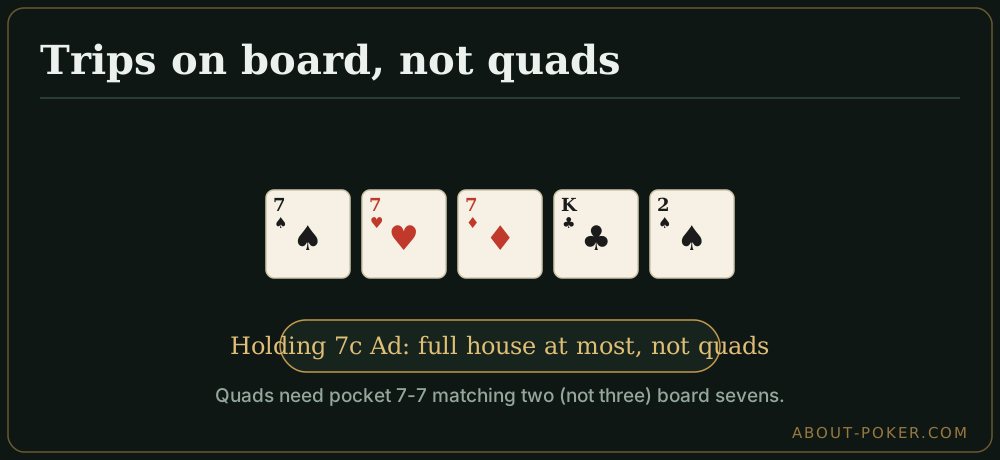
Picture this. The board reads 7♠ 7♥ 7♦ K♣ 2♠, three sevens staring back at you, and you look down at 7♣ A♦. Quads, right? No. In Omaha you must use exactly two of your four hole cards, and only one of yours is a seven. You cannot borrow all three board sevens and add your single 7♣ — that would use just one hole card. Your best here is a full house at most, never four of a kind.
That scenario is the whole lesson in miniature. Full houses and quads rank in Omaha precisely as they do everywhere — a boat beats a flush, quads beat a boat — but the two-card law decides who can actually build them, and it rules out hands that look like locks to a Hold’em player.
Two ways a full house forms
A full house is three of one rank plus two of another, and in Omaha you’ll make one via one of two routes, each using exactly two hole cards:
- Set plus board pair. You hold a pocket pair, catch a third of that rank on the board, and the board pairs a second rank too. Hold
9♠ 9♥on9♦ K♣ K♠and your two nines join9♦ K♣ K♠for nines full of kings — both nines come from your hand. - Two pair filled by the board. Your two hole cards pair two different board ranks, and one of those ranks pairs again. Hold
K♥ Q♦onK♣ K♠ Q♥and you playK♥ Q♦withK♣ K♠ Q♥for kings full of queens.
Quads need a pocket pair
Four of a kind in Omaha is possible only when you hold a pocket pair matching two board cards of the same rank. Return to the opener: if instead of 7♣ A♦ you held 7♣ 7♥ on 7♠ 7♦ A♣, now you have four sevens — both pocket sevens plus the two board sevens, with the ace as the board kicker. Two hole cards, two board cards, done.
Flip it back to a single seven in hand and no amount of board sevens helps. This is the most common Omaha misread at showdown, and it’s worth confirming out loud every time a board shows trips: without a pocket pair of that rank, you do not have quads.
Reading competing full houses
When several players fill up, the higher trips wins first; a tie on trips is broken by the higher pair — standard rankings. The Omaha wrinkle is verifying each claim uses two legal hole cards:
| Player holds | Board | Best hand | Note |
|---|---|---|---|
A♠ A♥ | A♦ 8♣ 8♠ 2♦ K♥ | Aces full of eights | Uses both aces |
8♥ 8♦ | A♦ 8♣ 8♠ 2♦ K♥ | Four eights | Pocket pair matches the two board eights — quads |
A♣ 8♥ | A♦ 8♣ 8♠ 2♦ K♥ | Eights full of aces | Two pair filled by the board pair |
Four eights beats aces full, so the second player scoops. Their pocket eights match the two board eights for quads — a reminder that a paired board plus the case pocket pair is exactly when a full house is no longer the nuts.
What this means when you’re deciding to bet
Paired boards are dangerous in Omaha exactly because boats appear so often — four hole cards connect with a paired board far more than two ever could. Before you fire with a full house:
- Name your two cards. A single matching card is trips, not a boat.
- Weigh your trips. Top set filling up beats bottom set filling up; on
Q♣ Q♠ 6♦, a set of sixes is second-best to trip queens. - Ask whether quads are possible. If the board is paired and someone could hold the case pocket pair, your boat may not be the nuts.
A full house crushes any flush, but only the biggest boat wins the pot — and on the wrong board, even that loses to quads.
The construction rule here is the same one that reshapes Omaha flush rules; both flow from the rules of Omaha. For the ranking order itself, keep the master poker hand rankings chart nearby.
Frequently asked
Can you make four of a kind in Omaha without a pocket pair?
No. Because you must use exactly two hole cards, quads require holding a pocket pair that matches two board cards of the same rank. Three board cards of one rank plus a single matching hole card is not quads — it would use only one hole card, which is illegal.
Does a full house on the board play in Omaha?
No. A board that shows a full house cannot play by itself, since you must contribute exactly two hole cards and use only three board cards. Whoever's two hole cards build the best legal five-card hand wins the pot.
What beats a full house in Omaha?
Four of a kind and a straight flush, exactly as in standard poker. The ranking order is identical to Hold'em; only the construction rule — two hole cards plus three board cards — is different.