Playing PLO Draws
In PLO, big draws are often favorites, not underdogs. Learn to count outs, spot combo draws, and play flush and straight draws aggressively for profit.
On this page · 6 sections
In pot-limit Omaha, draws are the engine of the game. Where a Hold’em player treats a draw as something to hit or fold, a PLO player treats a big draw as a hand that is often ahead right now. Because every player holds four cards, straight and combo draws can reach 20 outs, and at that point your draw is a favorite over most made hands. Learning to count and play draws correctly is the single biggest skill jump for new PLO players.
Why draws matter more in PLO
Four hole cards mean more ways to connect with the board. A single flop can give you a straight draw, a flush draw, and a pair all at once. The result is that raw equity swings are enormous. A monster combo draw against a made hand is frequently a coin flip or better, so playing draws passively — just calling and hoping — leaves money on the table. Aggression lets you win the pot two ways: your opponent folds, or you complete your draw.
That said, PLO punishes second-best draws harshly. A non-nut flush draw or the low end of a straight is a trap because when it hits, you often pay off a bigger hand. This is why draw quality, not just draw size, drives every decision.
Counting your outs correctly
Count every card that improves you to a likely winner, then subtract dirty outs. A nut flush draw is nine clean outs. A wrap straight draw can be 13, 17, or 20 outs depending on how your four cards surround the board. Combine them and you approach or exceed 20.
As a rule of thumb on the flop, multiply your outs by roughly 2 per remaining street to estimate percentage equity, or by about 4 for both cards to come when you are all in. A 15-out draw is therefore around 30 percent per street and roughly 54 percent to complete by the river — genuinely a favorite. For precise numbers, work through the math on our PLO pot odds and outs guide.
A worked example
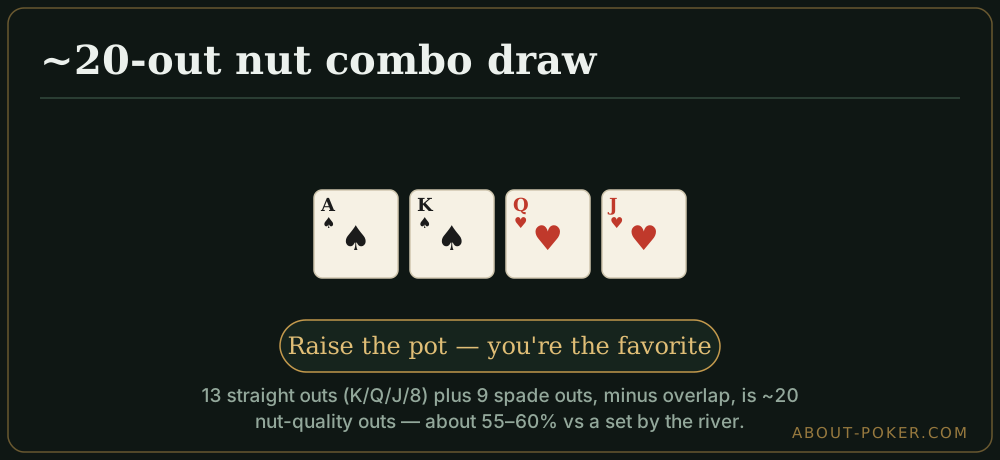
You hold As-Ks-Qh-Jh on a flop of Ts-9s-2h. You have a wrap: any K, Q, J, or 8 makes a straight, and any spade gives you the nut flush (with two spades on the board and two in your hand, the flush draw is live). Count it: the straight side alone hits on K, Q, J, or 8. That is 3 kings, 3 queens, 3 jacks, and 4 eights (adjusting for the cards you hold) — about 13 straight outs. Add nine spade outs, remove overlap, and you have roughly 20 clean, nut-quality outs.
Against a set of tens, that draw is about 55 to 60 percent to win by the river. You should raise the pot here, not call. You are the favorite, you have fold equity, and building the pot lets you get stacks in while ahead. This is the textbook PLO semi-bluff: a big nut draw played like the made hand it will usually become.
Nut draws versus trap draws
Draw quality decides how hard you press. The nut flush draw plus a wrap to the top end is a raising hand. A bottom wrap with a non-nut flush draw is a calling hand at best, because many of your “outs” complete a better hand for someone else. Blockers matter too — holding the ace of the flush suit not only gives you the nut draw, it removes your opponent’s nut flush. Read more on how removal reshapes these spots in our PLO blockers and draws breakdown.
Position amplifies everything. In position you can semi-bluff, then take a free card if the pot gets big and you miss. Out of position, big draws are harder to realize, so lean toward pot-sized bets that deny equity rather than passive calls that let opponents draw cheaply.
Multiway pots change the math
PLO pots are often three, four, or five handed. Fold equity shrinks and someone frequently holds a piece of your outs or a redraw. In these spots, downgrade marginal draws and only get aggressive with the true nuts-or-nut-draw combinations. A 13-out non-nut wrap that is great heads up becomes a modest holding five ways, where even hitting it may not be good. Our PLO postflop strategy guide covers how bet sizing shifts as more players enter.
A quick decision checklist
Before you commit chips to a draw, run through five questions. First, how many clean outs do I really have after removing dirty ones. Second, are my outs to the nuts or a dominated second-best hand. Third, do I have fold equity, or is my opponent never folding. Fourth, am I in position to realize my equity cheaply. Fifth, how many players are in the pot. If your draw is big, clean, and nut-quality with fold equity, raise. If it is small, dirty, or non-nut in a crowded pot, control the pot or fold. Getting this filter right is most of what separates winning PLO draw play from spew.
Frequently asked
Are draws favorites in PLO?
They can be. A big combo draw — a wrap plus a flush draw — can have 20 or more outs and be a mathematical favorite over a made set or two pair. That is why draws are played aggressively rather than passively in PLO.
How many outs does a flush draw have in Omaha?
A bare flush draw has nine outs, exactly as in Hold'em, because you can only use two hole cards. The difference is that PLO players usually want the nut flush draw, since second-best flushes lose large pots.
Should I always semi-bluff my draws in PLO?
No. Semi-bluff when your draw is strong, to the nuts, and you have fold equity or position. With weak, non-nut draws in multiway pots you often play more passively because your implied odds and equity are worse than they look.