PLO Nut Flush Play
In PLO, flushes are worth chasing only when they are the nuts. Learn to play the nut flush and nut flush draw, and avoid the costly non-nut flush trap.
On this page · 6 sections
Flushes in pot-limit Omaha are a double-edged sword. With four cards and countless suited combinations in play, flushes complete far more often than in Hold’em — which means second-best flushes are everywhere, and they are expensive. The winning approach is simple to state and hard to follow: chase the nut flush, and treat everything below it with suspicion. Here is how to play flushes profitably in PLO.
The nut flush rule
The single most repeated piece of PLO advice is “draw to the nuts.” Nowhere is this truer than with flushes. Because so many players hold suited cards, a king-high flush that would win in Hold’em routinely runs into the ace-high flush in Omaha. The nut flush wins full stacks; the non-nut flush pays them off.
This is why the ace of a suit is so valuable. Holding the ace gives you the nut flush draw, and it also acts as a blocker that removes your opponent’s ability to hold the nut flush. That blocker effect turns your draw into a semi-bluffing weapon on top of its raw equity. We cover removal in depth in PLO blockers and draws.
Counting the draw
A flush draw in Omaha has nine outs, exactly as in Hold’em, because only two hole cards count toward the flush. Using the standard rule, nine outs is about 18 percent per street and roughly 35 percent to complete by the river with two cards to come. That is meaningful equity, but it is not a favorite on its own. What makes the nut flush draw strong is quality and combination: pair it with a wrap and you have a 20-plus-out monster, as explained in our playing PLO draws guide.
The mechanics of which cards actually count are covered in Omaha flush rules — a common leak is thinking three suited cards in hand help, when only exactly two can be used.
A worked example
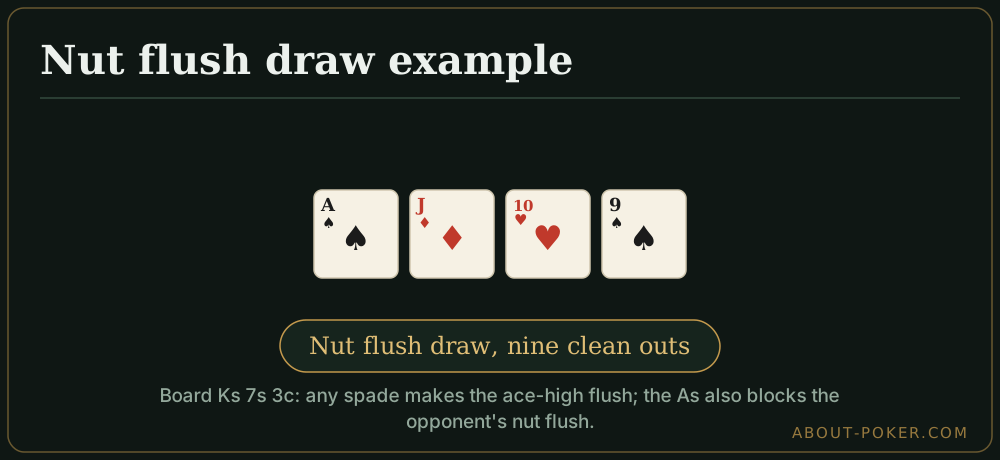
You hold As-Jd-Th-9s on a flop of Ks-7s-3c. You have the nut flush draw: any spade gives you the ace-high flush, the best possible flush on this board. That is nine clean, nut-quality outs, plus a backdoor straight from your J-T-9. Holding the ace of spades also means no opponent can already have the nut flush, so your semi-bluffs get credit.
Here you can bet or raise. If called and a fourth spade never lands, you can still represent it thanks to your ace-of-spades blocker. If the flush completes for you, you hold the mortal nuts on the flush and can bet for maximum value. Contrast that with holding Qs instead of As: now a spade only gives you the second-best flush, and the same line becomes a trap that can stack you off drawing dead-ish against a higher flush.
The non-nut flush trap
Second and third nut flushes are where money leaks fastest in PLO. When you make a king- or queen-high flush and face a pot-sized bet, especially on a board that is paired or shows four to a flush, you are often beaten by a higher flush or a full house. The discipline of folding these hands to serious aggression separates winners from losers.
Warning signs to fold a made non-nut flush include a paired board (a full house is now possible), a four-flush board where the ace could be out, and a passive opponent who suddenly bets big. When in doubt, remember that in PLO the second-best hand is the most expensive hand.
Playing the made nut flush
When you flop or turn the nut flush, your job is to get value. On a dry, unpaired board you can bet large because opponents with sets, two pair, and lower flushes will pay. Slow down when the board pairs on later streets — your nut flush can be counterfeited by a full house, and you should size down or check to control the pot.
Position lets you extract more. In position with the nut flush you can bet three streets thin; out of position you may check-raise the flop or lead to build the pot before scare cards arrive. Bet sizing should track how many worse hands can call, not just how strong your hand feels.
Nut flush checklist
Before you commit chips to a flush, run three checks. First, is my flush or draw to the ace-high nuts, or is it dominated. Second, does the board show pairing or a fourth flush card that threatens a bigger hand. Third, do I hold the ace as a blocker to strengthen bluffs and reads. Play nut flushes aggressively for value, fold non-nut flushes to real pressure, and let the ace blocker power your semi-bluffs. That framework keeps flushes a profit center instead of a leak.
Frequently asked
Why is the nut flush so important in PLO?
With four hole cards and many suited combinations, flushes appear often, so second-best flushes are common. Only the nut flush reliably wins big pots, which is why PLO players prize the ace-suited holding and fold weaker flushes to heavy action.
How many outs does a nut flush draw have?
Nine outs, the same as in Hold'em, because you can only use two hole cards for the flush. The value comes from those outs being to the nuts plus the blocker effect of holding the ace of that suit.
Should I ever fold a made flush in PLO?
Yes. A non-nut flush facing a large bet on a paired or four-flush board is often beaten by a higher flush or a full house. Folding second-best flushes to serious aggression is a core PLO discipline.