PLO Nut Low Play
In Omaha Hi-Lo the nut low wins half the pot but can be quartered. Learn when the nut low is safe, how to avoid getting counterfeited, and when to fold it.
On this page · 7 sections
In Omaha Hi-Lo eight-or-better, half the pot goes to the best low hand. Chasing and holding the nut low feels safe, but it is one of the most misunderstood parts of the game. The nut low guarantees at least a share of the low, yet it can be split, quartered, or counterfeited into nothing. Winning players know exactly how much a bare nut low is worth and when it is a trap.
What the nut low is
For a low to qualify in eight-or-better, you need five unpaired cards ranked eight or lower, using two from your hand and three from the board. The best possible low is the wheel, A-2-3-4-5, so A-2 in your hand making that combination is the classic nut low. When you hold the nut low you are guaranteed to win or split the low half of the pot. The trouble is that guarantee is worth far less than it looks. For the broader framework, see Omaha Hi-Lo strategy.
The quartering problem
Here is the danger. If another player also holds A-2 for the same nut low, the two of you split the low half between you. You each take a quarter of the total pot while someone else scoops the entire high half. In a heads-up pot, being quartered means you can actually lose money: you put in half the chips and get back a quarter. This is why a bare nut low with no high potential is a weak, often unprofitable, holding.
A worked example
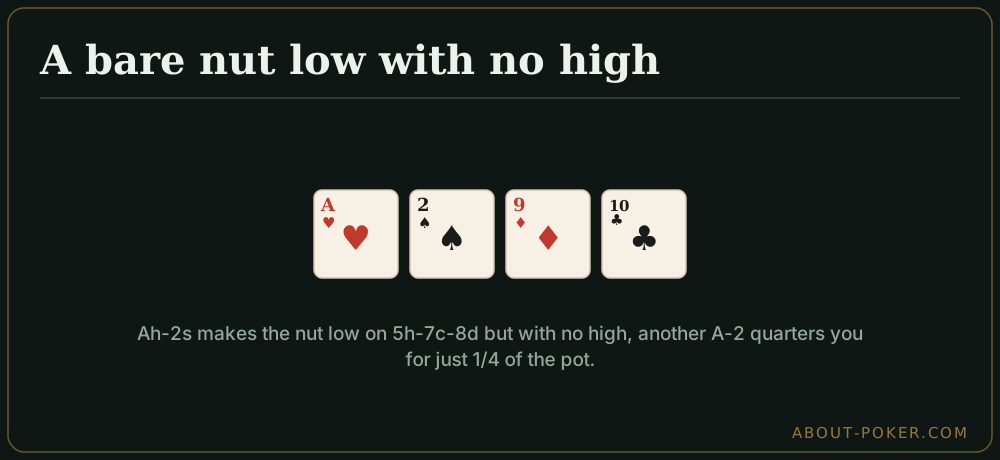
You hold Ah 2s 9d Tc and the board comes 5h 7c 8d Kh 3s. Your A-2 plays with the 5, 7, 8 to make the best low, so you have the nut low. But look closer: you have no realistic high hand, just ace high. If another player also holds an A-2, you are quartered and win only a quarter of the pot. If a single opponent has A-2 plus a made high like a straight or set, they scoop three quarters and you take one. A bare nut low in a raised multiway pot is frequently a losing proposition.
Now change your hand to Ah 2s 3d 4c on that same board. You still have the nut low, but you also hold protection against counterfeiting and better redraws, which makes the same nut low far more playable.
Counterfeiting and why the third low card matters
The nut low can be counterfeited. If you hold only A-2 and the board pairs an ace or a deuce, a player with A-3 can leapfrog you for a better low, or your low can be spoiled entirely. Holding a third low card such as in A-2-3 protects you: if your deuce is counterfeited, your ace and three still combine for a strong low. This is the single biggest reason Omaha Hi-Lo starting hands that include A-2-3 or A-2 double-suited are so much stronger than a naked A-2 with two high blanks.
Playing for the scoop, not just the low
The core lesson of Hi-Lo is that scooping the whole pot is worth roughly four times more than winning a quartered low. The best hands are ones that can make the nut low and a strong high, such as A-2-3-4 double-suited or A-2 with high cards that make Broadway. When your hand can only ever make a low, you should play cautiously, avoid bloated pots, and be ready to fold to heavy action. The PLO 8-or-better strategy guide covers hand selection built around scooping.
Common mistakes
The first leak is overplaying a bare nut low, calling raises and building pots with a hand that gets quartered or counterfeited. The second is failing to fold a low that has been counterfeited on the turn or river. The third is ignoring the high side entirely and drawing to a hand that, best case, wins a quarter. Nut low with no high is a mirage of strength.
Quick checklist for nut low play
Before committing chips, ask: is this the nut low or a second-best low that can be beaten? Do I have a third low card to protect against counterfeiting? Do I also have any high potential, or am I drawing only to a quarter? How many players are in the pot, and how likely is another A-2 out there? A nut low that comes with a big high draw is a hand to play hard for the scoop. A bare, unprotected nut low in a multiway raised pot is one to play cheaply or let go.
Frequently asked
What is the nut low in PLO Hi-Lo?
The nut low is the best possible low hand on a given board, which in Omaha Hi-Lo eight-or-better is usually A-2 making the wheel or the lowest five unpaired cards eight and below. Holding the nut low guarantees at least a share of the low half of the pot, but it can be split or even quartered.
What does it mean to be quartered?
You are quartered when you and another player both hold the nut low, so you split the low half between you and each receive only a quarter of the total pot. If you have only the low and are quartered heads-up, you can lose money in the hand even though you technically won part of it.
Can the nut low get counterfeited?
Yes. If you hold A-2 for the nut low and the board pairs one of your low cards, such as an ace or a deuce, a higher low can overtake you or you can lose your qualified low entirely. This is why A-2-3 type hands are stronger, since the third low card protects against counterfeiting.