PLO River Decisions
River decisions in PLO hinge on the nuts and blockers. Learn when to value bet, when to bluff, and when to check on the biggest street in Omaha.
On this page · 7 sections
The river is where Pot-Limit Omaha pots are won and lost — and where the four-card structure of the game bites hardest. Hands that would be monsters in Hold’em are routinely second-best in PLO, so your river decisions must be built around one question above all others: how close am I to the nuts?
The nuts rule everything
In Hold’em, top two pair or a set is usually good enough to stack off on the river. In PLO, those hands are frequently beaten because opponents hold four cards and make straights and flushes far more often. This changes river strategy fundamentally: the value of a hand on the PLO river is dominated by its proximity to the nuts.
A king-high flush that feels strong is a liability on a board where the ace of that suit is live in someone’s range. A straight that is not the nut straight loses to the higher straight that four-card hands make so easily. Before you fire a value bet, ask what beats you and how many of those combos your opponent’s calling and betting range contains. If the answer is “a lot,” slow down. Learning disciplined nut flush play in PLO is the foundation of good river play.
Value betting: nuts and near-nuts
Bet for value when you hold the nuts or a hand that beats a meaningful chunk of your opponent’s calling range. The cleanest value bets are the nut straight, the nut flush, and full houses on paired boards. With these you can bet large — often two-thirds pot to pot — because your opponent’s second-best strong hands cannot fold in PLO nearly as easily as they should.
Where it gets tricky is the near-nuts. The second-nut flush or a non-nut straight can still be a value bet against a wide, loose caller, but against a strong reg it is often a check because they only continue with better. This is the classic tension our guide on nut-peddling vs bluffing in PLO explores.
Bluffing with blockers
PLO bluffs work best when you block the nuts. If you hold a card that your opponent needs to have the strongest hand, two things happen: it is less likely they actually hold the nuts, and it is more credible that you do.
Say the river completes a spade flush and you hold the A♠ but not four spades to make the flush yourself. You cannot beat much at showdown, but you hold the one card that makes the nut flush — which means your opponent almost never has it. That A♠ blocker makes a bluff far more effective, because you are representing exactly the hand you are preventing them from having. Blocker-based bluffing is covered in depth in our PLO blockers and draws guide.
A worked river example
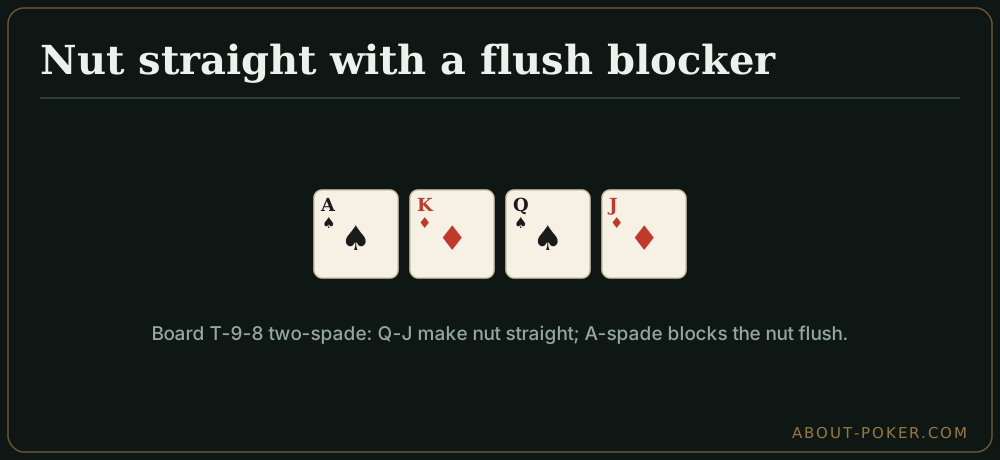
You hold A♠K♦Q♠J♦ and the board runs out T♣9♠2♥8♠4♠. The final board is three spades. You do not have a made flush — you hold only two spades (A♠, Q♠). But you do have the A♠, the nut-flush blocker, plus you have a straight (K-Q-J-T-9 uses your Q and J with the board’s T and 9… actually you make Q-J with board T-9-8 for a straight — you hold the Q-J-8 straight? Let’s be precise: board is T-9-8, your J and Q make Q-J-T-9-8, the nut straight).
So here you actually hold the nut straight (Q-J from your hand plus T-9-8 on board). But three spades are out, and a flush beats your straight. Your A♠ blocker tells you the nut flush is very unlikely in your opponent’s hand — they would need K♠+another spade, or a lower flush. This is a classic PLO river squeeze: you have a strong made hand (nut straight) that is beaten only by a flush, and you hold the single most important card (A♠) that makes the top flush impossible for them. You can bet for value with confidence, because the flushes that beat you are far fewer than they appear. Against most opponents this is a clear bet; only against a range heavy in made flushes do you consider checking.
When to check
Check the river when:
- Your hand beats bluffs but loses to value bets — a bluff-catcher. Betting only folds out worse and gets called by better.
- You hold a non-nut hand on a scary runout and betting turns your hand into a bluff you cannot back up.
- Pot control serves you: in PLO the second-nuts is beaten so often that checking back to realize showdown value is frequently better than betting into a range that raises you off your hand.
Common mistakes
- Value betting non-nut hands into big rivers. This is the number-one PLO river leak — you get called only by better.
- Bluffing without blockers. Random bluffs get snapped off because opponents also have strong ranges.
- Overfolding to raises when you hold blockers to the nuts, forgetting that your blockers make their raise less likely to be the nuts.
- Ignoring board pairing — a paired board means full houses are live and flushes/straights drop in value.
Quick checklist
- How close am I to the nuts, and how many combos beat me?
- If I am bluffing, do I hold a blocker to the nuts I am representing?
- Would a value bet get called by worse, or only by better?
- Has the board paired, changing what the nuts are?
Master the nuts-and-blockers lens and the PLO river stops being a guessing game and starts being a calculation.
Frequently asked
How important are the nuts on the PLO river?
Extremely. Because everyone holds four cards, non-nut hands are far more likely to be beaten in PLO than in Hold'em. On many rivers the practical question is not 'do I have a strong hand?' but 'do I have the nuts, and if not, how often am I beaten?' Value betting non-nut hands into big rivers is a major leak.
Should I bluff more on the PLO river?
Selectively. Good PLO bluffs use blockers — cards that make it less likely your opponent holds the nuts, such as holding a key card to the nut straight or nut flush. Random bluffs get called down in PLO because opponents also arrive with strong ranges. Bluff when you block the nuts and can represent them credibly.
When should I check the river in PLO?
Check when your hand is a non-nut bluff-catcher that beats bluffs but loses to most value bets, or when betting only gets called by better. Pot control matters more in PLO because the second-nuts is beaten far more often than in Hold'em.
How do blockers work on the PLO river?
A blocker is a card in your hand that reduces the combinations of a specific hand your opponent can hold. If you hold a card that completes the nut straight, your opponent is less likely to hold it, which both weakens their value range and makes your bluff more credible as a representation of the nuts.