8-Game Mix Strategy
8-Game mix strategy: the eight games in the rotation, how limit and no-limit rounds differ, where the money is made, and a plan for your weakest games.
On this page · 8 sections
What the 8-game mix is
The 8-game mix is HORSE’s bigger, tougher cousin. It rotates through eight games spanning draw, stud, and community-card poker, and crucially it mixes fixed-limit rounds with big-bet rounds. The standard lineup is 2-7 triple draw, limit Hold’em, limit Omaha hi-lo, Razz, seven-card stud, stud hi-lo, no-limit Hold’em, and pot-limit Omaha. If you want the exact rotation order and betting caps, the 8-game mix rules lay them out; here we focus on how to play the format for profit.
Limit versus big-bet inside one session
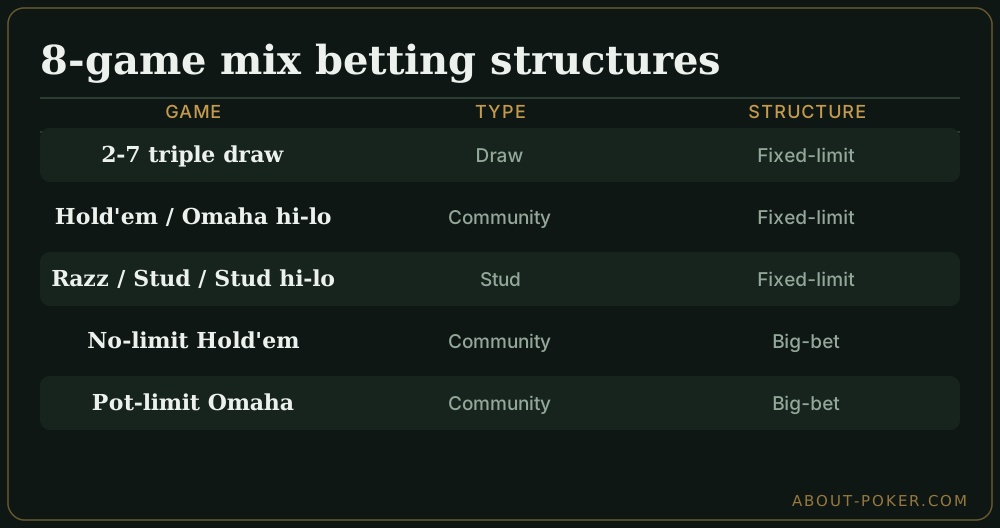
The defining challenge of 8-game is that you switch not only between games but between betting structures. Six games are fixed-limit, where draws are cheap and thin value rules. Two, no-limit Hold’em and pot-limit Omaha, are big-bet games where a single misjudged commitment can cost a stack. You must hold both mindsets and swap cleanly. A common leak is carrying limit-game passivity into the no-limit rounds, or big-bet aggression into the limit rounds where it just gets called down.
Where the money is made
Because the two big-bet games produce the largest pots, they carry the most reward and the most risk. Your edge in 8-game comes from playing those two rounds soundly while not hemorrhaging chips in your weakest limit games. Many 8-game specialists come from a no-limit background, so they attack the big-bet rounds and merely survive the draw and stud games. If your background is the opposite, invert the plan. Either way, the goal is the same: win big in your strengths, break even in your weaknesses.
Break your results into eight games
Your 8-game win rate is the sum of eight separate skill sets, not one blended skill. The fastest way to improve is to identify your two worst games and study them in isolation. If Razz and 2-7 triple draw are your weak spots, drill those specifically. The horse poker strategy guide covers the five HORSE games that overlap here, and the 2-7 triple draw strategy guide handles the lowball round that trips up most no-limit players.
A worked switch
The rotation moves from no-limit Hold’em to Razz. You just played an aggressive orbit of no-limit, three-betting light and applying pressure. First hand of Razz, you look down at (K-9) 5. The mistake players make is momentum: they carry the aggressive mood into a game where a starting king is a liability. In Razz, low is best, and a king in the hole is dead weight. The correct switch is to fold this holding without a thought and reset to Razz starting-hand discipline, which wants three cards eight-or-lower ideally. Recognizing the structural reset at the top of each new game is a skill in itself.
The draw games trip up most players
Because 8-game adds 2-7 triple draw to the HORSE lineup, no-limit specialists often meet a genuinely unfamiliar game. In 2-7 lowball the best hand is 7-5-4-3-2 with no straight and no flush, aces are always high (so they are bad), and you draw three times. Players who never play draw poker misjudge which hands to keep and which to break, and they draw too many cards too often. A rough guide: a pat 8 or 9 is usually worth keeping on early streets, a smooth one-card draw to a 7 is strong, and drawing two or more cards on the final draw is a losing proposition against a pat opponent. Treat this round with the same respect you give the stud games.
Common 8-game mistakes
- Bringing big-bet aggression into the fixed-limit rounds, where it simply gets called down for value against you.
- Playing one-way hands in the two hi-lo split games and getting quartered.
- Treating 8-game as one game to study rather than eight, so weak spots never get fixed.
- Failing to reset your starting-hand standards on the first hand after each rotation.
- Drawing too many cards in 2-7 triple draw instead of standing pat or taking a single card with a made low.
Your session plan
Before each round, name the game and its betting structure out loud in your head, then load the right starting requirements. Attack the two games you are strongest in, whether those are the big-bet rounds or the limit rounds. In your weakest two games, tighten up and take small, clean pots. In the hi-lo games, hunt scoops and fold one-way hands. Keep the 8-game mix rules nearby until every transition feels automatic. The players who beat 8-game are rarely the flashiest; they are the ones who make the fewest structural errors across all eight rounds.
Frequently asked
What games are in the 8-game mix?
The 8-game mix rotates through 2-7 triple draw, limit Hold'em, limit Omaha hi-lo, Razz, seven-card stud, stud hi-lo, no-limit Hold'em, and pot-limit Omaha. It combines draw, stud, and community-card games across both limit and big-bet betting structures.
Are all 8-game rounds fixed-limit?
No. Six of the eight games are fixed-limit, but no-limit Hold'em and pot-limit Omaha use big-bet structures. That mix means you must switch not only between game types but between limit and big-bet mindsets as the rotation moves.
Which 8-game rounds matter most?
The two big-bet games, no-limit Hold'em and pot-limit Omaha, carry the largest pots and the highest variance, so mistakes there cost the most. Playing them soundly while breaking even in your weakest limit games is the backbone of a winning 8-game session.
How do you improve at the 8-game mix?
Study each game individually rather than the mix as a whole. Your 8-game results are the sum of eight separate skill sets, so identifying and fixing your two weakest games gives the fastest improvement. Play tight in unfamiliar games until the fundamentals are solid.