Chinese Poker Strategy: How to Set 13 Cards
Chinese poker strategy: how to set 13 cards across three rows, avoid fouling, invest in the middle, and chase royalties safely. With a worked example.
On this page · 11 sections
Good Chinese poker is one discipline held above every other: set your 13 cards so all three rows stay legal, then win as many individual rows as you safely can. Because fouling — putting the rows out of order — loses all three at once and pays every opponent as if they scooped you, a clean setting that’s slightly weaker will almost always beat a greedy, illegal one. If the Chinese poker rules are already familiar, this is how to turn them into points.
There is no bluffing and no betting here — just arrangement and math. That sounds simple, and the mechanics are, but small edges in how you split each hand compound over a long session into a real win rate.
The 30-second refresher
If you’re here for strategy, you’ve likely met the rules already — but every setting decision below hangs on them, so here’s the whole game in four lines:
- Each player is dealt 13 cards and splits them into three face-down rows: a five-card back, a five-card middle, and a three-card front.
- The rows must ascend in strength: back ≥ middle ≥ front. Set them out of order and you foul, forfeiting all three.
- After everyone sets, hands are revealed and each row is compared head-to-head against every opponent, one row at a time.
- Winning a row scores points; the exact amounts depend on the scoring system below.
How scoring works
You are scored against each opponent separately, and your row-by-row result (how many of the three rows you win) drives the payout. Two systems dominate, and both count the same rows — they just price a sweep differently.
- 1-6 method (the standard). One unit per row you win. Win two rows and lose one (a 2-1) and the units cancel to a net +1. Win all three — a scoop — and you collect the 3 row units plus a 3-unit bonus, for +6. That “1 to 6” range is where the name comes from.
- 2-4 method (common in home games). One unit per row, plus a single overall unit to whoever takes two or three rows. A 2-1 is therefore net +2; a scoop is +4.
| Row result | 1-6 method | 2-4 method |
|---|---|---|
| Win all 3 (scoop) | +6 | +4 |
| Win 2, lose 1 | +1 | +2 |
| Win 1, lose 2 | −1 | −2 |
| Lose all 3 | −6 | −4 |
Everything that follows uses the 1-6 system, since it’s the tournament and cash-game default. Royalties (below) are added on top of these row scores.
Never foul — the question that comes first
Your rows must ascend in strength from top to bottom: the five-card back beats or ties the five-card middle, and the middle beats or ties the three-card front. Break that and you foul, scoring zero.
So the first thing to ask when you fan out 13 cards is not “how strong can I make my back?” It’s “what is the strongest legal arrangement I can guarantee?” Those are different questions, and the gap between them is where beginners lose money. Build your hand back to front, then confirm the descent one final time before locking it in.
Spread strength; don’t build a monster
You win one point per row against each opponent, so a 2-1 result (two rows won, one lost) nets +1 per opponent, and a scoop pays a bonus on top. The classic mistake is dumping everything into one huge row and leaving the other two as garbage — that’s a hand that wins one row and loses two, a net loss even though it “looks” strong.
- Don’t stack the back. Quads in the back over a junk middle and front loses two rows to win one.
- Two good rows beat one great row. Balance wins comparisons; concentration doesn’t.
- The middle is where sessions are decided. Almost everyone over-invests in the back. A strong middle wins the most rows over time precisely because your opponents keep neglecting theirs.
The front row is the swing
Because everyone reveals at once in standard Chinese poker, mid-hand reads matter far less than in betting games. What decides close matches instead is the front row — it’s only three cards, so a pair there is genuinely strong and trips there is rare and often worth a royalty.
- A pair of kings or aces in front routinely beats a raw high-card front.
- Demoting a marginal card to promote a pair into the front can flip a 1-2 loss into a 2-1 win — but only when the middle can still beat that front. Promote carefully; this is a common source of fouls.
Chasing royalties without hanging yourself
Royalties are flat bonuses for premium hands — trips in the front (the strongest a three-card row can be), quads or straight flushes in the middle or back. They’re real points, and they’re bait: reaching for one is the fastest way to force an illegal layout.
Point values vary by house, but the classic schedule below is the most widely used. Note the pattern: for the big hands — quads and straight flushes — the middle pays roughly double the back, because such a hand is far harder to fit in the middle without fouling. A royalty is added to your row score, so a full house in the middle (+2) that also wins the row is worth 1 unit + 2 = 3 units against that opponent.
| Hand | Front | Middle | Back |
|---|---|---|---|
| Three of a kind | +3 | — | — |
| Straight | — | — | +2 |
| Flush | — | — | +4 |
| Full house | — | +2 | +6 |
| Four of a kind | — | +8 | +4 |
| Straight flush | — | +12 | +5 |
| Royal flush | — | +16 | +10 |
Trips is the only front royalty because a three-card row can’t make a straight or a flush — three of a kind is the top of that hand’s range. Confirm your table before playing; some rooms scale front pairs or use different back values.
The rule of thumb is simple. Claim a royalty only when it fits the ascending order. If putting quads in the middle would leave a back that can’t beat them, you can’t do it legally — the quads belong in the back. Always confirm the royalty slots in without breaking the descent before you commit to it.
A foul waiting to happen
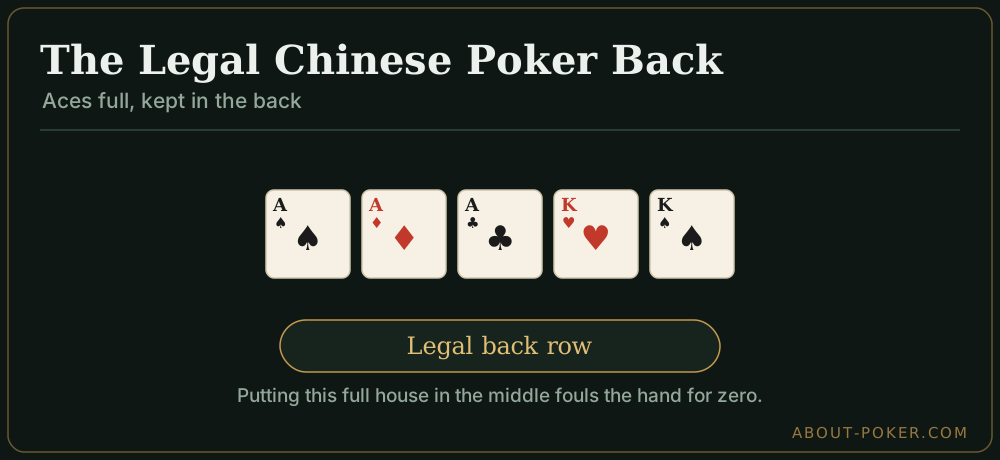
You’re dealt:
A♠ A♦ A♣ K♥ K♠ Q♦ Q♣ 9♠ 9♦ 7♣ 5♥ 4♦ 2♠
The greedy instinct is to build aces full of kings in the middle — a full house is a middle royalty and a huge row. But run the ordering check. If aces-full sits in the middle, your back has to beat aces full, and the best five cards left (Q Q 9 9 7, two pair) can’t come close. That layout fouls for zero.
The legal arrangement spreads the same strength so the descent holds:
- Back:
A♠ A♦ A♣ K♥ K♠— aces full of kings, your strongest legal five and a back royalty. - Middle:
Q♦ Q♣ 9♠ 9♦ 7♣— queens and nines, two pair. - Front:
5♥ 4♦ 2♠— five-high.
Now aces-full beats queens-up beats five-high — a clean, legal set. You keep the full-house royalty (in the back, where it’s legal) and present two competitive rows below it. The lesson generalizes: a premium hand only counts when every row above it in the order can still be legally beaten by the rows below. The full house was never the problem; putting it in the wrong row was.
Setting an ordinary hand, step by step
Most deals aren’t foul traps — they’re routine hands where the only question is where the strength goes. Say you’re dealt:
K♠ K♦ 8♥ 8♣ 8♠ 7♦ 7♥ 6♠ 5♠ 4♦ 3♣ 3♥ 2♣
Work back to front, reserving your best five-card hand for the bottom:
- Back:
8♥ 8♣ 8♠ K♠ K♦— eights full of kings, a full house and a +6 back royalty. - Middle:
7♦ 7♥ 5♠ 4♦ 3♣— a pair of sevens. - Front:
3♥ 6♠ 2♣— six-high.
The descent holds (full house ≥ pair of sevens ≥ six-high), and it’s tempting to stop there. But notice the middle is thin. The borderline decision is whether to break the full house — playing K♠ K♦ 8♥ 8♣ 8♠ is not the only option. Splitting to trip eights in the back (8♥ 8♣ 8♠ 7♦ 5♠) frees the kings to lift the middle to K♠ K♦ 7♥ 4♦ 3♣, a far stronger middle than lone sevens — but it surrenders the +6 royalty and downgrades the back. Against most opponents the full house is the higher-value hold: +6 in the bank plus a back that wins on its own outweighs a marginally better middle. Keep the full house.
The general habit: build the legal set first, then ask whether shifting a pair up or down buys you a row you’d otherwise lose. It usually doesn’t when a standing royalty is on the line.
When the trade-off is a real decision
Most hands set themselves once you commit to legal order. The interesting spots are the ones where two legal arrangements score differently, and you have to price them out. Do the arithmetic in units, because that’s what the game actually pays.
Suppose you can set your hand two ways against a single opponent. Layout A wins you the back and the front but likely loses the middle — a 2-1 result worth about +1 in the 1-6 system. Layout B sacrifices the front’s edge to jam a full house into the middle for a +2 royalty, but that weaker front now probably loses, so you’re looking at a 1-2 row result (−1) plus the +2 royalty, for a net of +1. The two layouts are roughly even on paper — so the tie-breaker becomes variance and reads: layout A is the steadier hold, layout B swings on whether your read of the opponent’s front is right.
That’s the mindset to carry: a royalty is worth chasing when the points it adds clearly outweigh the row (or rows) you give up to reach it, and it’s a trap when it only breaks even while adding risk. Winning two rows outright almost always beats a fragile layout that needs a royalty to justify itself.
Heads-up versus a full table
The number of opponents quietly changes how aggressive your setting should be, because you’re scored against each of them separately.
- Four-handed, every row you set is graded three times, so a genuinely strong row compounds — a dominant back can beat all three opponents for +3 on that row alone. Balance still matters, but a truly premium holding pays more when there are more people to beat.
- Heads-up, you’re playing one comparison, and the scoop bonus becomes the dominant swing. Winning 2-1 nets +1; scooping nets the full bonus. So against a single opponent it’s worth pushing a little harder for the third row when a clean sweep is in reach — the reward for the scoop is proportionally larger than it is at a full table, where you’d rather bank reliable rows across three players.
None of this changes the prime directive — never foul — but it should nudge how much risk you accept once the legal arrangements are on the table.
What to run through every hand
- Confirm legal order first, back to front, before locking anything.
- Spread strength across rows; never build one monster and two dumps.
- Invest in the middle — it wins the most rows over a session.
- Weaponize the front — a pair or trips there swings tight matches.
- Chase a royalty only when it fits the ordering.
Chinese poker rewards patient arrangement over flashy plays, and those habits transfer straight into its faster cousin. When you’re ready for the drip-fed, one-card-at-a-time version that turns foul-avoidance into a live skill on every card, step up to open-face Chinese poker. Keep the hand rankings handy while you learn to value each row.
Frequently asked
Should you always play for the scoop in Chinese poker?
No. A scoop pays a bonus for winning all three rows, but forcing it from a marginal hand often costs you two rows in the chase. The disciplined play is frequently to lock the two rows you can clearly win and concede the third rather than risk winning nothing.
Which row wins the most points over a session?
The middle. Players instinctively pour their best cards into the back and starve the middle, so a merely-solid middle quietly wins comparisons all night. Investing there rather than over-building the back is one of the highest-return habits in the game.