HORSE Strategy Basics
HORSE strategy basics: the five games explained, how limit betting changes your ranges, which rounds to attack, and a survival plan for your weakest game.
On this page · 7 sections
The five games behind the acronym
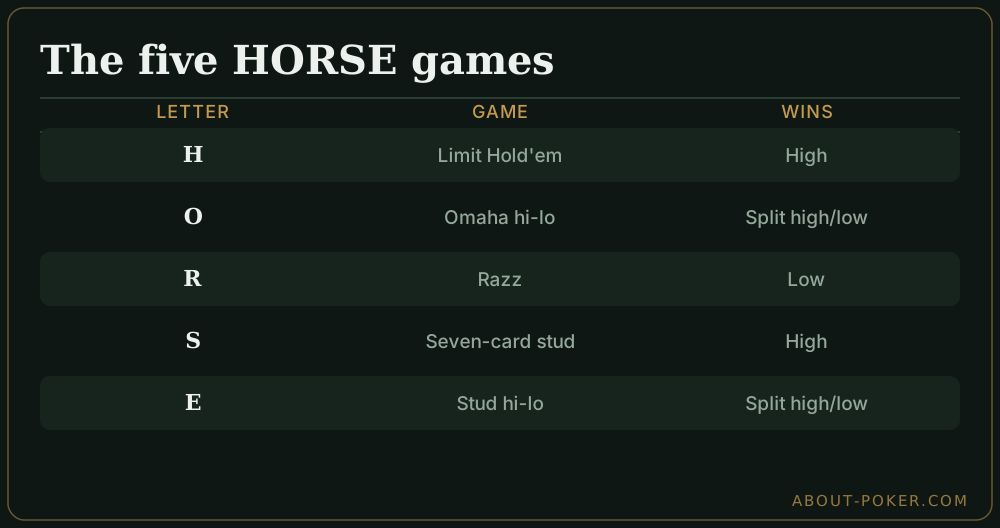
HORSE is the classic mixed-game rotation and a rite of passage for anyone moving beyond Hold’em. It cycles through five fixed-limit games: Hold’em, Omaha hi-lo eight-or-better, Razz, Seven-card stud, and Stud hi-lo eight-or-better. The games rotate on a set schedule, so you must switch mental gears every orbit. If you have not seen the format laid out, the HORSE poker rules cover the rotation and betting structure in full; this guide is about how to actually play it well.
Fixed limit changes your whole approach
Every game in HORSE is fixed-limit, and that single fact reshapes strategy. Bets and raises are capped, so you cannot blast opponents off draws or protect big hands with an overbet. Draws are cheap, which means more hands reach showdown and thin value becomes the main way you earn. The winning HORSE style is patient and fundamentally sound: play strong starting hands, extract value in small increments, and avoid the hero bluffs that work in no-limit but simply get called down here.
Protect your weakest game
The single most important idea in HORSE is that you do not have to win every game. You have to avoid bleeding chips in your worst one. Most players are strongest in Hold’em and weakest in one of the stud games or Razz. The pros do not try to get fancy in their weak rounds; they tighten right up, play only clear situations, and wait for the rotation to bring them back to their strengths. Breaking even in your weakest game while winning your best two is a winning formula. To shore up the common weak spots, work through the seven-card stud strategy and Razz strategy fundamentals separately.
Split-pot games: scoop or fold
Two of the five games, Omaha hi-lo and Stud hi-lo, split the pot between the best high and the best qualifying low (a five-card hand of eight or lower). The trap is playing one-way hands. If you can only win the low, you will frequently get quartered, meaning you split the low half with another player and net almost nothing while risking a full bet. Favor two-way hands that can win both directions, and treat scooping the whole pot as the goal on every split-pot street.
A worked rotation decision
Say the game has just rotated to Razz, your weakest game, and you are dealt (6-2) 9 as your first three cards, with a queen and a king showing on your left. In your best game you might get creative, but in Razz-as-weak-game the disciplined line is simple. A three-card nine is a marginal Razz start; with high cards behind you likely to fold, you can complete and take it down uncontested, but you should be ready to give up cheaply if someone with a lower board fights back. You are not trying to win a big pot here, you are trying to play a clean, low-variance hand and survive to the games you crush.
Common HORSE mistakes
- Carrying no-limit instincts into a limit game and trying to bluff people off draws that are cheap to chase.
- Playing one-way low hands in the split games and getting quartered repeatedly.
- Getting stubborn in your weakest game instead of tightening up and folding marginal spots.
- Losing track of the rotation and applying the wrong game’s strategy on the first hand after a switch.
A simple game plan
Start every rotation by reminding yourself which game you are in and adjusting your starting requirements accordingly. In your strong games, apply pressure and extract thin value. In your weak games, play only premium, clear situations and accept small pots. In the split games, hunt for scoops and fold one-way hands that will get quartered. For the mechanics that underpin all of this, keep the HORSE poker rules handy until the rotation feels automatic. Master those basics and you will beat most low- and mid-stakes HORSE tables simply by making fewer mistakes than everyone else. The players who lose at HORSE are rarely bad at all five games — they are bad at one or two and refuse to tighten up when those rounds come around. Identify your own weakest game honestly, play it close to the vest until it improves, and let your edge in the other rounds carry the session. Consistency across the rotation beats brilliance in any single game.
Frequently asked
What does HORSE stand for?
HORSE is a rotation of five games: Hold'em, Omaha hi-lo (eight or better), Razz, Seven-card stud, and Stud hi-lo (Eight or better). The games rotate on a fixed schedule, usually every orbit or after a set number of hands, and all are played fixed-limit.
Is HORSE always played fixed-limit?
Yes. HORSE is a fixed-limit format by definition, which is central to its strategy. Because you cannot make huge bets, pot control is easier and drawing is cheaper, so you play more hands to showdown and lean on solid fundamentals rather than large bluffs.
What is the most important skill in HORSE?
Not losing money in your weakest game. Strong HORSE players do not need to crush every round; they need to break even in their worst game and win in their best. Tightening up and playing straightforward in unfamiliar games is more valuable than fancy plays.
How do you play the split-pot games in HORSE?
In Omaha hi-lo and Stud hi-lo, aim to scoop or to make the nut low with backup. Playing hands that can only win half the pot is a slow leak. Favor two-way hands and be cautious with one-way holdings that get quartered.