OFC Fantasyland Explained
OFC Fantasyland explained: how to qualify with QQ+ up top, how the bonus round works, how to stay in it, and the trade-offs worth taking to get there.
On this page · 7 sections
What Fantasyland actually is
Fantasyland is the bonus round that makes open-face Chinese poker so addictive. Normally in OFC you place your cards a few at a time, face up, committing to positions before you know what is coming next. That uncertainty is the whole game. Fantasyland removes it. When you qualify, on the following hand you are dealt all your cards at once and set your entire board in secret while your opponents place theirs one card at a time in the open. Setting 13 cards with full information, hidden from everyone, is an enormous edge.
If you are new to the underlying game, start with the open-face Chinese poker rules and then come back here, because Fantasyland only makes sense once you understand fouling and row ordering.
How you qualify
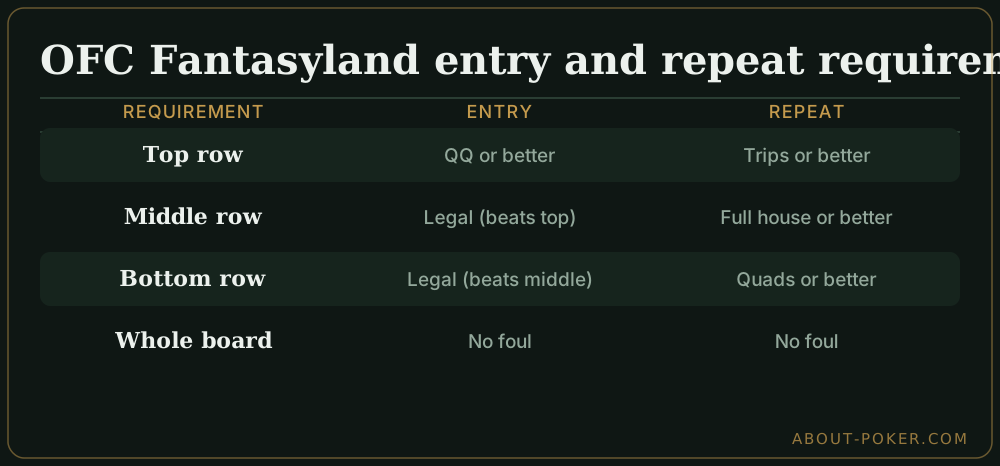
You enter Fantasyland by placing a pair of queens or better in your top row without fouling. That means QQ, KK, or AA up top, or any three of a kind. The catch is the usual OFC rule: your rows must be ordered weakest to strongest, so bottom must beat middle and middle must beat top. If your QQ top forces your middle or bottom into an illegal order, you foul and get nothing, Fantasyland included.
Most sites use the QQ threshold, but you will see variants. Some home games and apps require KK+ to enter, which makes the round rarer and more valuable. Always confirm the entry requirement before you start committing cards toward it.
The size of the edge
Being able to see and arrange all 13 cards at once is worth roughly two to four points per hand compared to setting blind, depending on the format and opponents. That is why strong players will accept a real cost to get there. Consider a top row of QQx: keeping queens up top instead of dropping one into the middle for a safer pair might cost you a point or two in the immediate hand, but it buys a round where you rarely foul and often collect royalties. Over a session that trade is heavily positive.
Staying in Fantasyland
The round is even better if you can repeat it. To stay in Fantasyland you must hit one of three targets while remaining legal:
- Trips or better in the top row
- A full house or better in the middle row
- Quads or better in the bottom row
Because you hold all your cards at once, you can plan toward one of these deliberately. Say you are dealt two aces and a third ace among your 14 cards. Setting AAA up top re-qualifies you immediately, provided your middle and bottom can still beat it. When trips up top are not available, look at whether your bottom-row draw can reach quads or your middle can reach a boat before you settle for a safe, non-repeating set.
A worked setting example
Suppose in Pineapple OFC your 14 cards include Ks Kh Kd, plus As Qs Ts 9s for a spade draw, and a scattering of low cards. You have a decision. Placing KKK up top re-qualifies you for Fantasyland and scores a large top-row royalty, but then your middle and bottom must both beat trip kings, which is demanding. If you cannot build a middle that beats KKK, you foul everything.
The disciplined line is to check your bottom first: with As Qs Ts 9s and one more spade you have a flush, which safely beats a strong middle. If your remaining cards give you a legal middle above two pair but below the bottom flush, KKK up top is gold. If they do not, drop to KK up top, keep the round with a clean, unfouled board, and take the sure points rather than gambling the whole hand.
Common Fantasyland mistakes
- Chasing QQ+ up top when your middle and bottom clearly cannot support it, turning a decent board into a foul.
- Forgetting the repeat conditions and settling for a safe set when trips up top were available with one small rearrangement.
- Ignoring royalties inside Fantasyland; the round is your best chance to stack flush, full house, and quad bonuses, so set for them when it is legal.
- Misreading the site’s entry requirement and playing toward QQ when the game actually needs KK.
For broader positional and foul-avoidance skills that feed directly into reaching the round, the open-face Chinese poker strategy guide covers the fundamentals. If you enjoy the discard mechanic, the Pineapple poker rules explain the three-cards-pick-two format that Pineapple OFC borrows.
Quick checklist before you commit
Ask three questions before locking QQ+ up top: Can my bottom row clearly beat a strong middle? Can my middle clearly beat my top? Is a repeat target realistically in reach? If the first two are yes, take Fantasyland almost every time. If a repeat is also available without risking a foul, take it. When in doubt, a clean legal board beats a fouled dream hand every session.
Frequently asked
How do you get into Fantasyland in OFC?
You enter Fantasyland by setting a pair of queens or better in your top row without fouling your hand. QQ, KK, and AA all qualify, as does any trips up top. The key requirement is that your middle and bottom rows must still be legally ordered, so the entry only counts if the whole hand is valid.
How many cards do you get in Fantasyland?
In standard OFC you receive 14 cards at once and set 13, discarding one. In Pineapple OFC you also get 14 dealt in one batch. Receiving every card together, in secret, is the core advantage of the round.
How do you stay in Fantasyland?
To repeat Fantasyland you must make trips or better in the top row, a full house or better in the middle, or quads or better in the bottom. Any one of these re-qualifies you. Because you can see all your cards at once, aiming for one of these while staying legal is realistic.
Is it worth sacrificing points to reach Fantasyland?
Usually yes. The informational edge of setting 13 cards in secret is worth several points per hand on average, so taking a small risk to place QQ+ up top is often correct. The exception is when going for it forces a likely foul that would cost you the whole board.