What Is a Dead Hand
What is a dead hand in poker: the exact ways a hand gets killed — mucking, folding out of turn, fouled cards, mis-declared holdings — and how to avoid it.
On this page · 7 sections
A dead hand is a hand that has lost its right to win the pot — permanently. It doesn’t matter if you were holding the nuts; once a hand is dead, it’s out of the pot for good. Understanding exactly what kills a hand is one of the cheapest skills in poker, because every dead-hand situation is avoidable.
The short definition
A dead hand is any holding that has been forfeited or fouled and can no longer compete for the pot. The critical feature is that it’s irreversible: there’s no appeal, no “but I had aces.” The dealer’s ruling that a hand is dead stands, and the pot is decided among the remaining live hands.
The main ways a hand dies
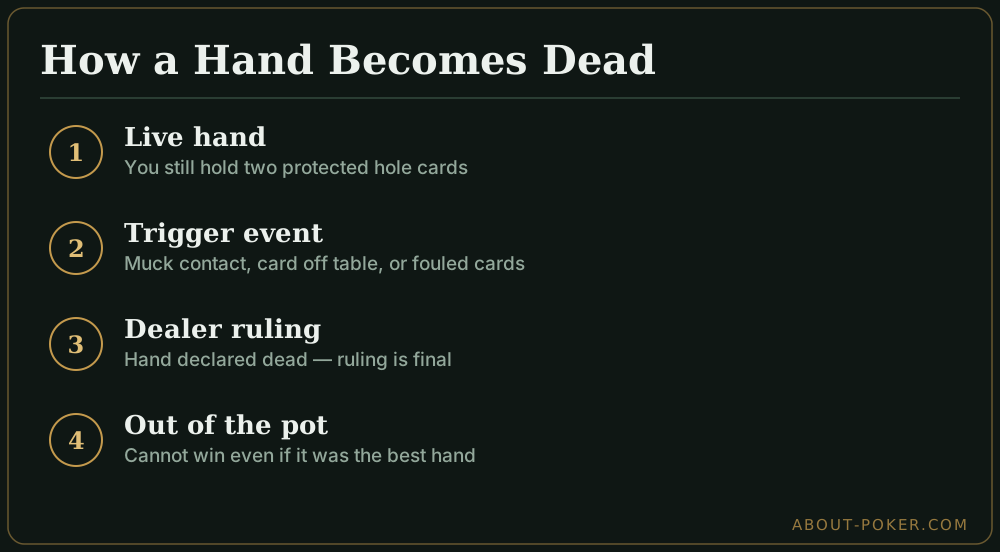
Most dead hands come from a small, predictable set of mistakes:
- Mucking: You toss your cards into the muck (the pile of folded cards). Once they touch it, they’re dead — even if you meant to call. See poker mucking rules for exactly when the muck becomes final.
- Folding out of turn (binding cases): If you fold when it’s not your turn and the fold is ruled binding, your hand is dead.
- Losing a card off the table: If a hole card leaves the table surface — flipped onto the floor, into your lap — the hand is typically dead.
- Fouling your cards: If your hole cards touch the community cards, the muck, or another player’s cards so they can’t be reliably identified, the hand is dead.
- Wrong number of cards: If you’re found holding too many or too few cards after action, your hand can be declared dead.
- Mis-declaring in a declare game or violating a specific house rule that carries a dead-hand penalty.
A worked example
You’re at showdown heads-up. Your opponent bets the river, you call, and they table Ah Kh for top pair. You’re holding 8s 8c — a small pocket pair that, on a board of Kd 8d 3c 2s 9h, is actually a set of eights and the winning hand.
But instead of turning your cards over, you slide them toward the dealer and they brush the muck. The dealer rules your hand dead. Even though you clearly had the winner, those cards can no longer be identified as yours with certainty, and the pot is pushed to your opponent’s live Ah Kh. A winning hand, killed by careless mucking. This is the single most painful dead-hand scenario, and it’s 100% preventable — always table your cards face up at showdown. Our showdown rules guide covers the safe way to reveal.
Why “protect your hand” matters
You’ll hear dealers and regulars say “protect your hand” constantly. It means keeping your cards on the table, in front of you, with something on top (a chip or card protector) so the dealer never sweeps them into the muck by accident and no stray card can foul them. A hand the dealer accidentally mucks is usually still ruled dead — the responsibility is on you. The habit takes two seconds and saves whole pots; we cover it fully in protecting your hand.
Dead hand vs folded hand vs mucked hand
These overlap but aren’t identical:
- A folded hand is one you chose to give up — it becomes dead by your decision.
- A mucked hand is one physically released into the discard pile — dead by contact.
- A dead hand is the umbrella term: any hand that can no longer win, whether by your choice, a rules violation, or an accident.
Every mucked or validly folded hand is dead, but a hand can also be ruled dead without a fold — for example, by fouling or holding the wrong card count.
How it varies by setting
Live cardrooms: Dealers enforce dead-hand rules strictly. The muck line is real; once cards cross it, the ruling is almost always final.
Home games: Rulings are looser and often negotiated, which causes arguments. Agree in advance that a mucked hand is dead, full stop — it prevents the “I didn’t mean to fold” dispute.
Online: You physically can’t muck a winning hand at showdown — the software awards the pot to the best hand automatically. Dead hands online come only from disconnection timeouts and time-bank expirations that auto-fold you.
How to avoid a dead hand — checklist
- Never release your cards until you’re certain you’re folding.
- Protect your cards with a chip or protector every hand.
- Table your hand face up at showdown before pushing anything forward.
- Keep cards over the table — never let a card near the edge.
- Wait your turn so an out-of-turn fold can’t kill your hand.
- Count your cards at the start of each deal to catch a wrong-count problem early.
A dead hand is one of the few disasters in poker that has nothing to do with variance or your opponent. It’s entirely on you — which means it’s entirely in your control to prevent.
Frequently asked
What is a dead hand in poker?
A dead hand is a hand that has been forfeited and can no longer win the pot, even if it would have been the best hand. Cards become dead when they hit the muck, are mis-declared, are fouled by touching another player's cards, or when the player breaks a rule that kills the hand.
What makes a poker hand dead?
Common causes are releasing your cards into the muck, folding out of turn in a binding spot, dropping a card off the table, mixing your cards with the community cards or another player's cards, and acting in a way ruled a violation. Once dead, the hand cannot be reclaimed.
Can you get a dead hand back?
Almost never. Once cards touch the muck or are declared dead by the dealer, the ruling is final even if you flip over a monster. This is why protecting your hand and keeping your cards visible and separate is so important.