What Is a Time Charge
What is a time charge in poker? How time collection works, how it differs from rake, when it's cheaper, and how to figure out which game costs you less.
On this page · 7 sections
A time charge is how many cardrooms make money without taking a cut of every pot. Instead of raking each hand, the house collects a flat fee from each seated player at regular intervals — most often every 30 minutes. You’re paying for your seat and the time you spend in it, not for the hands you win. It’s the standard model at mid and high stakes, and understanding it can meaningfully change which game you choose.
The core idea
In a raked game, the dealer pulls a percentage out of each pot, usually capped at a few dollars. In a time game, no money comes out of the pots at all. Instead, on a set timer, the dealer or a chip runner collects a fixed amount from every player at the table — for example, seven dollars per player every half hour. That’s it. Play one hand or fifty in that window and the cost is identical.
Because the fee is per player rather than per pot, time collection scales with your presence, not your volume of play or the size of the pots. That’s exactly why it dominates higher stakes, where percentage rake on large pots would be brutal.
How it’s collected
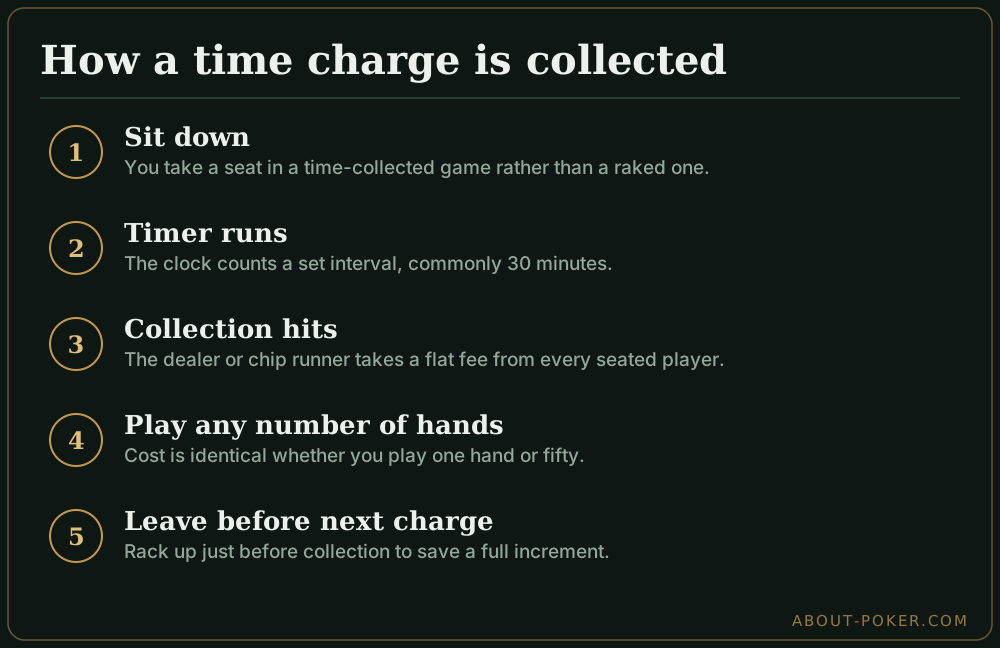
- Timing. Typically every 30 minutes; some rooms use 20 or 60. A timer or a card marks each collection.
- Who pays. Every seated player, whether or not they’re in the current hand. Sitting out temporarily usually still owes time.
- Proration. If you sit down mid-period, some rooms charge you immediately, some wait, and some prorate. Ask the floor.
- Leaving. If you rack up and go before the next collection, you generally avoid the upcoming charge. Time it well and you save a full increment.
For how seating and collection fit into the flow of a live game, see how a cash game works.
Time charge vs rake: a worked example
Suppose you play 30 hands in a half hour.
- Raked game: rake is 5% capped at $5 per pot. If you’re involved in pots that reach the cap on, say, 20 of those hands, and you win or contribute to raked pots totaling $60 in rake over the session’s share… in practice a busy $2/$5 table can generate $4 to $5 of rake on most contested pots. Across a table, that pot rake can easily exceed a flat time fee once pots grow large.
- Time game: the room charges $7 per player every 30 minutes. Your cost for that half hour is exactly $7, no matter how many big pots fly around.
At a $5/$10 table where pots routinely run into the hundreds, a percentage rake would cost each player far more than $7 per half hour — which is precisely why those games use time. At a $1/$2 table with $30 pots, a small capped rake often comes out cheaper than a flat time charge. The break-even point depends on your stakes, pot sizes, and how many hands you see per hour.
When time is better for you
- Higher stakes, bigger pots. Time wins easily; you’d pay far more as a percentage.
- You play many hands per hour (fewer players, fast dealer). More hands spread the fixed fee thinner, lowering your per-hand cost.
- You play tight and fold a lot. In a raked game you pay nothing on hands you fold early, but you still benefit from time when the pots you do play are large.
When rake might be better
- Low stakes, small pots. A capped percentage on tiny pots can beat a flat fee.
- Short sessions with little action. If you only play a few hands, a flat time charge can feel expensive per hand.
Common mistakes
- Ignoring the cost entirely. Both rake and time are real expenses that come straight off your win rate. Factor them in.
- Mistiming your exit. Leaving one minute after a collection wastes nearly a full period’s fee. If you’re done, rack up just before the next charge.
- Assuming all rooms are the same. Amounts, intervals, and proration rules vary widely. Confirm before you sit — the same way you’d confirm the rules when buying chips at a casino.
Quick checklist
- Ask whether the game is time or rake before sitting.
- Note the amount and interval (e.g., $7 every 30 minutes).
- Estimate your hourly cost and compare to a raked alternative.
- Track when the next collection hits.
- Rack up just before a collection if you’re leaving, to save an increment.
A time charge isn’t complicated, but it’s money leaving your stack on a schedule. Knowing how it stacks up against rake — covered further in how poker payouts work — helps you pick the game where more of your winnings actually stay yours.
Frequently asked
What is a time charge in poker?
A time charge, or time collection, is a fixed fee the cardroom collects from each seated player at set intervals — commonly every 30 minutes. It replaces taking a percentage rake from each pot, so you pay to occupy your seat rather than paying per hand.
How is a time charge different from rake?
Rake is a percentage taken from each pot, usually capped at a few dollars. A time charge is a flat per-player fee collected on a timer regardless of how many hands you play or how big the pots are. Higher stakes almost always use time; lower stakes usually use rake.
Is a time charge cheaper than rake?
It depends on stakes and how many hands you play. At higher stakes with big pots, a fixed time charge is far cheaper than a percentage rake would be. At low stakes with small pots, rake is often cheaper. Do the math for your game and hourly volume.
When do I pay the time charge?
Usually every half hour, collected by the dealer or a chip runner. You typically pay when the timer hits, sometimes prorated if you sit down mid-period. If you leave before the next collection, you generally don't owe the upcoming charge.