Why Do Dealers Burn a Card
Dealers burn a card to defeat cheating with marked or peeked top cards. Here's the real reason behind the ritual, its history, and how it protects the game.
On this page · 7 sections
Dealers burn a card — discard the top card face-down before dealing each community card — mainly to defeat cheating that relies on the top card of the deck. If a card is subtly marked, or if a player or dealer glimpses the top card, that information becomes useless the moment the card is burned instead of dealt. It’s a security ritual, not a superstition, and it survives today because it costs nothing and removes a whole category of angles. For the mechanics of what a burn is and when it happens, see what is a burn card.
The core reason: neutralizing marked cards
Old-time cheats marked decks — a tiny scratch, a bent corner, a shading on the back — so they could read the top card before it was dealt. Knowing whether the flop’s first card was, say, an ace is a massive edge. Burning the top card breaks this scheme. Even if a cheat can read the back of the top card, that card gets discarded and never touches the board. The actual card that comes into play is the next one down, which the cheat couldn’t have prepared for.
The same logic covers the honest-but-sloppy case: if the top card is accidentally flashed or peeked during shuffling and dealing, burning it means the exposed card never influences the hand.
Why it defends against dealer angles too
Burning also constrains what a dealer can do, whether crooked or careless. A dealer who could see or control the top card might time deals to favor a confederate. Because the procedure forces the top card into the discard on every street, a dealer can’t reliably steer a specific known card onto the board without being caught. The routine is rigid on purpose: burn first, then deal — every time, in front of everyone. The full dealing routine that enforces this is laid out in how to deal poker.
It does not change the odds
A common misunderstanding is that burning “wastes” a card or shifts the probabilities. It doesn’t. The burned card is random and unknown to everyone, so removing it is statistically identical to removing the next card instead. Your chance of completing a flush or hitting a set is exactly the same whether or not a card is burned first, because you never knew either card. Burning only matters when someone had information about the top card — and that’s precisely the situation it’s designed to erase.
A worked example
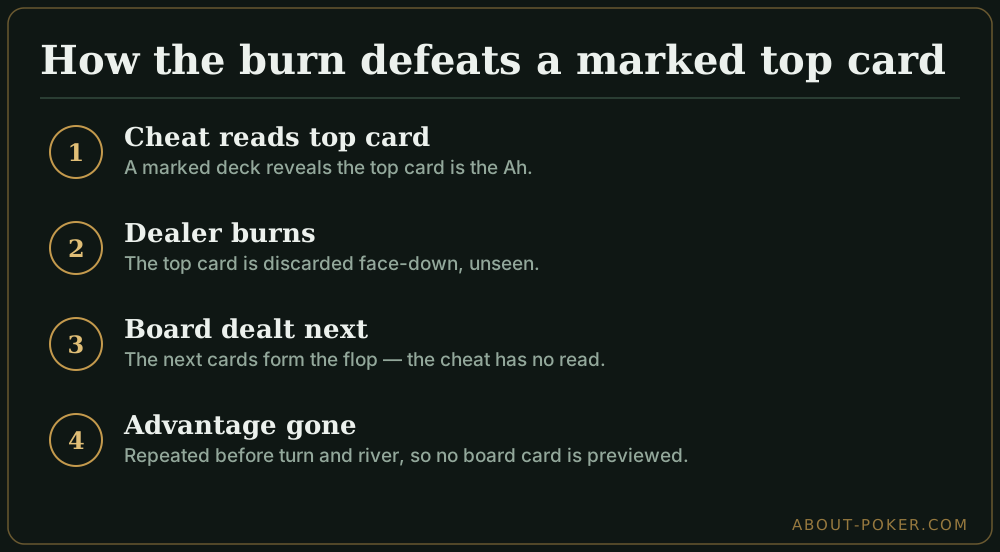
Imagine a cheat has marked the deck and can read that the top card is the Ah. Preflop betting finishes. Without a burn, the dealer would turn that Ah as the first flop card, and the cheat — holding, say, Ac Kc — would know an ace is coming and could bet accordingly with near-certainty.
Now add the burn. The dealer discards the top card face-down — the marked Ah goes into the muck, unseen and unused. The dealer then turns the next three cards for the flop, which the cheat has no read on. The marked-card advantage evaporates. That single discarded card is the entire defense, and it repeats before the turn and the river so the cheat never gets a preview of any board card.
History and where it still matters
The practice traces back to physical card rooms and riverboat games where cheating was rampant and card handling was far less regulated. Burning became standard casino procedure and stuck, even as decks got harder to mark and surveillance improved. In modern regulated rooms it’s a belt-and-suspenders measure: shuffle machines and cameras already deter marking, but the burn is a cheap, visible, additional safeguard that reassures players the top card can’t be exploited.
Online is the interesting exception. There’s no physical deck to mark and no top card to peek — the cards are drawn from a shuffled random-number generator. So most sites don’t burn at all, and where a “burn” appears it’s purely cosmetic, mimicking the live-game look with zero security value.
Common misconceptions
- “Burning improves my odds of hitting.” No — it’s a random unknown card; your probabilities are unchanged.
- “The burn card is bad luck / the card you would have gotten.” There’s no meaningful sense in which the burn was “yours.” Which card counts as the burn versus the deal is arbitrary from any player’s information.
- “Online sites burn for fairness.” Fairness online comes from the shuffle algorithm and audits, not from a burn.
- “You can figure something out from the burn.” Players never see it, and it carries no in-hand meaning even if flashed.
Quick summary
- The burn exists to defeat marked-card and peeked-top-card cheating.
- It also limits what a crooked or careless dealer can do with the top card.
- It does not change anyone’s odds, because the burned card is unknown.
- It happens before the flop, turn, and river — three times per Hold’em hand.
- Online games generally skip it because there’s no physical deck to exploit.
The next time you see a dealer flick a card aside before the flop, you’ll know it’s not habit or luck — it’s a small, deliberate act of game security with a long history and a very specific job.
Frequently asked
Why do poker dealers burn a card before the flop?
The burn defeats cheating based on the top card. If a player has marked the deck or glimpsed the top card, burning it means that known card never reaches the board, neutralizing the advantage.
Does burning a card change the odds?
No. Burning a random unseen card does not change any player's probability of hitting a hand. The card removed is unknown, so it is statistically identical to the card that would have been dealt.
Do online poker sites burn cards?
Most online sites do not physically burn cards because there is no deck to mark or peek. Some simulate a burn cosmetically, but with a shuffled random-number generator it has no purpose or effect.