Hyper-Turbo SNG Strategy: Winning Short-Stacked
Hyper-turbo SNG strategy is push/fold from the first hand. Learn shove ranges, Nash basics, turbo vs hyper differences and a worked shove.
On this page · 7 sections
Hyper-turbo SNG strategy is push/fold poker in its purest form. These sit & gos start with a very shallow stack — often 300 to 500 chips, roughly 10 to 25 big blinds — and blinds that climb every two to three minutes. There’s barely any postflop play; you win by shoving and folding correctly, keeping fold equity alive, and respecting ICM near the bubble.
Turbo vs. hyper-turbo (vs. super-turbo)
The names blur, so here’s the practical difference:
| Format | Starting stack | Blind speed | Play style |
|---|---|---|---|
| Standard SNG | 1,500–3,000 chips | ~10 min levels | Full early play, push/fold late |
| Turbo | 1,500 chips | ~5 min levels | Some early play, push/fold sooner |
| Hyper / super-turbo | 300–500 chips | ~2–3 min levels | Push/fold almost from hand one |
“Super-turbo” and “hyper-turbo” are usually the same thing — an extra-shallow, extra-fast SNG. If you’re comparing a specific room’s hyper structure to its turbo, check the starting stack first; that number tells you how quickly you’ll be shoving.
Why it’s a push/fold game
At 10 big blinds a min-raise to 2 BB is already roughly a fifth of your stack, and once you’ve invested that plus your blind, folding to a re-shove bleeds chips you can’t spare. Rather than raise-fold, you open-shove or fold — capturing the blinds and antes when everyone folds, and getting maximum fold equity when they don’t. The same logic only sharpens as you drop toward 5 BB.
This is the same short-stack engine that drives spin & gos. The difference is that most hyper-turbo SNGs pay multiple spots, so ICM matters more than in a winner-take-all spin.
Nash ranges: your default, not your master
Nash equilibrium push/fold charts give the unexploitable shove and call ranges for each stack and seat when everyone plays perfectly. They’re an excellent baseline. Below is a simplified open-shoving reference from the button:
| Effective stack | Button open-shove range |
|---|---|
| 15 BB | Pairs 22+, A2+, K9s+/KJo+, QTs+, JTs |
| 10 BB | Pairs, any ace, K7s+/KTo+, Q9s+, J9s+, T9s |
| 6 BB | Any pair, any ace, any king, most queens, most suited |
| 3 BB | Nearly any two cards |
Shoving is only half the framework — you also have to know when to call a shove. Calling ranges are always tighter than shoving ranges: to open-shove you only need everyone to fold often enough, but to call you must actually beat the shover’s range, and near the bubble ICM tightens you further still. Here’s a simplified chip-EV calling reference for the big blind facing a button open-shove:
| Effective stack | BB call vs button shove |
|---|---|
| 15 BB | Pairs 22+, ATo+/A9s+, KQ |
| 10 BB | Pairs 22+, A9o+/A7s+, KTs+/KQo |
| 6 BB | Any pair, A5o+/A2s+, KTo+/K9s+, QJ |
| 3 BB | Roughly any ace, any pair, any two Broadway |
Worked example: a value-shove that looks loose
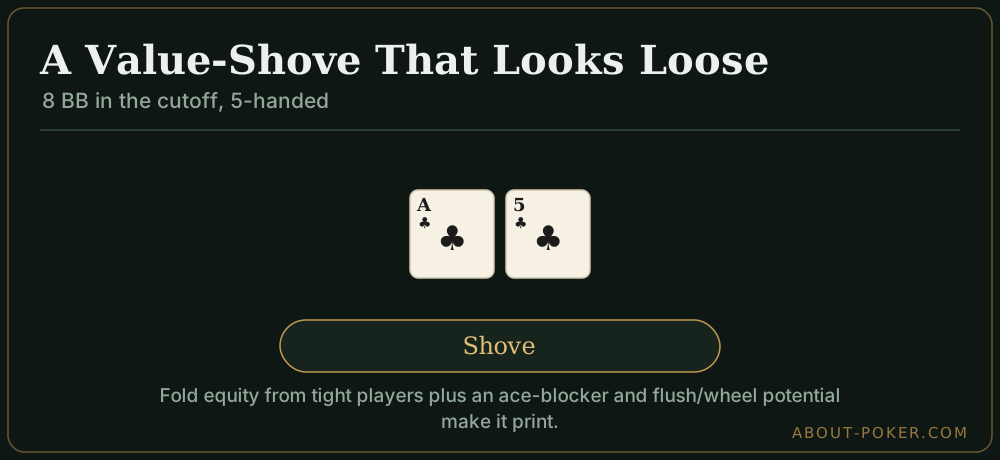
Five-handed, blinds 100/200 with antes, everyone folds to you in the cutoff. You have 8 big blinds and hold A♣ 5♣. Behind you sit a tight button, a tight small blind, and a big blind who defends too wide.
A-5 suited looks thin, but at 8 BB from the cutoff it’s a clear shove. You pick up ~500 in blinds and antes when folded to, your ace blocks many calling hands, and against the big blind’s wide defending range you have solid equity plus the nut-flush and wheel potential. Folding here would surrender chips you can’t afford to surrender.
Shove. The combination of fold equity from three tight-ish players and reasonable equity when called makes this comfortably profitable. That’s the hyper-turbo mindset: shove the spots that print, ignore the ones that don’t.
The bubble: shove wide, call tight
Near the money, ICM pulls your ranges apart:
- Shoving stays wide — folds are worth a lot when busting an opponent locks up a pay jump for you.
- Calling gets tight — risking your stack to bust yourself on the bubble is expensive in real money, even when it’s fine in chips.
Worked call example (why you fold a chip-EV call). Four players left in a top-three-paid hyper, blinds 200/400. You have 12 BB in the big blind; a covering big stack open-shoves from the button, and you look down at A♠ J♦. In pure chips this is a routine call — AJ is well ahead of a wide button shoving range. But you’re one bust from the money and the shover has you covered: lose, and you finish fourth for nothing while two shorter stacks are still in danger. In $EV terms the call is losing — the pay jump you protect by folding is worth more than the chips you’d win. Fold. That same AJ you’d snap off deep-stacked becomes a fold on the bubble; that’s ICM narrowing your calls even while your shoves stay wide.
This asymmetry is the single most important adjustment in short-stack tournament play. Learn the full framework in our push/fold and ICM guide and the broader ICM hub.
Common mistakes
- Min-raising and folding at 10 BB, torching fold equity.
- Calling shoves too wide on the bubble because “it’s a coin flip in chips.”
- Treating Nash as gospel against clearly exploitable opponents.
- Panicking at 4 BB and shoving trash into an obvious caller instead of picking a better seat.
Put it together
Hyper-turbo SNG strategy is a preflop skill: know your shove and call ranges cold, deviate from Nash to exploit weak opponents, and let ICM narrow your calls on the bubble. Cement the math in our ICM and push/fold guide, compare the close cousin in spin & go strategy, and return to the sit & go strategy hub for the full format map.
Frequently asked
What is a hyper-turbo sit and go?
A hyper-turbo SNG (sometimes called super-turbo) is a sit & go that starts with a very shallow stack — often 300 to 500 chips, roughly 10-25 big blinds — with blinds rising every two to three minutes. The whole game is essentially a push/fold contest.
What is the difference between turbo and hyper-turbo?
A turbo has faster blinds than a standard SNG but still allows some postflop play early. A hyper-turbo (or super-turbo) starts far shallower and escalates faster, so you're in push/fold mode almost from the first hand.
What are Nash ranges in hyper-turbo SNGs?
Nash equilibrium push/fold charts show the game-theory-optimal shove and call ranges for each stack size and seat when everyone plays perfectly. They're a strong default, but you should widen or tighten based on how your opponents actually play.
How important is ICM in hyper-turbos?
Very. Because stacks are short and the money bubble arrives quickly, ICM heavily narrows your calling ranges near the bubble even as your shoving ranges stay wide.