ICM & Tournament Math
ICM in poker explained: how the Independent Chip Model turns chip stacks into real-money equity, why it changes your decisions near pay jumps, and where
On this page · 7 sections
ICM — the Independent Chip Model — is the math that converts your tournament chip stack into its real-money value. It exists because of one fact: in a tournament, chips you win are worth less than the chips you risk. Understand ICM and you’ll stop playing the bubble and final table like a cash game, where every chip is worth the same.
Why chips aren’t dollars
In a cash game, $1 in chips is $1 in your pocket — you can stand up and cash out any time. A tournament is different. You can’t cash chips mid-game; they only become money through the payout structure. Doubling your stack does not double your equity, because first place doesn’t pay double second. That gap between “chip count” and “cash value” is what ICM measures.
The pieces, in order
Work through these in sequence and the whole model clicks:
- What ICM actually is — the plain-English definition, what the abbreviation stands for, and the core idea of diminishing chip value.
- How ICM is calculated — the formula behind the model, a full worked example, and the calculators pros lean on.
- ICM pressure explained — why a big stack can bully a medium stack, and why you sometimes fold aces’ worth of equity to survive.
- ICM and deal making — how final-table chops are calculated and when to take one.
- When ICM matters most — the bubble, pay jumps, bubble factor, and the spots where ICM should change your play.
Where ICM bites hardest
ICM is always technically in effect once a tournament is in the money or approaching it, but its impact spikes at three moments: the bubble (the spot just before the money), each pay jump (especially the final table), and satellites (where finishing 1st and 10th can pay exactly the same). Away from those points — deep in a big field, early on — chip-EV and ICM nearly agree, and you can mostly play your normal game.
Put it to work
ICM is one half of tournament skill; the other is everything that gets you to the money in the first place. Pair this hub with the broader tournament strategy guides, and treat ICM as the lens you switch on as the pay jumps get close.
A simple ICM example
Say four players remain in a tournament paying $50 / $30 / $20 / $0, with equal stacks. Under ICM, each player’s equity isn’t their chip share — it’s their expected prize money. With equal stacks everyone has an equal shot at each payout, so each is worth $25 (the $100 prize pool split by equal chances).
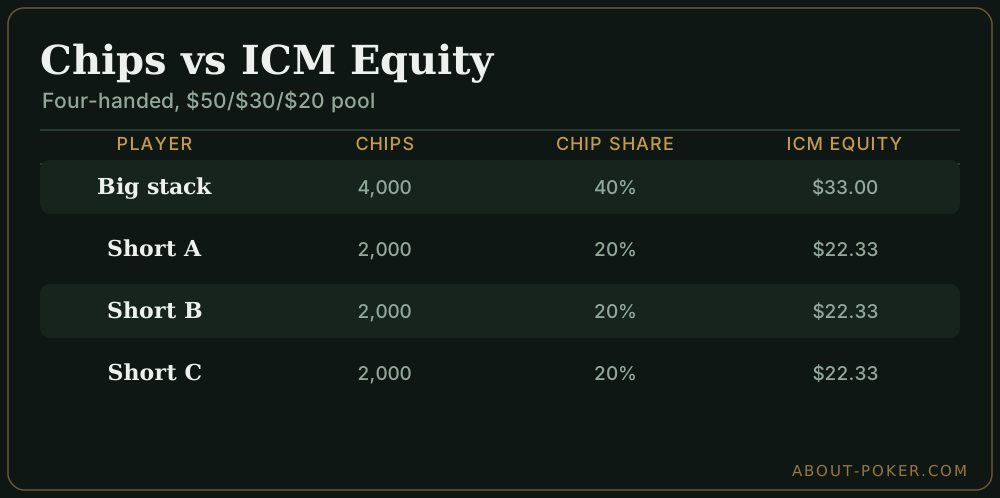
Now prove the headline claim with numbers. Keep the same four-handed table, 10,000 chips in play, but make one player twice as big:
| Player | Chips | Chip share | ICM equity |
|---|---|---|---|
| Big stack | 4,000 | 40% | $33.00 |
| Short A | 2,000 | 20% | $22.33 |
| Short B | 2,000 | 20% | $22.33 |
| Short C | 2,000 | 20% | $22.33 |
Look at what doubling did. A 2,000 stack is worth $22.33; doubling it to 4,000 lifts you only to $33.00 — not the $44.67 you’d get if equity doubled. Those extra 2,000 chips added just $10.67, less than half of what the first 2,000 were worth. You can’t win more than the $50 first prize, so every chip past the lead buys less and less. That diminishing value is the whole idea.
Reading the moment at the table
Bubble factor isn’t fixed — it swings with your stack and the payouts. It runs highest when you’re a medium stack with a shorter player still in and a pay jump looming: you have plenty to lose and little upside to busting first. A big stack covering everyone feels ICM least and can apply the pressure; the shortest stack, already committed, sometimes has a bubble factor close to 1.0 and should gamble. Read where you sit before you call — more in the tournament strategy hub, and lean on normal pot-odds math only once the bubble is far behind you.
Bubble factor: a number you can act on
Bubble factor puts ICM into a single number: how much more a lost chip costs you than a won chip is worth, in real equity. Away from the money it’s about 1.0 — a chip is a chip. On a tight bubble it commonly climbs to 1.5 or higher.
Here’s why that matters at the table. In chip terms, a symmetric all-in (you risk what you can win) is a call at 50% equity or better. Multiply the risk by a bubble factor of 1.5 and the break-even point moves to 60%:
break-even equity = bubble factor ÷ (bubble factor + 1) = 1.5 ÷ 2.5 = 60%
So a hand that’s a coin-flip 52% favorite — an easy call for stacks in a cash game — becomes a clear fold on the bubble, because 52% is well short of the 60% you now need. That single gap between 50% and 60% is ICM turned into an action you can take: near the money, fold hands you’d snap-call anywhere else.