How to Use ICM in Poker: A Playbook
A step-by-step process for using ICM at the table: spot when it matters, size the pay-jump tax, and turn your stack into the right shove-or-fold call.
On this page · 6 sections
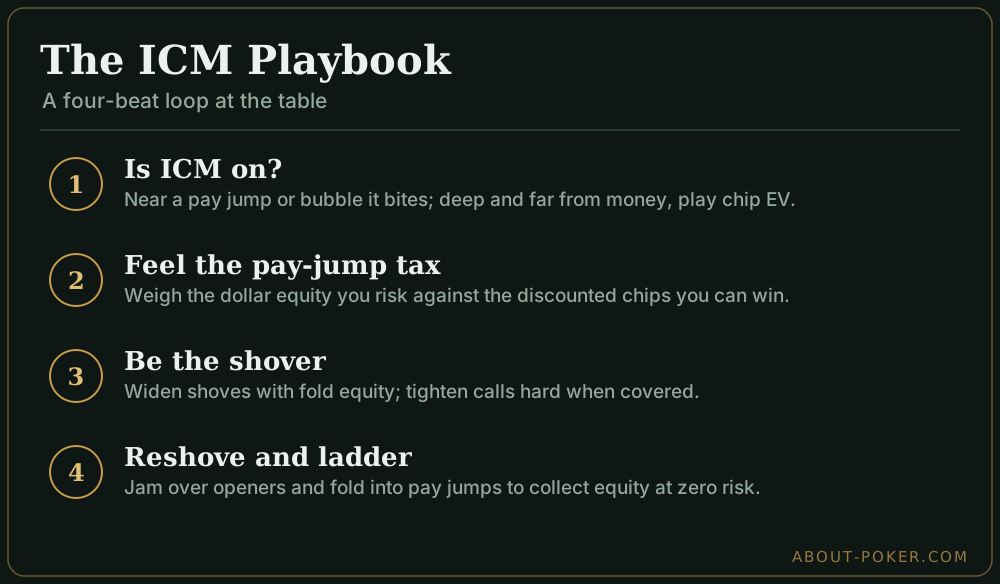
Using ICM at the table isn’t about running equity calculations mid-hand — it’s about applying a repeatable read. Check whether ICM is “on,” size the tax it puts on risking your stack, then bias toward being the aggressor and away from being the caller. That three-step loop turns the Independent Chip Model from theory into moves you can make in the seconds you actually have. This is the practical playbook, not the derivation.
Step 1: Decide whether ICM is even “on”
ICM only reshapes your play when busting is costly. Before adjusting anything, place the current spot on this scale:
| Situation | ICM strength | How to play |
|---|---|---|
| Deep, big field, far from money | Near zero | Maximize chips — play chip EV |
| Approaching the bubble | Rising | Start tightening calls, widening shoves |
| The money bubble | Peak | Attack with fold equity, call only premiums |
| Each final-table pay jump | High | Ladder up; avoid stack-threatening flips |
| Heads-up for the title | Off again | Back to chip EV — play to win |
The mistake beginners make is applying ICM everywhere. Two hundred players deep in a thousand-runner field, your stack converts almost linearly to dollars — play to accumulate. Save the survival instincts for when the scale actually tips.
Step 2: Feel the pay-jump tax before you commit
Once ICM is on, the core move is to compare what a decision risks in dollars against what it can win. Consider a real spot: five players left, four paid, a $1,000 pool paying $400 / $250 / $200 / $150. You’re the middle stack facing a shove-or-fold decision.
| Player | Chips | Chip share | ICM value |
|---|---|---|---|
| Chip leader | 5,000 | 38% | $280.05 |
| You | 3,000 | 23% | $230.69 |
| Player C | 2,500 | 19% | $212.72 |
| Player D | 1,500 | 12% | $160.24 |
| Short stack | 1,000 | 8% | $116.30 |
(All five equities sum to exactly $1,000 — the full pool.) Read the structure: the short stack is worth $116 and the bubble is one player away. Every seat above them is being paid, in equity, just to let the short stack bust. Your $230.69 is real money you keep by surviving — and it climbs the instant anyone else exits.
The lesson isn’t a formula to run live. It’s the shape: risking your 3,000 chips threatens $230 of equity to win chips that convert at a discount, while the short stack is doing the risky work for you. When the tax on busting is this high, the correct default is to let others take the risk.
Step 3: Be the shover, not the caller
ICM splits every all-in into two very different jobs. The shover has fold equity — opponents may fold and hand over chips for free — and can pick low-risk spots. The caller, especially when covered, risks their whole tournament on this one hand. That asymmetry means:
- Widen your shoving range. With fold equity against players who must fold to survive, open-jams that would be marginal in chips become clearly profitable in dollars.
- Tighten your calling range hard. A call that’s break-even at 50% in chips can need 70%-plus in dollars when you’re covered near a pay jump. That surcharge is your risk premium, and it collapses your calling range toward the very top.
This single adjustment — attack more, call less — captures most of ICM’s edge. When you’re the big stack, it’s a license to pressure everyone. When you’re covered, it’s a warning to fold hands that look like snap-calls.
Step 4: Reshove and ladder deliberately
Two specific tools do the heavy lifting near the money:
- Reshoving over openers. When a player opens and you can jam over the top, ICM often makes this profitable even with hands you couldn’t flat-call, because the opener now faces their own risk premium and has to fold. This is a whole discipline of its own — see ICM reshoving strategy.
- Laddering. Sometimes the highest-value play is to fold and let someone else bust. Watching your ICM value jump for free as a shorter stack busts is not passive — it’s collecting equity at zero risk. Fold into pay jumps when your survival is worth more than a marginal edge.
How to build the instinct off the table
You can’t compute equity mid-hand, so the skill is trained in advance:
- Drill spots in a calculator. Feed real stack and payout structures into an ICM tool and study which shoves and calls flip from profit to loss. After enough reps, the ranges live in your head.
- Memorize the direction, not the decimals. You don’t need “72.9%” at the table — you need to know that a covered call near a pay jump needs a monster, and that a shove with fold equity is cheap.
- Review after sessions. Flag the hands where you called off near a pay jump. Those are where ICM leaks hide, and where the biggest dollar corrections come from.
The takeaway
Using ICM in poker is a four-beat loop: confirm ICM is on, feel the pay-jump tax on your stack, take the shover’s side of every all-in, and ladder or reshove deliberately near the money. You apply patterns learned in study, not math done live — the numbers are for practice, the reads are for the felt. Deepen the underlying model at the ICM hub and round out your late-game game plan in tournament strategy.
Frequently asked
How do you use ICM while playing poker?
Use it as a three-step read: check whether ICM is 'on' (near a pay jump or bubble), estimate the pay-jump tax on risking your stack, then bias toward aggression as the shover and caution as the caller. You don't recompute equity mid-hand — you apply the pattern ICM produces.
How do you play ICM at the bubble?
Attack with fold equity and defend selectively. Open-shove wide when covered players must fold to survive, but call all-ins only with hands well above your chip break-even. On the bubble the cost of busting is at its peak, so shoving is cheap and calling is expensive.
Do I need to do ICM math at the table?
No. You learn the patterns away from the table with a calculator, then apply rules of thumb live: tighten calling ranges near pay jumps, widen shoving ranges when you have fold equity, and never stack off light while covered. The math is study; the play is pattern recognition.
When should I ignore ICM?
When ICM is effectively off: deep in a big field far from the money, in flat payout structures, and heads-up for the title. In those spots chip EV and dollar EV nearly agree, so you can play maximizing chips without a survival penalty.