When Does ICM Matter Most? Bubble Factor
ICM matters most on the bubble, at pay jumps, and in satellites. Here's bubble factor — the number that tells you exactly how much tighter to play.
On this page · 9 sections
ICM matters most when a pay jump is close and steep: on the bubble, at the final table, and — most extremely — in satellites. Far from the money in a deep field, ICM and ordinary chip-EV play nearly agree, so you can play your normal game. The closer you get to a meaningful jump in prize money, the more ICM should tighten your calls and sharpen your aggression. Bubble factor is the number that tells you exactly how much.
What ICM actually is
ICM (the Independent Chip Model) converts your chip stack into its real cash value. In a tournament your chips aren’t money — you can’t cash them out mid-game, and their worth depends entirely on the payout ladder. ICM estimates each player’s share of the remaining prize pool from their chip stacks, treating your probability of finishing 1st, 2nd, 3rd, and so on as proportional to how many chips you hold.
The key consequence: chips don’t have linear value. Doubling your stack does not double your equity — the first chips you win are worth far more than the last. That asymmetry is the entire reason ICM changes how you should play, and how ICM is calculated shows the math behind it.
The three high-ICM moments
ICM is technically always present once payouts exist, but its grip varies enormously:
- The bubble — the spot right before the money. Busting here means leaving with nothing after hours of play, so survival equity is at its absolute peak. ICM pressure is brutal.
- Pay jumps and the final table — each elimination bumps everyone up the ladder. The steeper the gap between, say, 3rd and 1st, the more your decisions should weigh survival.
- Satellites — where the top finishers all win identical seats. Chips beyond the qualifying amount are nearly worthless, making this the most extreme ICM format of all.
When ICM barely matters
The flip side is just as important — don’t over-apply ICM and play scared when you shouldn’t:
- Early, in a big field, far from the money. Chip accumulation is king; play close to chip-EV.
- Deep stacks, distant pay jumps. With lots of play left, the next jump is too far away to dominate decisions.
- Winner-take-all or flat top-heavy structures with no real ladder — there’s little survival premium to protect.
Bubble factor: putting a number on it
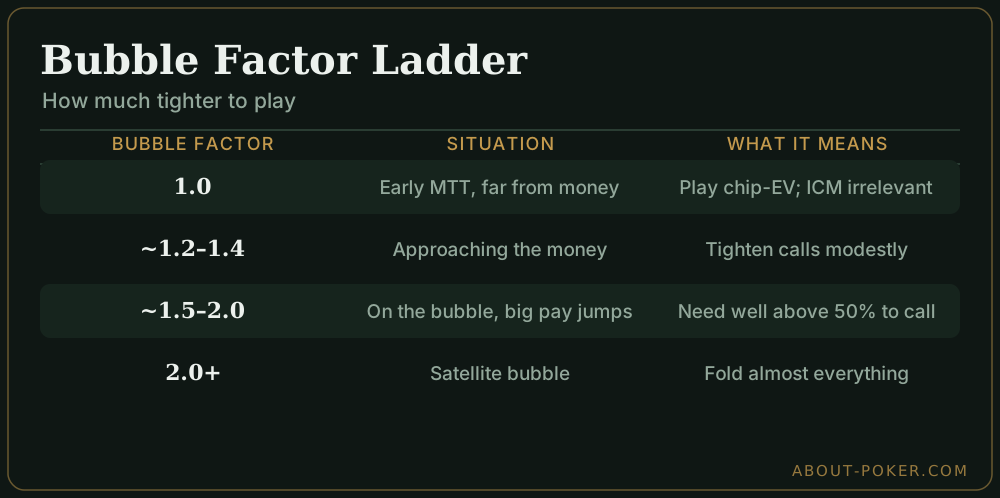
Bubble factor measures the asymmetry between losing and winning a hand in equity terms:
Bubble factor = (equity lost if you bust) ÷ (equity gained if you win the pot)
A bubble factor of 1.0 means chips lost and chips won are worth the same — pure chip-EV, no ICM tax. The higher it climbs, the more punishing a loss is relative to a win:
| Bubble factor | Situation | What it means |
|---|---|---|
| 1.0 | Early MTT, far from money | Play chip-EV; ICM irrelevant |
| ~1.2–1.4 | Approaching the money | Tighten calls modestly |
| ~1.5–2.0 | On the bubble, big pay jumps | Need well above 50% to call all-ins |
| 2.0+ | Satellite bubble | Fold almost everything, even big hands |
The practical effect: at a bubble factor of 1.5, a coin-flip that’s break-even in chips is a clear fold in dollars, because losing costs 1.5x what winning pays. You need meaningfully more than 50% equity just to break even on the call.
A worked example: the fold that’s +chipEV but −$EV
Numbers make this concrete. It’s a money bubble: 4 players left, top 3 paid $500 / $300 / $200 (a $1,000 pool). The short stack open-jams and you’re in the big blind:
- You: 12,000 chips (you cover)
- Shover: 8,000
- Two others: 15,000 each
Say you hold a hand that’s a pure coin flip (50%) if you call. In chips, that call is exactly break-even — on average you win zero chips. But run it through ICM:
| Outcome | Your stack after | Your ICM equity |
|---|---|---|
| Fold | 12,000 | $248.63 |
| Call and win (50%) | 20,000 | $354.29 |
| Call and lose (50%) | 4,000 | $105.59 |
Calling is worth 0.5 × $354.29 + 0.5 × $105.59 = $229.94. Folding is worth $248.63. So a call that’s perfectly neutral in chips bleeds $18.70 in real money — you’re literally paying to gamble. To make the call break even here you’d need about 57.5% equity, not 50% (a bubble factor of roughly 1.35). That gap is ICM, and it’s why survival beats a marginal edge near a pay jump.
ICM range adjustments: how much tighter to call
The example above generalizes into calling ranges. Under chip-EV you call an all-in whenever you have more than ~50% equity plus pot odds; under ICM you demand a cushion on top. Rough guidance for calling a shove, indexed to bubble factor:
| Bubble factor | Extra equity you need to call | Practical effect on your calling range |
|---|---|---|
| 1.0 | none (~50%+ as normal) | Full chip-EV range |
| 1.2–1.4 | +3–7% | Drop the thinnest calls; TT+ / AQ+ tightens toward JJ+ / AK |
| 1.5–2.0 | +8–15% | Call only premiums; snap-calls become folds |
| 2.0+ (satellite) | often need 65–80%+ | Fold almost everything, even QQ/AK when covered |
Two things this table does not say. First, shoving ranges tighten far less than calling ranges — a well-timed jam still picks up blinds risk-free, so you keep applying pressure even when you’d never call off. Second, ICM punishes the player who can be eliminated, not the one who can’t.
Big-stack ICM aggression
That last point is the flip side of the whole model, and the most profitable one: if a chip lost is worth more than a chip won for your opponents, then their folds are worth more to you. As the big stack near a bubble or pay jump, you can raise and shove into medium stacks relentlessly, because they carry the crushing bubble factor — busting costs them a pay jump they’ve almost secured, so they must fold hands they’d happily stack off with in a cash game.
The players you can’t bully are the other big stacks and the true short stacks with nothing left to lose. Target the medium stacks in between — the ones with real money on the line and enough chips that busting hurts. Attacking them turns everyone else’s survival instinct into your chip accumulation.
A quick decision rule
Before any big tournament confrontation near the money, ask three questions:
- How close is the next pay jump? Closer = more ICM weight.
- How big is the jump? Steeper ladders = higher bubble factor.
- Does busting eliminate me before a jump? If yes, raise your calling threshold; if I merely lose chips but survive, relax it.
If you’d snap-call a spot in a cash game but busting here costs a pay jump, that’s your cue to fold — and your cue to apply the same pressure to others when you’re the one covering them.
Tying it together
Knowing when ICM matters is what turns the theory into results. Combine this with the calculation method and the pressure dynamics from the ICM hub, and layer it onto your overall tournament strategy so you switch the ICM lens on exactly when it pays.
Frequently asked
When does ICM matter most in poker?
On the bubble (the spot just before the money), at every pay jump, at the final table, and in satellites. The closer and steeper the next pay jump, the more ICM should tighten your play.
What is bubble factor?
Bubble factor is the ratio of how much equity you lose by busting a hand to how much you gain by winning it. A bubble factor of 1.5 means losing costs 1.5x what winning gains, so you need extra equity to call.
When does ICM not matter?
Early in a big tournament, far from the money, ICM's effect is tiny and chip-EV play is fine. It also barely applies when stacks are deep and pay jumps are distant, or in winner-take-all formats with no ladder.
Why is ICM so extreme in satellites?
Satellites usually award identical seats to several finishers, so any chips above the amount needed to qualify are nearly worthless. Once you're locked to qualify, you should fold almost everything — even premium hands.