ICM Calling Ranges: Facing a Shove
ICM tightens the caller far more than the shover. See the breakeven-equity math for calling off near a pay jump, with a worked four-player spot.
On this page · 8 sections
Most ICM advice is about shoving — when to jam, how fold equity carries marginal hands. The other half of the decision gets far less attention and is where players bleed the most equity: calling a shove. Under ICM the caller is squeezed much harder than the shover, because a call has no fold equity and no escape hatch. Get this asymmetry wrong and you’ll call off hands near a pay jump that are clean folds in dollars.
Why the caller pays more
When you shove, two things can happen: opponents fold (you win the pot risk-free) or they call (you’re at showdown). That fold equity is pure profit and it survives ICM completely. When you call, you’ve thrown that upside away — there’s no chance the opponent folds behind you. You’re committed to a coinflip you can’t win by making anyone fold, and if you lose near a pay jump, you pay the full ICM risk premium for busting.
That’s why the same hand can be a fine shove and a terrible call. The push/fold charts covered in the Nash push/fold guide show shoving ranges staying wide near the money while calling ranges collapse. This article puts numbers on the call side.
The breakeven-equity formula
Deciding whether to call off is a comparison of three ICM equity states:
- Fold — your equity if you muck and keep your current stack.
- Call and win — your equity with the added chips.
- Call and lose — usually zero if the shove covers you and you bust.
You should call when your chance of winning, times your win-state equity, beats your fold equity:
Call if: (P_win × Equity_win) + (P_lose × Equity_lose) ≥ Equity_fold
Rearranged for a spot where losing busts you (Equity_lose = 0), the breakeven win probability is:
P_breakeven = Equity_fold ÷ Equity_win
That single ratio tells you how much raw hand equity you need before a call turns profitable in dollars.
Worked example: calling off on the bubble
Four players left, payouts $500 / $300 / $200 / $0 (a $1,000 pool). You cover no one — the shover has you covered. Stacks:
| Player | Chips | Role |
|---|---|---|
| Hero | 3,000 | facing the shove |
| Villain | 3,000 | shoves all-in |
| Player C | 2,000 | folded |
| Player D | 2,000 | folded |
If you fold, stacks stay 3,000 / 3,000 / 2,000 / 2,000 and your ICM equity is $282.14.
If you call and win, you have 6,000, Villain busts in 4th, and three players remain (6,000 / 2,000 / 2,000). Your equity jumps to $410.00.
If you call and lose, you bust in 4th for $0.
Plug into the breakeven formula:
P_breakeven = $282.14 ÷ $410.00 = 68.8%
You need 68.8% equity to call — despite the pot laying you what looks like a coinflip. In pure chip EV, a same-sized shove only needs 50% to call. ICM has added nearly 19 points of required equity. Against a shove that’s even close to a coinflip, this is a fold — and most players call it anyway. Notice each state’s equities sum to exactly the $1,000 pool; ICM only ever redistributes the pool, never invents chips.
From 68.8% to actual hands
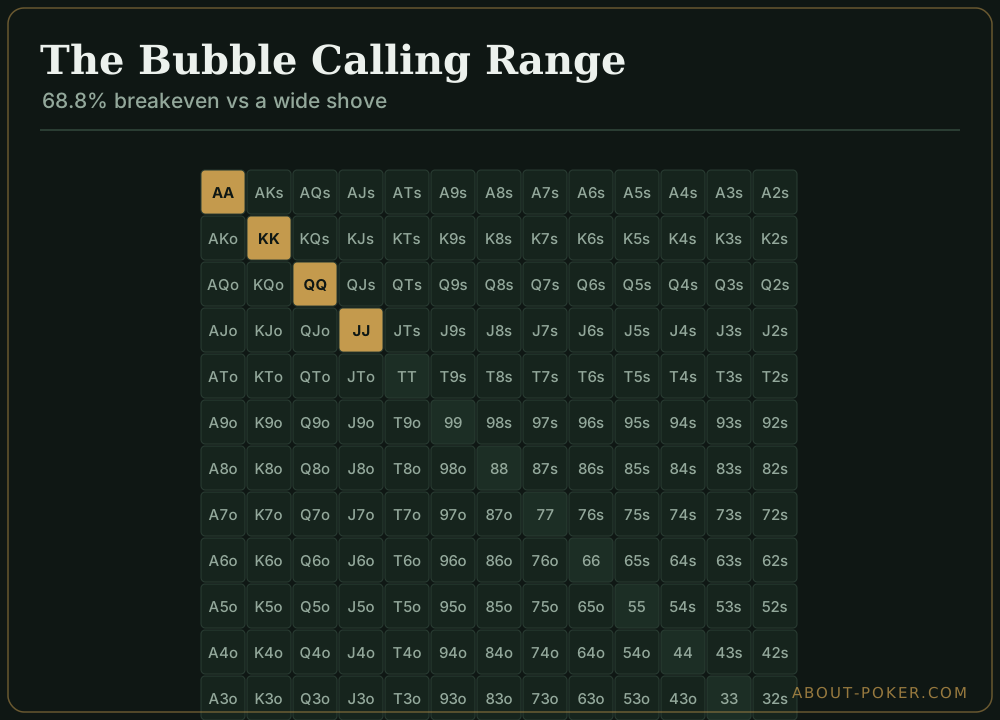
The breakeven number is useless until you turn it into cards. To do that you need the shoving range you’re up against, then check which of your hands clear the threshold against it. Suppose the same bubble spot is a ~15bb short stack jamming into you — a typical range of about 32% of hands: all pairs, any ace, most suited kings and broadways, and the better suited connectors. Here’s how common calling hands fare against that range, sorted against the 68.8% requirement:
| Your hand | Equity vs 32% shove | Call at 68.8%? |
|---|---|---|
| AA | 85% | Call |
| KK | 76% | Call |
| 72% | Call | |
| JJ | 68.5% | Borderline (fold if unsure) |
| TT | 65% | Fold |
| AKs | 65% | Fold |
| AKo | 63% | Fold |
| AQs | 63% | Fold |
| 99 | 61% | Fold |
The headline result surprises most players: against a wide shove, only QQ+ is a clear call, JJ is a coin-toss with the threshold, and AK and TT are folds. The calling range here is roughly QQ+ — three hand classes out of 169. That’s what a 68.8% requirement actually looks like at the table, and it’s dramatically tighter than the “any pair or ace” range you might jam yourself.
Two levers move this range hard:
- The shove range. Against a tight 12% jam (88+, ATs+, AJo+, KQs) only AA and KK stay above 68.8% — even QQ drops to ~62% and AK to the mid-50s — so you fold more: you need a premium to beat a premium. Against a very loose 60%+ shove, TT climbs past the bar (~71%) and rejoins the call, while AK stubbornly sits at ~65–67% because two overcards barely improve as the range widens.
- The threshold itself. If you cover the shover so busting doesn’t end you, the requirement can fall to the mid-50s, and TT, AK, AQs, and 99 all become calls. The chart above is specific to the covered, bubble worst case.
Stack depth and position
Stack depth sets the shove range, which sets your call. At 8–12bb a short stack jams a wide range (30–45%), so your calling threshold is met by more hands even though the percentage requirement is high — a 32% range is beatable by QQ+. At 20bb+, players jam far tighter (often 10–15%), so even though you’re deeper the hands that clear the bar shrink toward QQ+/AK only, and frequently you should just fold everything but the top of your range.
Position matters through who’s left to act. Calling in the small blind with the big blind still behind is worse than calling on the button heads-up: a caller behind can wake up with a better hand and cost you the pot, so shade the earlier-position calling range tighter. When you’re the last player who can call and everyone else has folded, you get the full breakeven range with no such discount.
How the requirement shifts
The breakeven number isn’t fixed — it moves with the spot:
| Factor | Effect on calling requirement |
|---|---|
| Closer to a pay jump (bubble, FT ladder) | Higher — busting costs more, tighten calls |
| You cover the shover (busting doesn’t end you) | Lower — you can call much wider |
| Flat payout structure (satellites) | Very high — often you can’t profitably call at all |
| Deep-stacked, far from money | Near chip EV — call close to 50% |
The single biggest swing is whether busting ends your tournament. When you cover everyone, a lost call doesn’t bust you, your Equity_lose is well above zero, and your calling range widens dramatically. When you’re covered and busting means going home, your calling range is at its tightest.
Common calling mistakes
The recurring error is treating pot odds as the whole story. Pot odds tell you the chip-EV breakeven; ICM adds a premium on top that pot odds can’t see. Players who “have the odds to call” routinely make losing dollar-EV calls on the bubble. The second error is symmetry bias — assuming that because a hand is a good shove, it’s a good call. It almost never is: the shove keeps its fold equity, the call throws it away.
The takeaway
Calling off is where ICM bites hardest and where field-wide mistakes cluster. The rule is simple: compute your fold equity and your call-and-win equity, take the ratio, and demand that much raw hand equity before you commit. Near the money that number climbs to 65-70% or more, so most marginal calls are folds — and you keep your fold equity for spots where you’re the one applying pressure. Anchor this against the wider ICM hub and your overall tournament strategy.
Frequently asked
Why does ICM tighten calling ranges more than shoving ranges?
Because calling has no fold equity. When you shove, opponents can fold and hand you the pot for free — that upside survives ICM. When you call, you're committed to a showdown with no escape, paying the full risk premium of busting near a pay jump. So ICM squeezes the caller hard while barely touching the shover.
How much equity do I need to call a shove under ICM?
Far more than the pot odds suggest. In a pure chip-EV coinflip you need 50% to call a same-sized shove; near a pay jump ICM can push the breakeven requirement to 65-70% or higher. The exact number depends on stacks and payouts — always run the specific spot.
Should I ever call off light near the bubble?
Rarely. Near the bubble the caller's breakeven equity is at its highest, so light calls are usually large ICM mistakes. The exception is when calling and winning locks a huge equity gain, or when you cover everyone and busting doesn't end your tournament. Otherwise, when in doubt, fold and keep your fold equity for your own shoves.
Is a call that's correct in chips ever wrong in dollars?
Yes — that's the core of ICM. A call can be clearly profitable in chip EV and still be a losing play in real prize-pool dollars near a pay jump, because busting costs you more equity than the chips you'd win are worth. This gap is exactly why calling ranges tighten under ICM.