Timing Tells in Live Poker
Learn to read timing tells in live poker — snap calls, long tanks before bets, and instant checks — plus how to hide your own tempo so opponents can't read you.
On this page · 6 sections
Timing tells are the rhythm of the game — how long a player takes to act, and how that tempo shifts between hands. Because deliberation is partly involuntary and hard to fake convincingly, timing is one of the most reliable categories of live read. This guide covers what different tempos usually mean and how to keep your own timing from betraying you.
Why timing leaks information
Every decision has a natural speed. A trivial choice happens instantly; a genuinely hard one takes time. When a player’s tempo does not match the difficulty of the spot, that mismatch is the tell. An instant call in a spot that should require thought, or a long tank in a spot that should be automatic, both reveal something. Your job is to notice when the clock and the situation disagree.
As always, tempo must be read against a baseline — some players are simply slow or fast by nature. Overlay timing on the behavioral picture from reading poker hands rather than treating it alone.
What common tempos usually mean
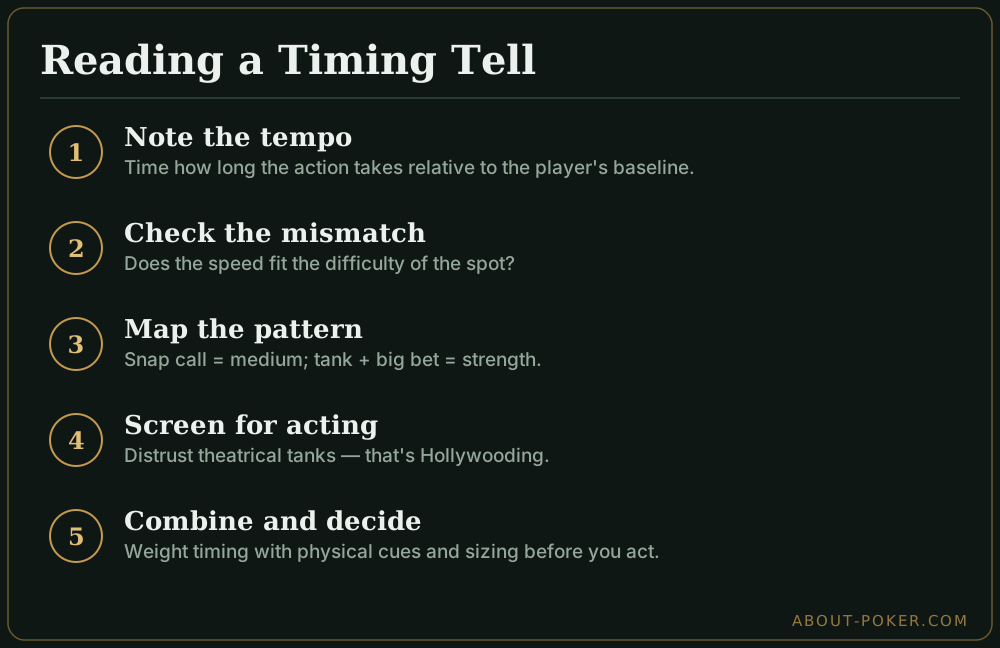
Here are the reliable tendencies for live No-Limit:
- Snap call (instant). Usually a medium-strength hand — a decent pair or a draw the player never considered folding or raising. Strong hands often pause to consider raising; weak hands pause to consider folding; the middle calls fast.
- Snap bet (instant bet or raise). Often a planned, polarized action — either a pre-decided bluff or a hand so strong the decision was automatic. On the river, snap bets lean toward bluffs more often than tanks do.
- Long tank, then a big bet. Frequently strength. Players sizing a max value bet take time, and many act out uncertainty to disguise a monster.
- Long tank, then a check. Often genuine weakness or a marginal hand that could not find a reason to bet.
- Snap check. Usually a hand giving up or a weak holding with no plan to bet.
None of these is absolute, but each is a strong tendency worth weighting.
Worked example: the river tank-shove
You bet the turn with two pair and get called. The river bricks. Your opponent, who has been snap-checking marginal hands all night, suddenly goes deep into the tank — 45 seconds — then announces all-in for a pot-sized bet. Against his baseline of fast, casual actions, this abrupt shift to a long, dramatic tank before a huge bet is a red flag. The tank-then-big-bet pattern skews heavily toward strength; he likely rivered a set or backed into a straight and spent that time calculating how much he could extract. The two pair that looked strong on the turn is now a fold. The tell was not the shove itself — it was the tempo that did not match his all-night baseline.
Manufactured tempo and Hollywooding
Skilled players know timing tells and will fake them — a practice called “Hollywooding.” The classic is the tank-then-shove designed to look like agonized indecision while actually holding the nuts, hoping you read the tank as weakness and call. The counter is the same as with physical tells: an involuntary tell is consistent with the player’s baseline and the situation, while a performance is usually a beat too theatrical or perfectly timed. Distrust drama that seems staged for your benefit.
Online, timing tells behave differently because of pre-action buttons and time banks — if you play both formats, compare with our guide to online timing tells.
Protecting your own timing
The flip side is discipline: do not leak your own tells through tempo. The gold-standard habit is to take a consistent amount of time on every decision, whether you have the nuts or air. Many strong players count silently to a set number before acting, so their tempo is identical across the board. At minimum:
- Do not snap-call with medium hands and tank with big ones — that is the exact pattern opponents exploit.
- Do not speed up when comfortable and slow down when uncomfortable.
- Avoid theatrical tanks; they invite equally theatrical reads.
The full interplay of tempo and sizing is covered in betting and timing tells.
Timing-tell checklist
When a decision feels off, check the clock:
- Does the player’s tempo match the difficulty of the spot?
- Is this faster or slower than their baseline?
- Snap call = medium; snap bet = polarized; long tank + big bet = strength.
- Treat theatrical tanks as possible Hollywooding.
- Weight timing alongside physical cues and betting patterns, never alone.
- Keep your own tempo uniform on every street.
Tempo is one of the few live tells that is genuinely hard to disguise. Read it against the baseline, combine it with the rest of your information, and it becomes one of your sharpest edges at the table.
Frequently asked
What does a snap call usually mean in poker?
A snap call — an instant call with no thought — usually means a medium-strength hand, like a decent pair or a draw, that the player never considered folding or raising. Strong hands often pause to consider raising, and weak hands pause to consider folding, so an instant call sits in the middle.
What does it mean when a player tanks then bets big?
A long tank followed by a large bet is frequently a strong hand or the nuts. The player is often acting out deliberation to appear uncertain, or genuinely calculating the maximum value bet. Snap bets on the river more often represent bluffs or planned, polarized actions.
Are timing tells reliable?
Timing tells are among the more reliable live reads because tempo is hard to fully control, but they must be read against a player's baseline and combined with other information. A single timing cue is a data point, not a verdict.