Poker Tells & Live Play
Poker tells are involuntary patterns that leak information about a hand. Learn what they are, how to read them, and how to hide your own at a live table.
On this page · 8 sections
A poker tell is any habit or reaction that leaks information about a player’s hand. Some are physical — a shaking hand, a glance at chips — others live in how someone bets or talks. Read well, tells turn a guessing game into an edge. Read badly, they cost you money. This hub shows you how to use them sanely.
What a tell actually is
Players make hundreds of small decisions a session, and the brain leaks. A nervous player with a monster hand may freeze to avoid “scaring off” the action. A player on a bluff may overact relaxation. These slips are tells: signals you didn’t mean to send.
The honest version of the topic — the one most marketing skips — is that tells are noisy. People differ, the same person differs day to day, and good players fake them on purpose. So you never play a tell as a certainty. You play it as a nudge to a probability you already hold.
That framing matters enough to repeat: a tell shifts your estimate, it doesn’t replace it. If your read says a player is likely strong and a tell agrees, lean in. If the tell contradicts strong evidence, distrust the tell first.
Common poker tells and what they usually mean
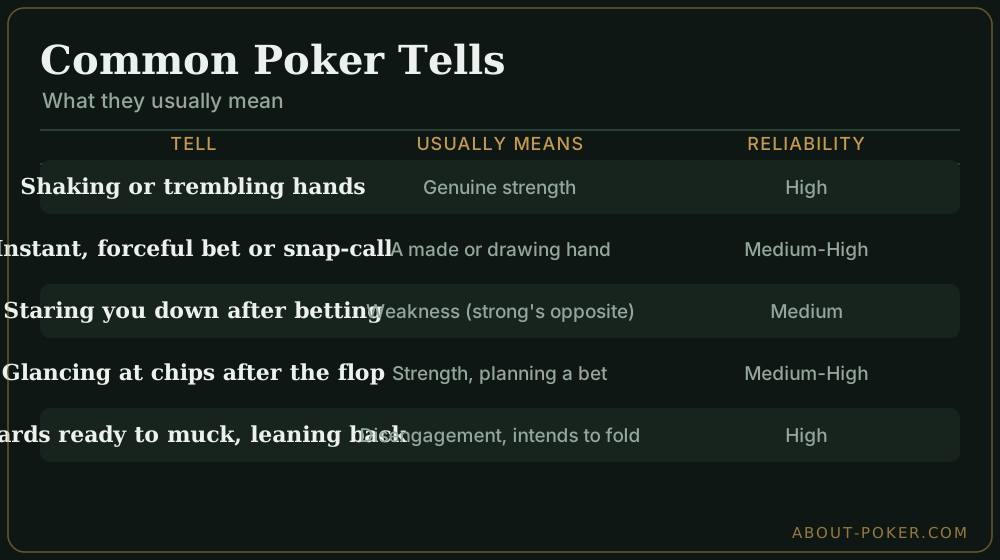
Here are the specific tells you’ll actually see at a live or online table, the most common meaning, and how much you should trust each one. “Reliability” is a rough guide only — always weigh it against the player’s baseline and the betting story.
| Tell | What it usually means | Reliability |
|---|---|---|
| Shaking or trembling hands | Genuine strength — adrenaline from a big hand, not nerves from a bluff | High |
| Instant, forceful bet or snap-call | A made hand or a drawing hand already decided on; rarely a tanked bluff | Medium–High |
| Long tank, then a bet | Often a genuine tough spot or a strong hand acting reluctant; a tank before calling leans weak/drawing | Medium |
| Staring you down after betting | Weakness — an attempt to look strong and discourage a call (weak means strong’s opposite) | Medium |
| Staring at the board / avoiding eye contact | Strength — a made hand quietly protecting the action | Medium |
| Glancing at chips after seeing cards or the flop | Strength — subconsciously planning a bet | Medium–High |
| Sudden talkativeness or friendly chatter | Relaxation, usually a strong or comfortable holding; silence often signals a bluff | Low–Medium |
| Verbal “I guess I’ll call” / feigned reluctance | Weak means strong — reluctant callers are often trapping | Medium |
| Overacting disappointment at the flop | The flop likely helped them; genuine misses draw little reaction | Medium |
| Holding cards ready to muck / leaning back | Disengagement — they intend to fold | High |
| (Online) Instant check | Weakness — an auto-check button clicked with air | Medium |
| (Online) Long delay then raise | Often genuine strength, not a tough decision — the delay is for effect or multi-tabling | Medium |
Two categories deserve a note because they travel across formats. Verbal tells are among the most trustworthy physical tells, precisely because talking is voluntary and most players stay quiet under real pressure — a chatty opponent is usually comfortable, and the classic “weak means strong” reluctant call (“well… okay, I call”) is a frequent trap. Online timing tells replace body language entirely: an instant check usually means a hand gave up, a snap-call signals a drawing or capped hand, and an unusually long pause before a big raise is more often theatrical strength than a genuine dilemma.
How the tells-live silo fits together
This pillar is split into focused guides. Read them in roughly this order.
| Guide | What it covers | Best for |
|---|---|---|
| How to read poker tells | A repeatable process: baseline, deviation, context | Building the core skill |
| Common physical tells | The classic body-language signals and what they usually mean | Knowing what to watch |
| Betting & timing tells | The most reliable category — bet sizing, snap-calls, tanks | Players who want real edges |
| Keeping a poker face | Hiding your own information | Plugging your leaks |
The one heuristic everyone quotes
“Weak means strong, strong means weak.” When a player acts disappointed or weak, they’re often strong; when they act confident or aggressive in their demeanor, they’re often weak. It exists because people unconsciously try to steer your decision, and overacting is the result.
It’s a useful starting bias against thinking opponents — and a trap against everyone else. Beginners often have no act at all: their weakness is real weakness. So the heuristic is a hypothesis to test against the player in front of you, never an automatic answer. We unpack it fully in the betting and timing guide.
Why betting patterns win
A physical tic can mean a dozen things. A bet has a number attached and a decision behind it. When someone three-bets large on a dry board, checks back the turn, then bombs the river, that sequence narrows their range far more sharply than any sigh.
That’s why online players — who see no faces — still crush. They read bet sizing, timing, and frequencies. Concepts like position and pot odds carry more weight, hand to hand, than the entire body-language canon. If you’re choosing where to spend study time, spend it on why position matters and on bet-pattern reading first.
Tells are not a substitute for fundamentals
You can’t out-read bad fundamentals. Hand selection, position, pot odds, and bet sizing decide most pots before a single tell enters the picture. Tells are a tie-breaker on close decisions and a confirmation on clear ones.
If you’re newer, build the base first: learn the hand rankings, the rules of play, and the structure of Texas Hold’em. Then layer reading on top. A strong fundamental player with mediocre reads beats a “psychic” with leaky fundamentals every time.
Responsible play
Poker involves risk and money. Nothing here guarantees results — tells reduce uncertainty, they don’t remove it. Play within a bankroll you can afford to lose, and treat the edge tells give you as marginal, because it usually is.
Where to start
If you take one action from this page: start watching how opponents bet before you study how they sit. Then build the habit of baselining each player. Begin with how to read poker tells, keep the common tells table handy, and shore up your own game with a solid poker face.
Frequently asked
What is a poker tell?
A poker tell is any behavior — physical, verbal, or betting-related — that gives away information about a player's hand or intentions. Most are involuntary and unconscious.
Are poker tells reliable?
Tells are probabilistic clues, not certainties. Any single tell can be a fluke or a deliberate act, so treat them as small adjustments to a read built mostly on betting patterns.
What is the most reliable poker tell?
Betting and timing patterns are the most reliable, because they're tied directly to decisions. Physical tics are noisier and easier to fake.
Can you play winning poker online without tells?
Yes. Online play removes physical tells entirely, so winning players rely on bet sizing, timing, and statistical reads instead.