When to Quit a Live Session
Learn exactly when to quit a live poker session — stop-loss rules, tilt signals, fatigue, and game quality. A clear framework so you leave a winner more often.
On this page · 7 sections
Knowing when to quit a live poker session is one of the highest-value skills a winning player can build, and it has almost nothing to do with luck. Your long-run results are the sum of the edges you take and the edges you give away. A great session played two hours too long, when you are tired or tilted or the good players have left, can erase an entire night of profit. The goal is simple: keep playing while you have an edge and stop when you do not.
The three questions that decide it
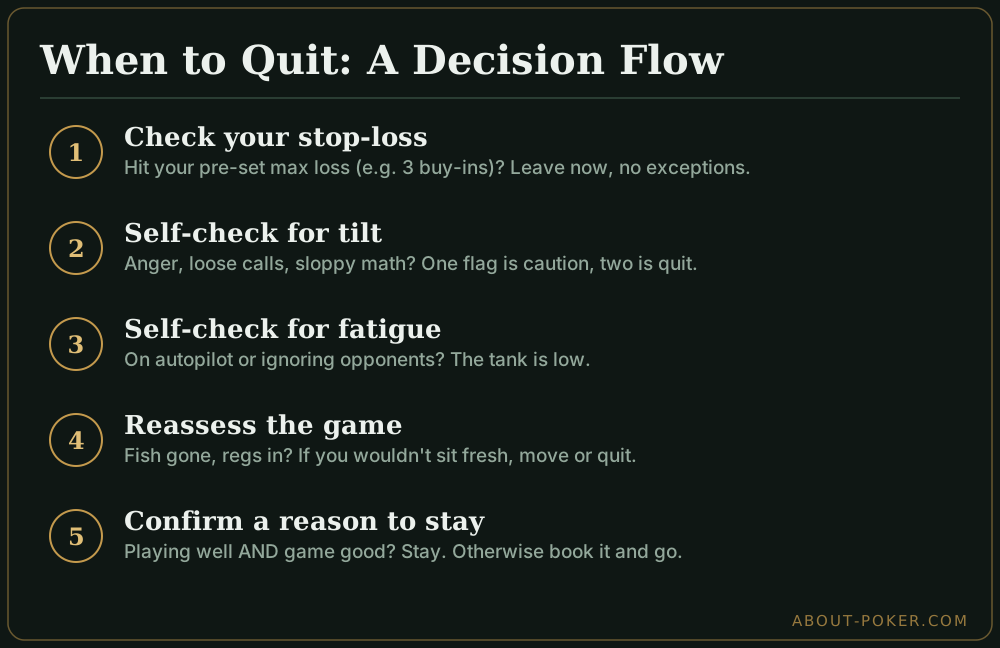
Every time you consider quitting, ask three things: Am I still playing my best? Is the game still good? Do I have a real reason to be here? If the answer to any of the first two is no, you should be leaving. The third question is about your own limits — bankroll, sleep, life obligations. You do not need all three to line up perfectly to keep playing, but if two of them turn against you, get up.
Notice that “am I winning tonight?” is not on that list. Your stack size for the session is close to irrelevant to whether staying is correct. A player up three buy-ins in a table full of nits should probably leave; a player down two buy-ins in a table full of drunk gamblers should probably stay. The money already on the table is a sunk result. What matters is your expected edge for the next hour.
Set a stop-loss before you sit down
A stop-loss is a pre-committed maximum you will lose before you quit for the day. Decide it while calm, ideally at home, not at the table with your judgment clouded. A common structure for a cash grinder is three buy-ins. If you buy in for 200 big blinds, a three-buy-in stop-loss means you leave once you are down 600 big blinds, no exceptions.
The purpose is not the exact number — it is removing the decision from your emotional in-the-moment brain. Tilt is very good at inventing reasons to stay: “I’m due,” “these guys are terrible,” “one more orbit.” A stop-loss you set in advance is a commitment device that beats your future compromised self. Many players who master managing a big live session will tell you the stop-loss is the single rule they never break.
Watch for tilt and fatigue signals
Long before your stack disappears, your play degrades in ways that are hard to feel from the inside. Learn your personal warning signs. Common ones: you stop counting the pot before betting, you start calling river bets “to see it,” you feel a hot flush of anger after a bad beat, you find yourself opening hands you would normally fold, or you notice you have not really looked at your opponents in twenty minutes. Any one of these is a yellow flag. Two at once is a red flag.
Fatigue is sneakier than tilt because it feels like nothing. You do not get angry — you just get slightly worse at everything. Reading a board, sizing a value bet, holding your composure and keeping a poker face all cost mental energy, and that energy is a finite tank. When you catch yourself on autopilot, that is your brain telling you the tank is low.
Game quality: leave when the fish leave
Live games change constantly. The recreational player who was splashing chips busts and goes home. A tight regular takes his seat. Two loose players leave and the table quietly becomes a lineup of grinders trading rake. When the composition shifts against you, your win rate can drop from strongly positive to negative without a single card being dealt.
Get in the habit of reassessing the table every time a seat changes. Ask honestly: if I walked into this exact game right now, would I sit down? If the answer is no, the only reason you are still there is inertia. That is not a poker reason. Consider a table change first — but if the whole room has tightened up, quitting is the right move. Our guide to live poker tips covers how to scout for the softest game in the room.
A worked example
You sit down at a 1/2 no-limit game with a 300 dollar buy-in and a pre-set stop-loss of two buy-ins, so 600 dollars. For three hours the game is a dream: two players are gambling wildly and you grind up to 720 dollars, well over a full buy-in in profit. Then both loose players rack up and leave. The two open seats fill with quiet regulars who min-defend and never pay off. You also notice it is now past midnight, you have an early morning, and you just angrily called a river you knew was beat.
Run the three questions. Playing your best? No — that angry call was tilt and you are tired. Game still good? No — the fish left and regs replaced them. Real reason to stay? No — you have an early start. That is a clean quit. You rack up 720 dollars, book the win, and go home. The temptation to “give the regs a chance to pay me off” is exactly the trap that turns winning nights into break-even ones.
Reasons that are NOT good reasons to quit or stay
Beginners often quit for the wrong reasons and stay for worse ones. Do not quit just because you took one bad beat, because you are slightly stuck, or because you hit an arbitrary time you set with no basis. Do not stay just because you want to “get even,” because you are running hot and feel invincible (variance does not owe you a continuation), or because your friends are still playing.
The discipline of quitting well is unglamorous and it will feel, in the moment, like you are leaving money on the table. You are not. You are protecting the edge you spent hours building — and you are showing up for the next session fresh instead of stewing over a decision you made at 2 a.m. when you should have been in bed.
Quick pre-quit checklist
Before every session, write down your stop-loss and a rough time ceiling. During the session, reassess the table on every seat change and do a quick self-check every hour: anger, autopilot, sloppy math. When you hit your stop-loss, quit — no negotiating. When the game turns and you would not sit down fresh, quit or move. When you catch a second tilt or fatigue signal, quit even if you are winning. Booking a win in a good spot is a skill, and the players who do it consistently are the ones with the fattest bankrolls over a year.
Frequently asked
Should I quit when I'm stuck in a live session?
Being stuck is not a reason to quit by itself, and it is not a reason to stay either. Quit if you have hit your stop-loss, if you are tilting, or if the game has gotten tough. Stay only if you are playing well and the game is still good. Chasing losses because you are stuck is one of the most expensive habits in poker.
Is there a best time to leave a poker game?
The best time to leave is while the game is still soft and you are still sharp — often earlier than you want to. Weak players bust or leave, tables tighten up late at night, and your own focus fades after several hours. Booking a win in a good game beats grinding a marginal one.
How long should a live poker session be?
There is no fixed number, but most players lose their A-game somewhere between four and seven hours. Track when your decisions start to slip — misreading bet sizes, autopiloting, splashing into marginal pots — and treat that as your personal ceiling rather than a clock.