Live Poker Betting Procedures
A clear guide to live poker betting procedures — verbal declarations, minimum raises, string bets, all-ins, and acting in turn — so you never misfire a bet.
On this page · 7 sections
Betting in live poker follows a set of procedures that keep the game fair, countable, and dispute-free. Online, the software enforces all of this for you; live, you enforce it yourself, and a single sloppy bet can cost you a pot on a technicality. This guide covers the rules that govern how bets are made, sized, and declared at a live No-Limit table.
Act in turn, one player at a time
Action moves clockwise, starting left of the big blind preflop and left of the button on later streets. You may only act when it is your turn. Acting out of turn — folding early, reaching for chips, or announcing a bet before the players ahead of you have acted — leaks information and can be penalized.
There is a wrinkle: if you act out of turn and the action in front of you does not change (everyone folds or checks to you), your action may be held binding. But if someone raises before your turn, your premature action is void and you regain full choice. The lesson is simple — wait for the dealer’s eyes on you before you do anything.
Verbal declarations are king
A clear verbal statement made in turn is binding and overrides your chips. If you say “raise,” you must raise; if you say “call,” that stands even if you push in the wrong amount. This is a feature, not a trap:
- Announce before you touch chips. “Raise to fifty” removes all ambiguity and cannot be ruled a string bet.
- Be precise. Say the total you are making it, not the amount you are adding. “Make it fifty” means the bet is now $50 total.
Verbal declarations also protect your bet mechanics — see our guide to handling chips at the table for the physical side.
Bet sizing: minimums and increments
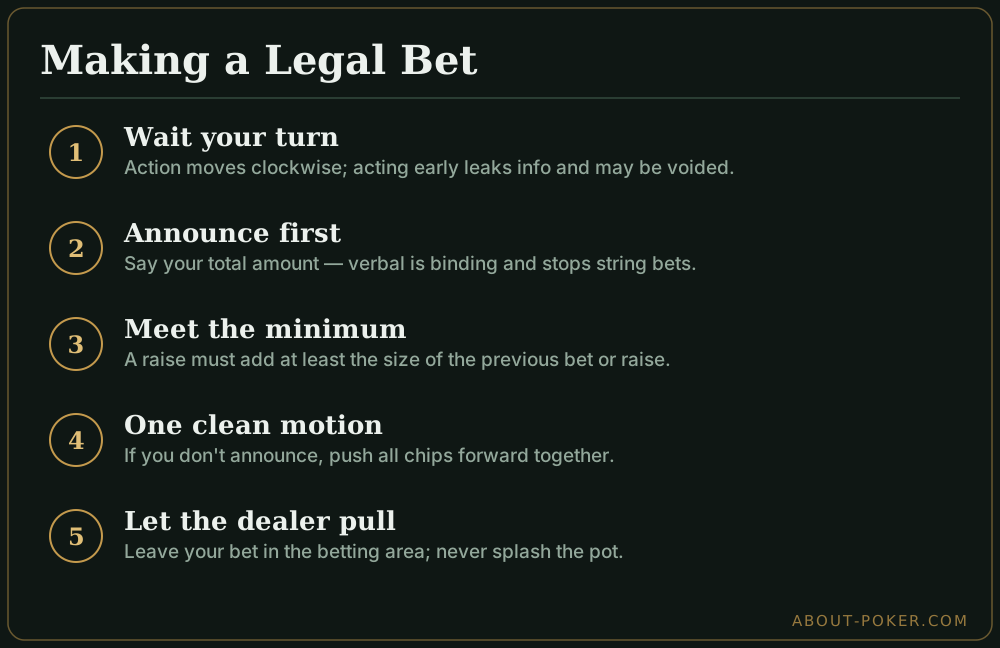
Two numbers govern legal bets in No-Limit:
- Minimum bet. On any street with no prior bet, the minimum bet is the size of the big blind. At $1/$2, the minimum bet is $2.
- Minimum raise. A raise must be at least the size of the previous bet or raise. If the bet is $10, the minimum raise makes it $20. If a player raised from $10 to $30 (a $20 increment), the next raise must add at least $20, making it $50.
There is no maximum in No-Limit — you can move all in at any time.
Worked example: sizing a re-raise correctly
The blinds are $1/$2. Preflop, the under-the-gun player opens to $8. You are next and want to three-bet. What is legal? The previous “raise increment” is $6 (from the $2 big blind up to $8). So your minimum re-raise must add at least $6 more — making it $14 total. In practice you would size larger, say $24-$28, for strategic reasons, but $14 is the legal floor. Now suppose a player behind you cold-four-bets from $8 to $24 (a $16 increment); the next legal raise must add at least $16, making it $40. Getting these increments wrong forces the dealer to correct your bet, which both slows the game and telegraphs inexperience.
String bets and single-motion rule
A string bet is pushing chips forward, then going back for more without having announced the amount. Only the first motion counts. Avoid it by either announcing the amount first or moving all your chips forward in one clean motion. This is the most common procedural mistake beginners make and the easiest to fix — just declare before you bet.
All-ins, side pots, and calling
A few more procedures round out the rules:
- All-in. You can bet all your chips at any time. If your all-in raise is less than a full minimum raise, it may not reopen the betting for players who already acted (an “incomplete raise”).
- Side pots. When a player is all-in for less than others, the dealer creates a main pot they can win and a side pot for the remaining bettors. The dealer manages this automatically.
- Calling. To call, match the current bet. You can announce “call” or simply put the correct amount into your betting area. Do not splash the pot.
These procedures are part of the wider ruleset covered in live poker rules, and the etiquette around them lives in poker etiquette rules.
Betting-procedure checklist
Before every action, remember:
- Wait for your turn — never act out of turn.
- Announce your action verbally before touching chips.
- Know the minimum raise: at least the size of the previous bet or raise.
- Move chips forward in one motion if you do not announce.
- State totals, not add-ons, when declaring an amount.
- Leave your bet in your betting area for the dealer to pull.
Nail these and your bets will always stand as intended — no corrections, no string-bet rulings, and no free information handed to the table.
Frequently asked
What is the minimum raise in No-Limit poker?
A minimum raise must be at least the size of the previous bet or raise. If the bet is $10 and it's the first raise, the minimum you can make it is $20. If someone raised from $10 to $30, the next raise must be to at least $50 — an increment of $20.
Are verbal declarations binding in live poker?
Yes. If you clearly announce 'raise,' 'call,' 'fold,' or a specific amount in turn, that declaration is binding and takes priority over your chips. Verbal declarations are the safest way to bet because they prevent string-bet and amount disputes.
What happens if I act out of turn?
An out-of-turn action may be binding if the action in front of you does not change. If a player between you raises before your turn, your premature action is voided and you may act however you like. Either way, acting out of turn gives away information, so wait for your turn.