Requesting a Table Change
How to request a table change in a live poker room — the procedure, when to use it, and how to move to a softer game without breaking etiquette. A practical guide.
On this page · 6 sections
Requesting a table change is one of the simplest tools in live poker, and one of the most underused by newer players. If your table is full of tough regulars, if you have an awkward history with someone in the seat next to you, or if you just want a fresh start, you can ask to move. It costs nothing, it is completely accepted, and over a year it can meaningfully raise your win rate. Here is exactly how it works and when to pull the trigger.
What a table change actually is
In a poker room that spreads more than one table of the same game and stake, players can move between those tables as seats open. A table change (sometimes shown as a “T/C” or “table change button” on the floor’s list) is a request to be moved to the next available seat in your game. You keep your entire stack — you do not cash out and re-buy — and you keep your accumulated time toward any promotions in most rooms. You simply pick up your chips and carry them to the new seat when your name is called.
This is different from a “must-move” table, which some rooms use to keep their main game full. On a must-move, you are required to move to the main table when a seat opens there, whether you like it or not. A voluntary table change is the opposite: it is entirely your choice.
The procedure, step by step
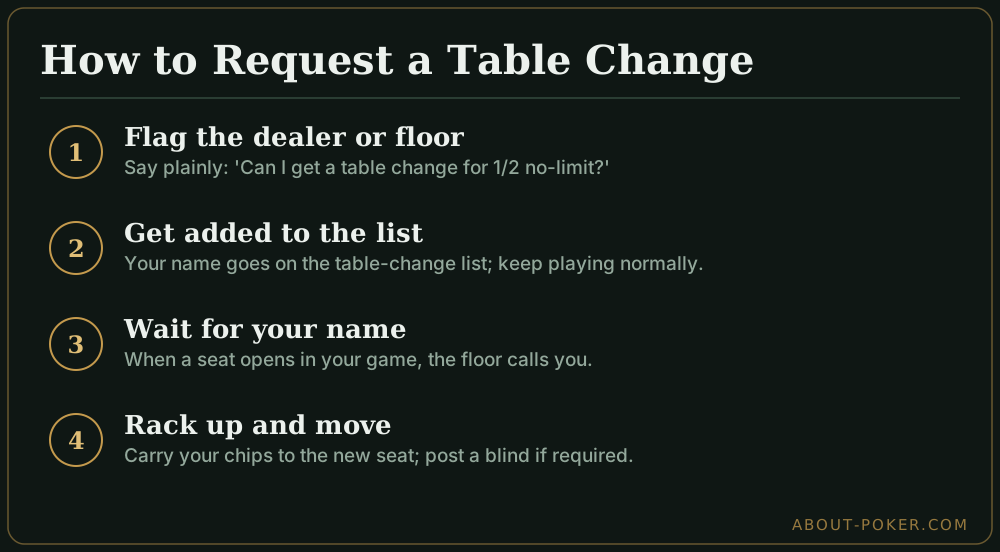
The mechanics are quick. Get the attention of your dealer or wave over a floorperson and say, plainly, “Can I get a table change for 1/2 no-limit?” The floor adds your name to the table-change list for that game. You keep playing normally at your current table. When a seat opens at another table of the same game, the floor calls your name — “table change for Alex, table 12, seat 4” — and you rack your chips and move. If you would rather not carry loose chips, ask the dealer for a rack.
That is the whole process. There is no fee, no need to explain yourself, and nothing announced to your tablemates about your reasons. If you are unsure whether a room even offers table changes, or how a specific procedure works, that is a normal thing to ask the floor — our guide to calling the floor, when and how covers how to flag them down without disrupting the game.
When you should request one
The strongest reason to move is game quality. If you look around your table and see six players who all clearly know what they are doing — tight opens, correct sizings, no one paying off — your edge is thin at best. Meanwhile another table in the room might have two players gambling every hand. Moving toward the softer game is pure profit. Learning to scout the room for the best seat is a core live skill, and our live poker tips guide goes deeper on reading a lineup before you commit.
Other good reasons: a specific opponent has your number or is needling you and it is affecting your play; you are seated with a friend and want to avoid the awkwardness of playing pots against them; the player directly to your left is aggressive and has position on you all night; or the physical seat is uncomfortable and it is wearing on your focus. Any of these is reason enough. You never need to justify a table change to anyone.
A worked example
You are playing 2/5 no-limit at table 8. After an hour you realize the lineup is brutal: five regulars you recognize, all of them tight and tricky, and the one recreational player just busted and left. Your realistic win rate here has quietly turned negative. You glance at table 3 across the room and notice a very different picture — several stacks of varying sizes, loud table talk, players limping and splashing.
You catch the dealer between hands and say, “Table change for 2/5, please.” Your name goes on the list. Twelve minutes later the floor calls, “Table change, seat open at table 3.” You rack your 620 dollars, walk over, and sit down in a game where the two loosest players are stacking off with second pair. You did not gamble, you did not tilt, and you did not quit for the night — you simply relocated your edge. That single decision can be worth more than a dozen well-played hands.
Etiquette and the small print
A table change is polite by default, but a few courtesies keep it clean. Move promptly when your name is called so you do not hold up either game. Rack your chips neatly rather than juggling loose stacks across the room. Do not announce loudly why you are leaving — saying “this table’s too tough, I’m out” is both bad manners and free information for the players you are leaving behind. Just go. For the broader picture of how to carry yourself, see our poker etiquette rules.
Be aware of a couple of room-specific rules. Some rooms require you to post a blind when you sit at the new table if you would be skipping the blinds by moving; ask the dealer if you are unsure. And in a room using a must-move table, understand that you may be moved involuntarily to keep the main game full — that is not the same as your voluntary request.
Quick reference checklist
Before you ask: confirm the room spreads more than one table of your exact game and stake, because you can only be moved within the same game. To request: tell the dealer or floor “table change for [stake],” keep playing, and wait for your name. When called: rack up, move promptly, and post any required blind at the new seat. The bigger lesson is a mindset one — treat your seat as a business decision, not a permanent home. The next open seat might be the softest game in the building.
Frequently asked
How do I request a table change in a poker room?
Tell the dealer or a floorperson that you want a table change for your game and stake. They add you to the table-change (or 'must-move') list, and you keep your seat and stack until a seat opens at another table of the same game. When a seat frees up, the floor calls your name and you move with your chips.
Is it rude to ask for a table change?
No. Requesting a table change is a completely standard, accepted part of live poker. You are allowed to move for any reason — a tough lineup, a personal conflict with a player, or just wanting a fresh seat. You do not owe anyone an explanation, and no one at your table is told why you left.
Can I change tables to find a softer game?
Yes, and good players do it routinely. Moving away from a table full of strong regulars toward a looser, more recreational game is one of the easiest ways to raise your win rate. Just remember you cannot pick your exact new table — you take the next open seat in your game.