Straddles and Live Game Rules
Straddles and live game rules explained — how the straddle works, the button and Mississippi variants, when straddling is worth it, and the etiquette.
On this page · 6 sections
Straddles and live game rules cover one of the most distinctive features of a card room: the voluntary blind bet that supercharges a hand. A straddle is an optional wager, typically double the big blind, posted before any cards are dealt. It raises the effective stakes, shifts the action order, and changes the strategy of the whole table for one hand. Understanding how straddles work — and when they’re a trap — is essential once you move past the basics of a live session.
What a straddle is
A straddle is a blind raise posted in the dark, before you see your cards. The standard version comes from the player under the gun (UTG), immediately to the left of the big blind, and is exactly twice the big blind. At a $1/$2 game, a UTG straddle makes it $4 to play, effectively turning the game into $1/$2 with a $4 blind for that hand.
Because the straddle acts as a raise, everyone must call $4 to enter, and the straddler earns the right to act last preflop — the same positional privilege the big blind normally holds. Straddling is always voluntary, and whether it’s allowed at all is set by house rules, which you can confirm at the desk during your first casino poker session.
Straddle variants
The under-the-gun straddle is the default: UTG posts 2x the big blind and gets last preflop action. Simple and most common.
The button straddle lets the player on the button post the straddle instead. This one reshuffles the order — the button straddle gives the button last action preflop, which many players love because the button already has the best position. Some rooms allow it, some don’t.
The Mississippi straddle allows any position (often the button or cutoff) to straddle, with preflop action then starting to the left of the straddler. Rules vary widely by room, so ask before you post one. The overarching point is that straddles interact with turn order, so they sit squarely within the broader live poker rules framework.
When straddling is worth it
In a vacuum, straddling is a losing play. You’re posting a blind bet out of position (in the UTG case) with two random cards, committing money before you have any information. Over time that bleeds chips.
Straddling makes sense for a few specific reasons. First, to increase stakes: if you’re a strong player at a table of weaker ones and want bigger pots, a straddle deepens the game in chip terms and magnifies your skill edge — provided your opponents play worse in inflated pots, which recreational players usually do. Second, to match table dynamics: at a loose, action-heavy table where everyone straddles, refusing can leave you card-dead while pots balloon. Third, the button straddle specifically can be worth it because you buy last action in the best seat.
If you’re a beginner or a tight player, the correct default is simple: don’t straddle. Let the players who straddle donate the dead money.
A worked example
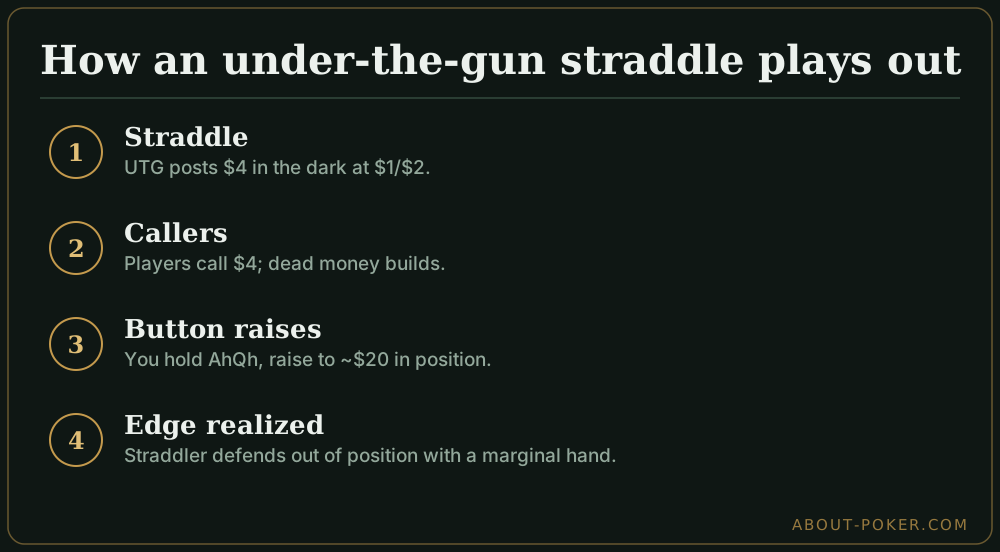
You’re at $1/$2 with $300 effective stacks. The UTG player straddles to $4. You’re on the button with Ah-Qh. Three players call the $4 straddle, and action reaches you.
With a strong, position-friendly hand and dead money already in the pot (the blinds plus four callers of $4), this is a clear raise. You make it around $20 — roughly the straddle plus one big blind per caller. The blinds and most limpers fold; the straddler, priced in and out of position, calls with a marginal hand.
You’ve turned the straddle to your advantage: the extra blind inflated the pot, and your positional and hand-strength edge now plays for more chips. Note the contrast — the straddler posted $4 blind with unknown cards and is now defending out of position, exactly the losing pattern that makes straddling a poor play for the person posting it, and a profitable pot for a disciplined button. Ah-Qh is a comfortable favorite over the random hands a straddle-defender typically shows up with.
Etiquette and house rules
A few courtesies. Post your straddle clearly and before the deal — announce “straddle” and put out the chips so the dealer and table know. Don’t try to straddle out of an unauthorized position; ask the floor if you’re unsure whether button or Mississippi straddles are permitted. Once a table agrees to a straddle format, follow it consistently rather than switching mid-orbit and causing confusion.
Also know the rake and stakes implications: a straddle can push a hand’s pot into a higher rake bracket, and it changes the effective stakes for everyone. If you’re on a fixed budget, factor that in before joining a straddle-heavy table.
Quick checklist
A straddle is an optional blind bet, usually 2x the big blind, posted before the deal. The UTG straddle gets last preflop action; button and Mississippi variants change the order and need house approval. Straddling is generally a losing play for the poster — do it to inflate stakes against weak opponents or to buy position on the button, not by default. Announce it clearly, confirm house rules, and if you’re new, simply don’t straddle.
Frequently asked
What is a straddle in poker?
A straddle is a voluntary blind bet, usually double the big blind, posted before the cards are dealt — most often by the player under the gun, immediately left of the big blind. It buys the last action preflop and inflates the stakes for that hand.
Is a straddle mandatory?
No. Straddling is always optional. Some tables have a rule that straddling must be consistent once started, but in most cash games you choose hand by hand whether to post one. House rules govern whether straddles are even allowed at a given table.
Does the straddle get last action preflop?
In a standard under-the-gun straddle, yes — the straddler acts last preflop, just as the big blind normally would, because the straddle functions as a raise that others must call. A button straddle changes the order so the button acts last preflop.
Is straddling a good idea?
Usually not for the straddler. Posting a blind out of position with random cards is a losing play in a vacuum. Straddling makes sense mainly to increase stakes, exploit weak opponents who play badly in bigger pots, or match a loose table's dynamic with position.