Drilling Preflop Ranges
How to drill preflop ranges until they're automatic: chunk by position, use active recall and a trainer, and lock them in with spaced repetition. Worked plan inside.
On this page · 7 sections
Preflop is the most repeated, most memorizable, and most fixable part of poker — which makes range drilling the highest-return study you can do. A player who knows their ranges cold avoids a huge share of losing spots before a single card hits the flop. But re-reading a chart until it “feels familiar” doesn’t work. Here’s how to drill ranges so they become genuinely automatic.
Why re-reading charts fails
Recognizing a chart when you see it is not the same as recalling the right action when you’re under the gun with the clock ticking and no chart in sight. Familiarity is a trap: it feels like learning but fades within days. Two principles make drilling beat passive review:
- Active recall. Retrieving an answer from memory strengthens it far more than re-reading it. The effort is the learning.
- Spacing. Reviewing right before you’d forget forces that effortful retrieval and pushes the memory into long-term storage.
So the whole game is to test yourself repeatedly, spaced out over time, not to stare at the grid.
Chunk by position and action
Don’t try to swallow a whole range set at once. Break it into small, testable units — one position and one action at a time. A sensible order, by how often the spot arises and how much it costs:
- Opening ranges, position by position (button and cutoff first — you’re in them constantly).
- Responses to a raise: which hands call and which 3-bet.
- Blind defense: what to defend and how against different open sizes.
Master one chunk to automaticity before adding the next. Small wins compound, and a half-learned pile of ranges is worse than a few learned cold. Reliable, solver-checked starting charts from preflop chart tools give you a trustworthy source to drill against.
Focus on the borderline hands
The middle of a range is easy — everyone knows to open aces and fold seven-deuce. Money is won and lost on the edges: is K9 offsuit an open from the cutoff? Does A5 suited 3-bet or fold to a raise? Do you defend Q7 offsuit in the big blind against a min-raise? Drill the borderline hands hardest, because those are the decisions that actually vary between winning and losing players. Flag every borderline hand you miss and give it extra reps.
Use a trainer and active recall
The most efficient way to build recall is a tool that quizzes you under a clock, exactly like the table does. A GTO trainer app or a preflop-specific drill deals you a hand and position, makes you choose an action, and instantly tells you if you were right. That instant feedback plus the time pressure trains the precise skill you need in-game. Fifteen focused minutes of this beats an hour of chart-gazing.
Lock it in with spaced repetition
Drilling gets a range into short-term memory; spacing keeps it there. Turn each position-and-action chunk into flashcards and review them at expanding intervals — a day, then a few days, then weeks — always just before you’d forget. Spaced repetition for poker study is purpose-built for this: it schedules the reviews for you, so maintaining a full range set costs only a few minutes a week once it’s locked in.
A worked two-week drill plan
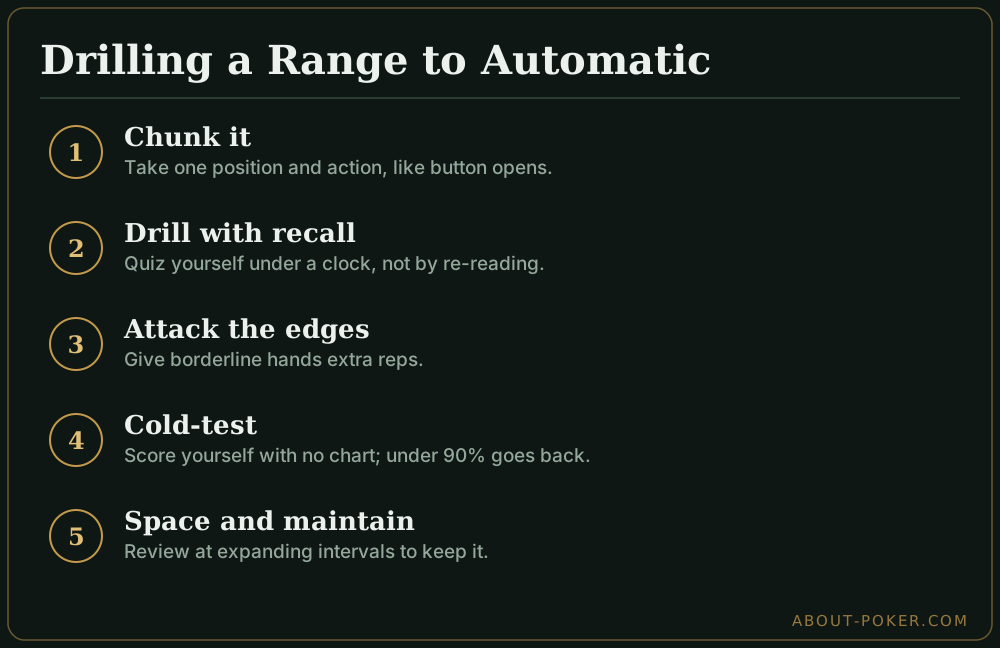
Say you want the button and cutoff open ranges automatic. A tight plan:
- Days 1–3: Drill button opens only, ~15 min/day. Note every borderline miss (e.g. K8s, A7o, 54s).
- Days 4–6: Add cutoff opens; keep a short button refresh at the start of each session.
- Day 7: Test yourself cold — no chart. Score yourself; anything under ~90% goes back into the deck.
- Days 8–10: Drill the two positions mixed, so you can’t autopilot by knowing which one is coming.
- Days 11–13: Spaced review only — clear due flashcards, extra reps on borderline hands.
- Day 14: Final cold test. Both ranges should now feel automatic; move them to a long maintenance interval and start the next chunk.
Two focused weeks turns two full opening ranges from “I think so” into instant recall — and you’ve built a repeatable process for every remaining position.
A drilling checklist
- Chunk ranges by position and action; master one at a time.
- Drill borderline hands hardest — that’s where money moves.
- Use active recall under a clock, not passive re-reading.
- Space your reviews so memory survives to the table.
- Cold-test each chunk before moving on, and maintain with quick weekly reviews.
Frequently asked
How do I memorize preflop ranges fast?
Break ranges into small, testable chunks — one position and action at a time — turn each into a drill, and test yourself with active recall rather than re-reading a chart. Then review on a spaced schedule so the memory sticks. Chunking plus testing plus spacing is far faster than staring at a full chart.
What order should I learn preflop ranges in?
Start with the ranges that come up most and cost the most: your opening ranges from each position, then your responses to a raise (call and 3-bet), then blind defense. Master the button and cutoff opens early — you're in these spots constantly.
How long until preflop ranges become automatic?
With daily active-recall drills and spaced review, core opening ranges typically feel automatic within a few weeks. Maintenance then takes only a few minutes a week as the review intervals stretch out.
Should I drill exact ranges or general rules?
Both. Memorize the borderline hands exactly — they're where money is won and lost — but also learn the underlying logic so you can adjust ranges by position, stack depth, and opponent. Rote memory plus understanding is more robust than either alone.