Fold Equity Calculators: Make Your Bluffs Add Up
A fold equity calculator tells you whether a bluff or shove profits once you factor in fold frequency and your equity when called. The formulas and a
On this page · 5 sections
A fold equity calculator answers one question: does this bet or shove make money once you account for how often the opponent folds? It takes your fold frequency, the pot, your bet, and the equity your hand keeps when called, and returns a single expected-value number. That number is the line between a disciplined semi-bluff and hopeful chip-flinging.
The reason you need a tool at all is that two different sources of profit are tangled together in every aggressive bet, and they don’t add up in your head cleanly. Untangling them is the whole exercise.
The two profits inside a bet
Most players are comfortable with pot equity: the share of the pot your cards win at showdown. A tool that measures only that is an ordinary poker equity calculator. Fold equity is the second, aggressive half — the money you win before showdown because a hand that would have beaten you folds instead.
A profitable bet stacks the two on top of each other:
- When they fold, you win the current pot immediately, and your cards never matter.
- When they call, you fall back on your pot equity to win at showdown.
A fold equity calculator weighs each branch by how often it happens and hands you the net. Crucially, fold equity only exists when the opponent can fold. Shove into a player who never folds, or get it in with no cards left to come, and your fold equity is zero — only showdown equity counts.
The break-even fold formula
For a pure bluff — a hand with no equity when called — the math collapses to one ratio. You need folds often enough to cover the price you’re laying yourself:
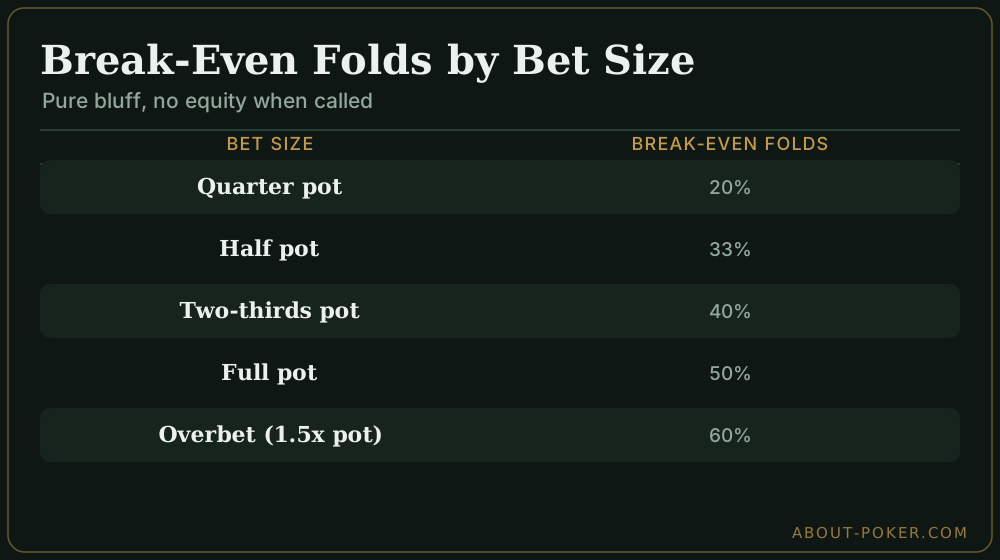
Break-even fold % = bet / (bet + pot)Bet 60 into a 90 pot and you need 60 / (60 + 90) = 40% folds to break even. That single ratio is the backbone of every bluff decision, and it scales predictably with size:
| Bet size | Break-even folds (pure bluff) |
|---|---|
| Quarter pot | 20% |
| Half pot | 33% |
| Two-thirds pot | 40% |
| Full pot | 50% |
| Overbet (1.5× pot) | 60% |
Read that as a menu. A bigger bet demands more folds, but it also wins more when the folds come. If you think an opponent gives up about a third of the time, a half-pot bluff is roughly break-even before any equity, while an overbet is a clear loss. The moment you hold a live draw, though, every one of those thresholds drops — because the call branch is no longer a total write-off.
Adding pot equity: the semi-bluff
Real semi-bluffs keep some equity even when called — a flush draw, an open-ender, a pair of overcards. That equity lowers the fold percentage you need, and it’s where the calculator stops being optional. The full expected value of a shove is:
EV = (fold% × pot) + (call% × [equity × final pot − (1 − equity) × risk])Nobody computes that reliably at the table, which is exactly why it belongs in study. You feed in the pot, your bet, an estimated fold frequency, and your when-called equity; the tool prints the EV. Then you build intuition by watching how the number moves as you nudge each input.
Fold equity calculator
A positive EV means the bet beats checking at these inputs.
It loads with the turn-shove example below already plugged in. Change one input at a time — drop the fold frequency, add a few points of equity — and watch the EV swing so the two profits stop being abstract.
The one above is deliberately minimal, and other well-known tools cover the same math from different angles. Equilab and Flopzilla are the standards for pulling accurate when-called equity against a range, which is the input you’ll then feed into a fold-equity model. PokerCruncher builds explicit fold-equity and EV scenarios on mobile. And a modern GTO solver — GTO Wizard or PioSolver — effectively bakes fold equity into every solved line, showing you the folds a balanced range actually produces rather than the fold you guessed. None replaces a clean read on how often this opponent folds; they sharpen the other inputs around it.
A worked shove
You have a flush draw on the turn. The pot is 100, the effective stack behind is 100, and you shove.
| Input | Value |
|---|---|
| Pot before your bet | 100 |
| Your shove | 100 |
| Equity if called (flush draw) | ~20% |
| Estimated fold frequency | 45% |
Walk the two branches:
- Fold branch (45%): the opponent folds, you win the 100 pot. Contribution:
0.45 × 100= +45. - Call branch (55%): the final pot is 300 and you risk 100 to build it. You win 20% of the time. Contribution:
0.55 × (0.20 × 300 − 0.80 × 100)=0.55 × (60 − 80)=0.55 × −20= −11.
Net EV is about +34 chips compared with checking. Notice what the 20% equity bought you: a pure bluff in this exact spot would have needed 50% folds to break even, but the draw drops the requirement enough that 45% is comfortably profitable. That gap is fold equity and pot equity working together, and it’s invisible until you run the numbers.
A worked non-all-in bet
The shove is the easy case because the hand ends on that street. A partial bet is trickier: money is left behind, and a card is still to come. Say the pot is 100 on the turn, you hold the same flush draw, and you bet 60 rather than shoving.
| Input | Value |
|---|---|
| Pot before your bet | 100 |
| Your bet | 60 |
| Equity if called (one card to come) | ~20% |
| Estimated fold frequency | 40% |
Run the single-street model first, treating a call as if both players check the river:
- Fold branch (40%): you win the 100 pot. Contribution:
0.40 × 100= +40. - Call branch (60%): the pot becomes 220 and you risk 60.
0.60 × (0.20 × 220 − 0.80 × 60)=0.60 × (44 − 48)=0.60 × −4= −2.4.
That’s about +37.6 chips — already a clear win, since 40% folds comfortably clears the 37.5% a pure bluff would need here (60 / 160).
But the single-street number is a floor, and this is exactly where it undersells you. When the flush comes on the river — roughly 20% of the time you’re called — you don’t just win a showdown, you get to bet again and extract more, or fold out a hand that would have checked back and won. That extra river fold equity and value isn’t in the +37.6 at all. Model only the immediate bet and you’ll routinely pass on semi-bluffs that a two-street view shows are plainly profitable.
Where the inputs come from
A calculator is only as honest as what you feed it, and one input is far softer than the rest.
Fold frequency is the guess that matters. Everything else can be measured; this you estimate. Ground it in the opponent’s range, not their single likely hand: how much of what they’d continue with actually beats you and won’t fold? Your feel for that — sharpened by studying postflop patterns — sets the whole calculation. Overestimate folds and every bluff looks profitable on paper.
To anchor that guess, these are rough starting points for how often a single opponent folds to a two-thirds-to-pot bet on a later street. Treat them as a sanity check on your read, not gospel — board texture and stack depth move them several points either way:
| Opponent type | Typical fold to a big bet |
|---|---|
| Calling station / recreational | ~15–25% |
| Straightforward “fit-or-fold” reg | ~45–55% |
| Tight-aggressive, capped range | ~55–65% |
| Nit facing a scary runout | ~65%+ |
Cross-check against the break-even table above. If a fit-or-fold reg gives up around half the time and your two-thirds bet only needs 40% folds, the bluff clears even before any equity — but the same bet against a station is a straight loss unless your draw is doing the heavy lifting.
The other inputs are firmer, but still worth care:
- Get equity from a real tool. Your when-called equity should come from a solver or equity calculator, not a gut read. The fundamentals in how to calculate equity show you how to read it properly.
- Respect blockers. Holding a card that removes value combos from their continuing range genuinely nudges fold frequency in your favor — account for it rather than hand-waving it.
- Remember the streets to come. A calculator that models only the immediate bet undervalues a draw that can fire again profitably on the river. A semi-bluff’s realized equity is often higher than its raw pot equity, so treat a single-street EV as a floor, not the full picture.
Turning the math into a habit
The goal isn’t to run a calculator mid-hand — that’s impossible and, in real time, against the rules everywhere. The goal is to run enough spots away from the table that the ratios become instinct. After a few dozen worked examples you’ll glance at a turn shove and know, roughly, that a half-pot bluff wants a third of the range to fold, that a flush draw shaves several points off that number, and that an overbet into a sticky opponent is usually a trap you’re setting for yourself.
Learn the break-even fold ratio cold first — it’s the most portable number in all of bluffing. Then layer in when-called equity so your semi-bluffs get credit for the times you actually hit. Pair the habit with a general equity calculator and the wider poker tools kit, and your aggression stops being a hope and starts being a decision you can defend.