Off-Table vs On-Table Learning
Off-table study builds knowledge; on-table play builds skill. Learn how to split your time, transfer solver work into real reads, and close the gap between them.
On this page · 6 sections
Every serious poker player eventually hits the same wall: they understand a spot perfectly when they study it, then butcher it at the table an hour later. That gap is the whole story of off-table versus on-table learning. Off-table study builds knowledge. On-table play builds skill. They are not interchangeable, and treating them as the same thing is why so many people study hard and improve slowly.
If you are building a study plan from scratch, pair this with how to study poker for the foundational structure. Here we focus on the split itself and, more importantly, on the bridge between the two.
What off-table learning actually does
Off-table study is where you acquire correct information. Solvers, range charts, database reviews, and training videos all live here. The defining feature is that you have unlimited time and access to answers. You can pause, rewind, run a solve, and check whether your instinct matched the equilibrium.
This is where you learn that ace-king suited is roughly a coin flip against a pair (about 46% versus a pair like queens), that a continuation bet needs fold equity plus equity to profit, and which turn cards let you barrel. Off-table work is efficient at loading facts into your head. What it cannot do is teach you to retrieve those facts under pressure.
What on-table learning actually does
On-table play is where knowledge is stress-tested and where a different set of skills forms: reading timing tells, managing tilt, tracking a specific opponent’s tendencies, and making decisions in the seven seconds the timer gives you. No amount of solving teaches you how it feels to fire a third barrel bluff into an unknown for your stack. That composure is a skill, and skills are built only through repetition under real conditions.
The catch is that play alone reinforces whatever you already do, right or wrong. Ten thousand hands of the same leak just carves the leak deeper. Play becomes learning only when it feeds an off-table review loop.
A worked example of the transfer gap
Imagine you study button versus big blind single-raised pots for a week. You learn the solver checks back a lot of the flop as the preflop raiser on low, connected boards to protect its checking range. You nod. You get it.
Then you sit down, raise the button with king-queen, the big blind calls, and the flop comes 7-6-5 with two hearts. Your studied answer is to check a chunk of your range here, including some overcards. But in the moment, you feel the urge to c-bet because you “have two big cards.” You bet, get raised, and fold.
The knowledge was there. The retrieval failed. Closing that gap is the actual job, and it has three parts: simplify the study into a rule you can recall (“on low connected boards out of position for the caller, I check most of my range as the raiser”), rehearse it, and review the specific hands where you defaulted to the old habit.
Building the bridge between them
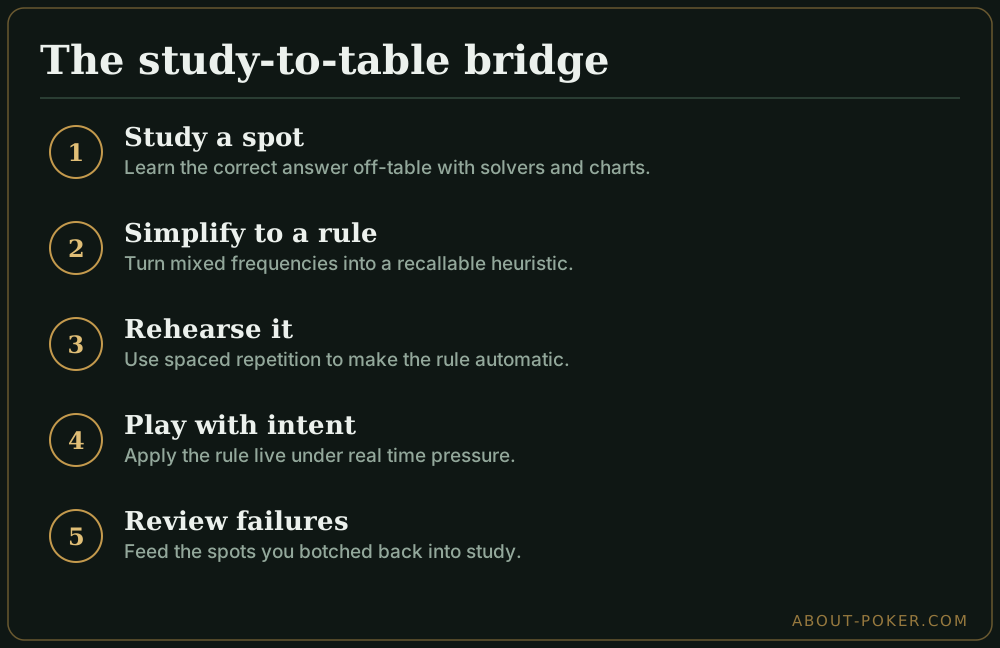
The most valuable study is the kind designed to survive contact with a live table. Three techniques help:
- Convert solver outputs into simple heuristics. “Bet small on dry ace-high boards, check more on wet middling boards” is recallable. A 13-by-13 mixed-frequency grid is not, at least not in seven seconds.
- Use spaced repetition to make heuristics automatic. Reviewing a rule the day after you learn it, then a few days later, moves it from fragile to reflexive. See spaced repetition for poker study for how to schedule this.
- Review the hands you actually misplayed, not the theory in the abstract. The hand history review workflow turns your on-table failures into your next off-table lesson.
How to split your time
A workable baseline for an improving player is roughly one hour of focused study for every three to four hours of play. Newer players should tilt toward study because they lack the base knowledge; high-volume regulars can study less per session but must review consistently or their edges decay. The exact ratio is less important than making both halves deliberate. An hour of distracted YouTube is not study, and four hours of tired autopilot is not practice.
Common mistakes on both sides
The classic study mistake is collecting knowledge you can never use: memorizing exact mixed frequencies that no human recalls at the table. The classic play mistake is grinding volume with no review, mistaking hands played for progress. A subtler error is doing only one of the two. Pure theory produces a player who can explain every spot and win none of them; pure volume produces a player with a thousand reps of the same mistake.
The players who improve fastest run a tight loop: study a spot, simplify it into a rule, play it, flag where they failed, and feed those failures straight back into the next study session. Off-table and on-table stop being separate activities and become two halves of one engine.
Frequently asked
What's the right ratio of study to play?
For most improving players, roughly one hour of focused study for every three to four hours of play is a workable baseline. Beginners benefit from more study; high-volume regulars often study less per session but review more consistently. The ratio matters less than making both halves deliberate.
Why do I understand a spot in study but misplay it live?
Knowledge and skill are different. Off-table you have unlimited time and the answer key; on-table you have seconds and no feedback. The gap closes through repetition, simplifying your study into rules you can actually recall, and reviewing the specific spots you botched.
Is playing more hands a form of learning?
Only if you play with intent and review afterward. Volume without reflection reinforces existing habits, good and bad. Playing teaches pattern recognition and emotional control that no solver can, but it needs an off-table review loop to convert experience into improvement.