What Is C-Bet Percentage in Poker?
C-bet percentage is how often a player continuation-bets the flop after raising preflop. Learn how it works, good ranges, and how to exploit high and low c-betters.
On this page · 6 sections
C-bet percentage measures how often a player fires a continuation bet on the flop after having raised before the flop. It is one of the most-watched HUD stats because the c-bet is the most common bet in poker — nearly every hand where you raise and get called comes down to whether you continue on the flop. Reading an opponent’s c-bet frequency tells you how much you can trust their flop bet and how often you can float or raise them.
What c-bet percentage measures
A continuation bet is a bet on the flop by the player who was the aggressor before the flop. The stat asks: of the flops this player saw as the preflop raiser, what percentage did they bet? A high c-bet percentage means the player fires nearly every flop regardless of whether it helped them — which makes their bets less meaningful and easier to attack. A low c-bet percentage means they only bet when they connect, so their bets are honest and their checks signal weakness. For where it sits among the core numbers, see poker HUD stats explained.
How it is calculated
Flop C-Bet = (flops bet as preflop raiser ÷ flops seen as preflop raiser) × 100
If a player raised preflop, got called, and reached 120 flops as the aggressor, betting 78 of them, their flop c-bet is 78 ÷ 120 = 0.65, or 65 percent. Most trackers also break this out by turn and river c-bet, which are far more revealing than the near-automatic flop number.
What is a good number
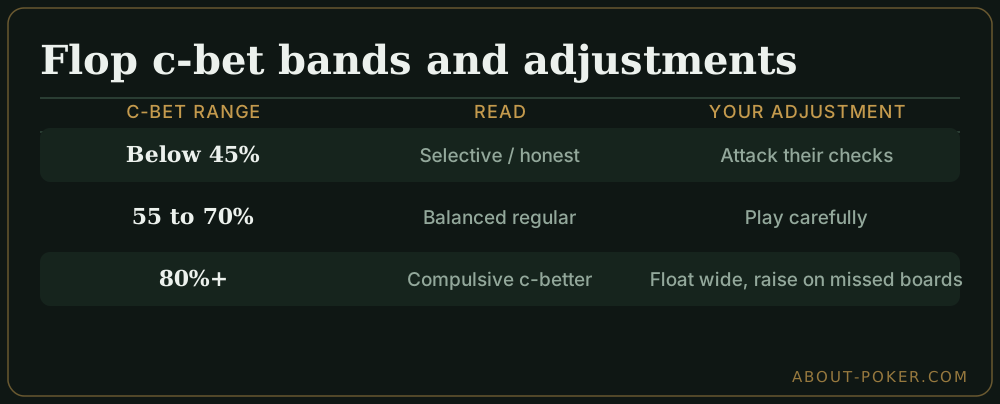
For heads-up flops in no-limit cash, the practical bands are:
- Below 45 percent — a selective c-better. When they bet, respect it; when they check, attack, because they are giving up their air.
- 55 to 70 percent — standard and balanced. This is where thoughtful regulars sit, betting a mix of value and bluffs.
- Above 80 percent — a compulsive c-better firing every flop. Float them wide and raise their bets on boards that miss their range, because most of those bets are air.
Modern solver-approved play uses smaller c-bet sizes at higher frequencies on favorable boards, so a high number is not automatically a leak — but a player who c-bets 85 percent for a big size is very exploitable.
A worked example
You call a button raise from the big blind against a player whose HUD shows flop c-bet 84 over 500 hands. The flop is 7h 6h 5s — a wet, connected board that hugely favors your calling range, which is full of suited connectors, sets, and straights, while the button’s range is skewed toward high cards. They fire a c-bet, as they almost always do.
Against an 84-percent c-better on this board, the correct response is to attack. You can check-raise your strong hands and semi-bluffs, and float wide with backdoor equity, because most of their c-bets here are missed overcards. A hand like 8h 8s — an overpair with a backdoor flush and straight equity — is a clear check-raise; you are ahead of their entire bluffing range and get value from worse. Against a 45-percent selective c-better on the same board, you tread more carefully, because their c-bet actually means something.
Common mistakes
The biggest mistake is treating flop c-bet as the whole story. Flop c-betting is nearly automatic for most players, so the more valuable reads are turn and river c-bet — the second and third barrels reveal who is genuinely aggressive versus who just fires one bet and gives up. Learn to read these together in how to read and use a poker HUD.
The second mistake is ignoring board texture. C-bet percentage is a population average; a good player’s real frequency swings hugely by board. Use the stat as a baseline, then adjust for the specific flop. The third is trusting it on a small sample — give it 200-plus flops as the aggressor before leaning on it.
Quick checklist
- Wait for 200+ flops as raiser before trusting it.
- Below 45: their bets are honest, attack their checks.
- 55 to 70: standard and balanced, play carefully.
- 80+: float wide and raise on boards that miss them.
- Prioritize turn and river c-bet over the flop number.
- Always factor in board texture before reacting.
Read alongside fold-to-c-bet and the aggression stats, c-bet percentage tells you whether an opponent’s flop bet is a genuine threat or a reflex you can exploit — and that read shapes almost every flop you play.
Frequently asked
What is a good c-bet percentage in poker?
For heads-up flops, a flop c-bet frequency of roughly 55 to 70 percent is standard depending on board and sizing. Above 80 percent means the player c-bets nearly everything and can be floated and raised; below 45 percent means they only c-bet when they connect.
How is c-bet percentage calculated?
Flop c-bet percentage = (flops bet as the preflop raiser ÷ flops seen as the preflop raiser) × 100. It only counts hands where the player took the betting lead before the flop and then had the chance to continue.
Should you always continuation bet?
No. Modern strategy c-bets selectively based on board texture, number of opponents, and range advantage. Small c-bets work on dry boards you connect with; checking is better on wet, low boards that favor the caller's range or in multiway pots.