6-Max Poker Tournament Strategy
6-max poker tournament strategy: fewer seats mean wider ranges, more aggression, and blinds every six hands. How to open, defend, and 3-bet short-handed.
On this page · 8 sections
The core of 6-max tournament strategy is aggression forced by the math: with only six seats you post the blinds nearly twice as often as at a full ring table, so folding constantly bleeds you dry. The winning approach is wider opening ranges, relentless blind stealing, more three-betting, and heavy use of position — you cannot wait for premium hands when the blinds come around every six hands.
A 6-max (six-handed) table removes the early seats that let full-ring players fold and wait. Every hand you are closer to the blinds, and a bigger share of the table sits in late position, so both the pressure to act and the opportunity to steal go up.
Why fewer seats means more aggression
Fold a full orbit at a nine-handed table and you pay one small blind and one big blind across nine hands. At six-handed you pay the same blinds across only six hands — so blinds and antes eat your stack noticeably faster. To stay ahead of that drain you have to win more pots without a showdown, which means stealing and re-stealing far more often.
Fewer opponents also means any given hand is stronger on average, because it is less likely someone woke up with a monster behind you. That is exactly why ranges widen.
Position is even more valuable
With six seats, half the table acts after the button folds through to the blinds. The button and cutoff become blind-stealing machines: when the action folds to you there, you can open a large share of hands profitably because only the two blinds remain. Conversely, tighten up under the gun — you still have most of the table left to act. The relative reward for late position is higher six-handed than anywhere else, so lean into it.
Opening and defending wider
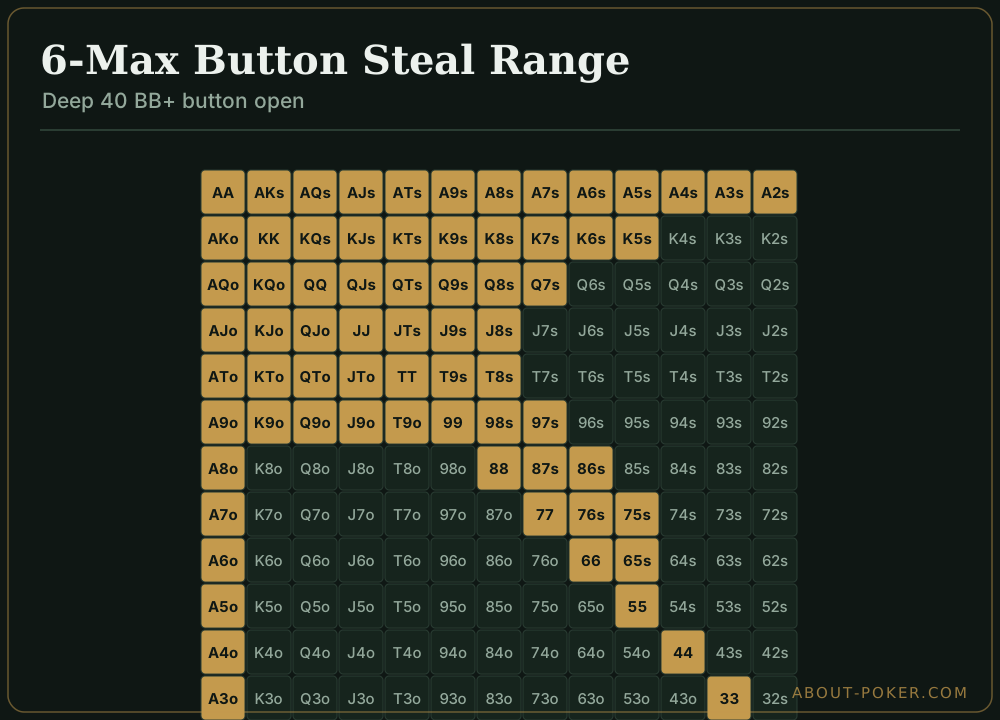
Every range shifts wider short-handed, but not uniformly. The table below gives rough raise-first-in opening frequencies for a deep (40 BB+) 6-max MTT, with a sample of the hands each seat adds. Treat the percentages as targets, not gospel — they tighten a little with antes off and shift with table dynamics.
| Seat | Open % | Sample opening range |
|---|---|---|
| Under the gun | ~15–18% | 22+, ATs+, KQs, KJs, QJs, JTs, AJo+, KQo |
| Lojack / middle | ~19–22% | 22+, A9s+, KTs+, QTs+, J9s+, T9s, ATo+, KJo+ |
| Cutoff | ~26–28% | 22+, A2s+, K9s+, Q9s+, J9s+, T8s+, 98s, A9o+, KTo+, QJo |
| Button | ~42–48% | Any pair, any suited ace, K5s+, Q7s+, J8s+, T8s+, 97s+, 86s+, 75s+, A2o+, K9o+, Q9o+, J9o+, T9o |
| Small blind (RFI) | ~35–45% | Wide, but raise-only — flat-calling out of position invites the BB to squeeze |
Because opens are wider, so are the reactions. Late-position steals get attacked more, which pushes both stealer and defender toward the three-bet and four-bet game. Master a re-steal shoving range for the medium-stack zone; it punishes the wide button opens that define 6-max. The exact frequencies come from preflop GTO work, adjusted for tournament stack depth.
Re-steal: 3-bet shoving from the blinds
When you hold roughly 15–25 BB and the button opens 2–2.2 BB into your blind, a jam is often better than calling — it denies him the chance to outplay you postflop and puts maximum pressure on a range that is mostly folding. Against a button opening ~45%, a solid big-blind 3-bet-shove range at ~18–20 BB looks like:
- Value: 77+, ATs+, KQs, AQo+ — hands that are ahead when he calls.
- Leverage / blockers: A2s–A9s (the ace blocks his big aces and calling range), plus KJs and occasionally KQo and A9o–AJo mixed in.
That is roughly the top 12–15% of hands. The blocker hands matter more than raw equity here: most of the profit comes from fold equity, so holding an ace or a king that shrinks his continuing range is worth more than an extra point of showdown value. Trim the bluffy end when the opener is a station or opening tighter, and widen it against a button you know is stealing near 50%.
Worked example: defending the big blind
You are in the big blind with K♣ 8♠ and 40 big blinds. The button — a competent, aggressive regular — opens to 2.2 BB with what you know is a very wide stealing range. Everyone folds to you.
Full ring, K8o is an easy fold. Six-handed against a wide button, defending is clear. You are getting a good price (you only need to add 1.2 BB to a pot that already holds about 3.7 BB) and your hand plays fine against his wide range — it flops top pair often and has a live king. Folding here every time simply hands the aggressive button your blind, and short-handed you cannot afford to donate that repeatedly. Calling — or occasionally three-bet shoving lighter than usual — keeps him honest. This defend-wider instinct is the heart of blind stealing and steal defense.
Postflop is more aggressive too
Wider preflop ranges carry into wider postflop play. With fewer players seeing flops and lighter ranges in the pot, top pair goes up in value and continuation bets succeed more often, because your opponent also holds a wide, frequently-missed range. Fire more continuation bets in position, barrel scare cards that hit your range, and do not be afraid to bet thinner for value than you would at a full table. The flip side: your opponents know your range is wide too, so expect more float calls and raises, and be ready to fire a second barrel or give up cleanly rather than paying off.
Stack depth interacts with short-handed play
Short-handed poker widens ranges, but stack depth still governs how you deploy them. Deep (40+ big blinds), play a full postflop game with your wide opens. In the re-steal zone of 15 to 25 big blinds — the medium-stack zone — your wide button opens become shove-or-fold targets for the blinds, so tighten opens slightly and be ready to fold to aggression. Under about 12 big blinds, everything collapses into push-fold, and the wide short-handed shoving ranges are what make 6-max so aggressive late — with only a few players behind you, open-shoving a large share of hands is correct.
The chart below shows roughly how wide you can open-jam first-in at 10 BB (ante on) by seat. Fewer players left to act = a far wider jam.
| Seat (players behind) | ~10 BB open-shove range | ≈ % of hands |
|---|---|---|
| UTG (4 behind) | 66+, ATs+, KQs, AJo+ | ~9% |
| Cutoff (2 behind) | 22+, A5s+, K9s+, QTs+, JTs, ATo+, KJo+ | ~20% |
| Button (2 behind) | 22+, A2s+, K7s+, Q9s+, J9s+, T9s, A7o+, KTo+, QJo | ~30% |
| Small blind (1 behind) | 22+, A2s+, K5s+, Q8s+, J8s+, T8s+, 98s, A5o+, K9o+, QTo+ | ~35–40% |
At 8 BB or less these ranges widen further still; by ~6 BB the button and small blind are jamming closer to half their hands. Chart ranges assume folds to you — a limp or open in front tightens you back toward premiums.
Antes, ICM, and the bubble
Two tournament-only forces reshape everything above, and they hit harder six-handed.
Antes widen you further. Once antes are in play, the pot you are stealing is bigger relative to your raise, so your steals need to succeed less often to profit. A button open risking 2.2 BB to win a pot that antes have swollen to ~2.5 BB (instead of 1.5) is a much better price — which is why the wide opening percentages above assume antes are on. Ante off, shade every non-blind range 2–4% tighter.
ICM tightens you back — especially calling ranges. On the bubble and at the final table, chips you can lose are worth more than chips you can win, because busting costs you a pay jump. This does not kill aggression so much as redirect it:
- Keep applying pressure with fold equity. Open-jamming and re-stealing against covered opponents stays strong — you are the one threatening them with elimination.
- Tighten your calling ranges sharply. Calling an all-in risks your tournament life for no fold equity, so hands you would snap-call for chip EV (small pairs, weak aces) become folds under ICM pressure. A hand near the bottom of your 10 BB open-jam list is often a clear fold when facing a shove on the bubble.
- Attack the medium stacks, respect the shorts. Big stacks should lean on the mid-sized stacks who have the most to lose; the true short stacks have little ICM pressure left and will call wide.
Six-handed, pay jumps arrive faster because tables break and redraw sooner, so these adjustments come into play earlier than in a full-ring field.
Bottom line
Six-max tournaments reward controlled aggression: open wide, steal often, defend your blinds, and use position as your biggest weapon. The variance is higher than full ring, so bankroll for it — but the edges for a disciplined, aggressive player are large. Ground the fundamentals in the tournament strategy hub and build the short-handed ranges on top.
Frequently asked
How is 6-max tournament strategy different from full ring?
With only six seats you post blinds nearly twice as often as a nine-handed table, so folding constantly bleeds your stack. That forces wider opening ranges, more blind stealing, more three-betting, and a generally more aggressive style. There are also more late-position seats relative to the table, so position matters even more.
Should I play tighter or looser in 6-max?
Looser than full ring. Because the blinds hit you more often and there are fewer players left to act behind you, hands that would be folds nine-handed become profitable opens and defends six-handed. You still tighten from early position, but every range shifts wider.
How wide should I open in 6-max?
It depends on seat, but ranges run noticeably wider than full ring. Under the gun stays fairly disciplined, the cutoff and button open very wide to steal blinds, and the small blind opens or completes carefully. On the button with folds to you, you can open a large share of hands profitably.
Is 6-max higher variance than full ring?
Yes. Wider ranges, more three-bet and four-bet pots, and more frequent confrontations mean bigger swings hand to hand. The edges are real for a skilled aggressive player, but the variance is higher, so a solid bankroll and comfort with volatility matter more.