Advanced MTT Strategy: Winning the Long Game
Advanced MTT strategy: exploit stack-size dynamics, weaponize fold equity, blend ICM with chip EV, and adjust to opponents for deep runs.
On this page · 9 sections
Advanced multi-table tournament play is about layering three things at once: chip EV, ICM pressure, and opponent-specific exploits. Winning players build a solid game-theory baseline so they can’t be punished, then deviate constantly to attack how the field actually plays — over-folding to three-bets, calling too wide, or refusing to gamble near pay jumps. The edge lives in those deviations, not in memorizing a chart.
An MTT is a marathon of shifting stack sizes and payout pressures. The hand that’s a clear fold at 12 big blinds on the bubble is a clear shove at 40 big blinds in the middle stage. Reading those contexts faster and more accurately than your opponents is what separates a consistent deep-runner from someone who occasionally spikes a cash.
Read every stack before you act
Before you make a decision, you should already know the effective stack in the pot and the stacks of everyone still to act. Stack sizes dictate fold equity, shove ranges, and who can put whom to a decision for their tournament life.
- Against a covering big stack, tighten your all-in ranges — they can call and bust you without pain.
- Against a short stack behind, factor in that they may jam over your open, which shrinks your effective raising range.
- When you cover the table, you hold maximum leverage; use it to pressure the medium stacks who most fear losing their position.
This stack awareness is the backbone of the chip accumulation versus survival trade-off that defines every stage of a run.
Weaponize fold equity
Deep runs are built on pots won without a showdown. Advanced players are relentlessly the aggressor, applying pressure through three-bets, squeezes, and timely shoves rather than passively calling and hoping to hit.
The squeeze is a signature advanced weapon: when a loose player opens and a fit-or-fold caller flats, a well-sized three-bet often takes it down uncontested. You collect the blinds, antes, the open, and the call — a meaningful pot for a hand you never had to show. Sharpen the mechanics in the three-bet and four-bet guide, and anchor your ranges in preflop fundamentals so your bluffs and value stay balanced.
Concrete sizings. In-position, three-bet to roughly 3x the open; out of position, go bigger at 3.5–4x so you’re not laying a cheap price. For squeezes, add about 1x for each caller on top of your standard three-bet — so over a 2.5bb open plus one flat, a squeeze to 11–12bb (roughly 4.5x the open) is typical. Four-bet to about 2.2–2.5x the three-bet as a bluff, which keeps your risked chips low while still folding out the bluff-catchers.
Put numbers on that squeeze pot. With a 1bb big-blind ante, a 2.5bb cutoff open, and one button flat, dead money before you act is 7.5bb (2.5 + 2.5 + 0.5 SB + 1 BB + 1 ante). A squeeze to 11bb that folds both players out wins that 7.5bb while risking 11 — profitable the moment your combined fold equity clears roughly 60%, which fit-or-fold fields hand you routinely.
Blend chip EV with ICM
Early and in the middle stages, most spots are close to pure chip EV — take the profitable gamble, accumulate, and build a stack that can dominate later. As you approach pay jumps and the final table, ICM increasingly overrides chip EV, and thin chip-EV calls become clear folds.
The advanced skill is knowing exactly where that transition happens for your stack. A chip leader can gamble more freely because busting costs them relatively little equity, while a middle stack near a pay jump must play far tighter than the raw chip math suggests. The full framework lives in the ICM hub.
Deviate to exploit the field
A balanced baseline keeps you safe, but the profit comes from exploiting population tendencies. Most MTT fields share predictable leaks:
- They over-fold to three-bets, so you can three-bet light for value and folds.
- They call too wide preflop, so you value-bet thinner and bluff less against them.
- They refuse to gamble on the bubble, so you attack their stacks mercilessly when you’re big.
Identify the dominant leak at your table, then push on it until it stops working.
Advanced adjustments by stack depth
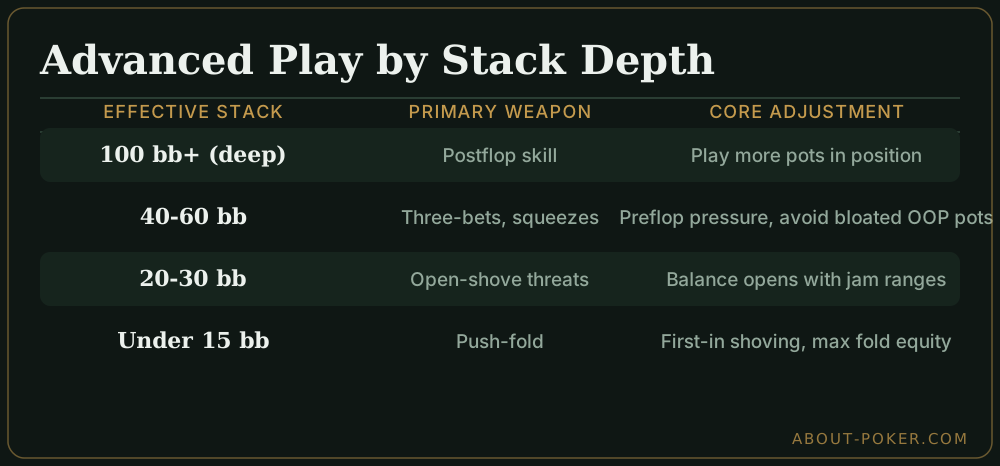
| Effective stack | Primary weapon | Core adjustment |
|---|---|---|
| 100 bb+ (deep) | Postflop skill | Play more pots in position, realize equity |
| 40–60 bb | Three-bets, squeezes | Apply preflop pressure, avoid bloated pots OOP |
| 20–30 bb | Open-shove threats | Balance opens with jam-over-raise ranges |
| Under 15 bb | Push-fold | First-in shoving, maximize fold equity |
Push-fold thresholds you can actually use
Under about 15bb, folding then facing a raise is usually worse than shoving or folding pre. Position and how many players are left to act swing the numbers hard. As rough Nash-style first-in jamming baselines at chip EV:
| Stack | Position | First-in shove range (approx.) |
|---|---|---|
| 10 bb | Button | ~40%+ — any ace, any pair, K7s+, most suited connectors, 22 is an easy jam |
| 10 bb | UTG (full ring) | ~12–15% — 66+, ATs+/AJo+, KQs |
| 15 bb | Small blind vs BB | ~50%+ — the BB folds so often that almost any two playable cards shove |
Two callouts advanced players internalize: fewer players behind widens you dramatically (the same 10bb hand you fold UTG is a clear jam on the button), and ICM tightens the caller far more than the shover near a pay jump, so your fold equity actually rises on the bubble even as your own calling range collapses. Treat these as a starting grid, not gospel — antes, opponent calling tendencies, and payout pressure all shift them.
Worked example: the ICM-aware light four-bet
It’s the middle stage of a large MTT. A competent regular opens from the cutoff, and you’re on the button with 45 big blinds holding A♦ 5♦. You’ve noticed this player opens wide from late position and folds too often to four-bets.
A basic player calls or folds. The advanced play is a small four-bet as a semi-bluff, sized to roughly 2.2–2.5x the three-bet it’s answering — enough to fold out bluff-catchers while keeping your risked chips low. Your read says they fold most of their range, you collect a healthy pot uncontested, and even when called you hold an ace-blocker with a suited wheel card that flops equity. Because stacks are deep and no pay jump looms, chip EV dominates and the aggression is clearly correct. That same four-bet on the bubble against a short stack would be a mistake — context is everything.
Worked example: the ICM fold that chip EV would call
Now the bubble, three from the money, and you’re a comfortable middle stack with 25bb. A short-stacked 9bb player shoves all-in from the button into your big blind and you look down at A♥ Q♠. Against a short stack’s wide button-jamming range, AQo is a clear chip-EV call — you’re often a modest favorite or a coin flip, and in a cash game or early tournament you snap.
On the bubble it’s a fold. Calling risks 9bb of your stack to knock out a player who’s about to bust anyway, and if you lose the flip you crater to 16bb on the money bubble — a catastrophic ICM hit. The chips you’d win are worth far less than the chips you’d lose, because survival into the money is worth real money and busting here is worth nothing. This is the ICM tax in one hand: a +chip-EV call becomes a clear fold the instant a pay jump looms and someone shorter can bust for you. Let the short stacks fight; you cash. See the full framework in the ICM hub.
Bottom line
Advanced MTT strategy is a constant balancing act between chip EV, ICM, and opponent exploitation, executed through relentless fold-equity pressure and precise stack reading. Build the baseline, then deviate to attack how your specific field actually plays. Return to the tournament strategy hub to connect these ideas across every phase of a run.
Frequently asked
What separates advanced MTT strategy from basic play?
Advanced players constantly weigh chip EV against ICM pressure and adjust to specific opponents and stack sizes, rather than following a single fixed chart. They know when to deviate from a solver line to exploit a fit-or-fold opponent or an ICM-terrified short stack.
How important is fold equity in advanced MTT play?
It's central. Deep runs are built by winning pots without showdown, so advanced players prioritize being the aggressor with three-bets, squeezes, and well-timed shoves. Fold equity turns marginal hands into profitable chips.
Should I follow a GTO strategy or play exploitatively in MTTs?
Both. Use a GTO baseline so you're never badly exploitable, then deviate to attack clear population tendencies — over-folding to three-bets, calling too wide preflop, or refusing to gamble on the bubble. The edge in MTTs is mostly exploitative.
How do stack sizes change advanced MTT decisions?
They change everything. The same hand plays completely differently at 100 big blinds versus 15. Advanced players read every stack at the table before acting so they know who can pressure whom and where the fold equity lives.