Bounty and PKO Tournament Strategy
In a bounty or PKO event, busting opponents pays cash. Here's how the extra prize widens your ranges, with the bounty-EV math and a worked call.
On this page · 7 sections
In a bounty or progressive knockout (PKO) tournament, eliminating an opponent pays you cash on the spot, so the correct adjustment is to call and shove wider than pure chip math suggests — but only against players you cover, because you can only collect a bounty when you knock the shorter stack out. That single rule, plus the bounty-EV math below, drives everything else.
How bounty and PKO formats work
A slice of each buy-in funds a bounty pool instead of the regular prize pool. Every player carries a bounty on their head. When you eliminate someone, you collect it. Two common variants:
| Format | What happens to a bounty when you win it |
|---|---|
| Standard (static) bounty | You collect the full bounty as cash |
| Progressive KO (PKO) | You pocket half in cash and add half to your own head |
| Mystery bounty | Bounties are random amounts revealed after the knockout |
The PKO twist is the important one: because half of every bounty you win compounds onto your own head, the biggest stacks accumulate the biggest bounties. Those players become the prime targets — and you become one when you run well.
Why the bounty widens your ranges
The bounty is guaranteed cash attached to a specific outcome — busting a covered opponent. That means a winning call earns you the pot plus the bounty, which effectively improves the price you’re getting. In plain terms, you can call worse than raw pot odds because part of your reward is the knockout money.
The catch is coverage. If a 25-big-blind stack shoves and you have 8 big blinds, calling can’t win their bounty even if you win the hand — you’d be all-in for less. You only collect a bounty when you cover the shorter stack. So the adjustment is asymmetric:
- You cover them: call and shove wider — the bounty sweetens the spot.
- They cover you: ignore the bounty entirely and play standard chip and ICM math.
The bounty-EV math
Here’s how to fold the bounty into a call. First convert the bounty from cash into chip terms so it lives on the same scale as the pot. A workable rule of thumb: bounty-in-chips ≈ (bounty cash ÷ buy-in) × starting stack, i.e. the bounty is worth however many buy-ins of cash it represents, priced in starting stacks of chips. (Late in a tournament chips are worth less per unit than at the start because of ICM, so treat this as an upper-bound estimate.) Once the bounty is in chip terms, drop it into the standard equity threshold:
Equity needed = (chips to call) ÷ (chips to call + pot before your call + bounty in chip terms)
Without the bounty term this is just ordinary pot odds; the bounty simply enlarges the reward side of the fraction, which is what lowers the equity you need. The bigger the bounty relative to the pot, the bigger the discount — which is why fat PKO bounties justify very loose calls. In the worked example below the discount comes out to about 12 percentage points (from ~43% down to ~31%), and with a smaller bounty it would be less; as a loose guide expect anywhere from a few points up to 10–15 when the bounty rivals the pot.
This is the same value-per-cost logic behind pot odds and implied odds: you’re paying a fixed price for a pot that’s secretly larger than it looks.
Worked example: a PKO call
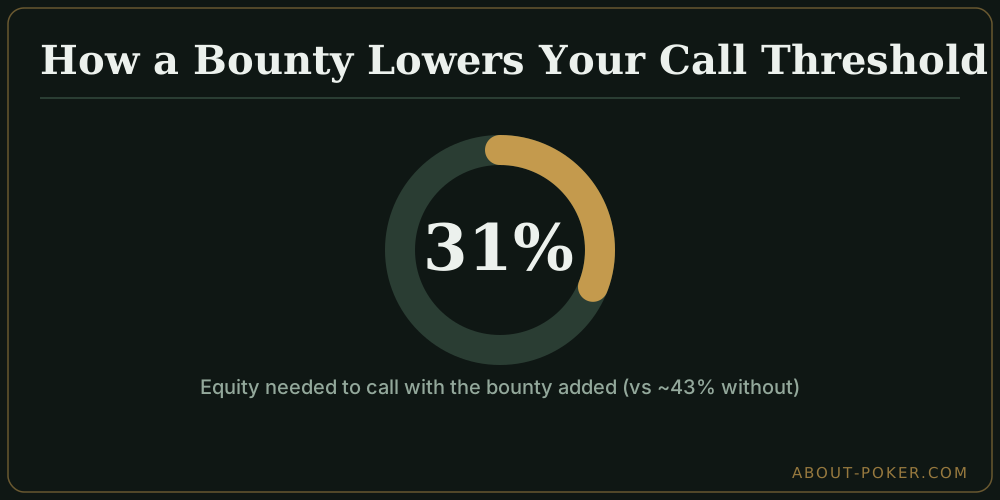
Blinds 1,000/2,000. A 9-big-blind stack (18,000) shoves from the button. You’re in the big blind with 40 big blinds and A♣ 8♣. Their head carries a bounty worth about 15,000 in chip-equivalent value.
Set up the numbers. You’ve already posted your 2,000 big blind, so you need 16,000 more to call. The pot before your call is 18,000 (their shove) + 2,000 (your posted BB) + 1,000 (the small blind) = 21,000.
- No bounty: equity needed = 16,000 ÷ (16,000 + 21,000) = 16,000 ÷ 37,000 = ~43%. Against a wide button shove that’s a fine price, but A-8 suited (roughly 45–50% against a top-40% shoving range) clears it only modestly — a routine, unexciting call, and hands like A-5s or K-9s would be borderline folds here.
- With the bounty: add the 15,000 chip-equivalent to the reward side. Equity needed = 16,000 ÷ (16,000 + 21,000 + 15,000) = 16,000 ÷ 52,000 = ~31%. That’s a ~12-point drop in the equity you need. A-5 suited and K-9 suited both sit comfortably above 31% against a wide shove, so hands that were marginal without the bounty become clear calls.
The hand strength barely changed; the coverage plus the live bounty knocked the required equity from ~43% down to ~31% and made it a snap. Contrast that with a standard event, where you’d lean on strict push-fold and shove ranges.
Stack and stage adjustments
- Build a covering stack early. In PKOs, chips are extra valuable because they let you cover and hunt bounties. Accumulating early has bonus utility beyond the regular prize pool.
- Target the fat heads. Late in a PKO, seek pots against players carrying huge bounties — that’s where the money concentrates.
- Respect the payout pool near the money. The regular prize pool still has pay jumps. Near the bubble, ICM pressure returns, and you can’t let bounty greed talk you into busting before a pay jump. Read the split on the payout structure sheet — bounty events divert money from top prizes, so the top-heavy incentive is milder.
Common bounty mistakes
- Chasing bounties you can’t win. Calling a shove for your whole shorter stack collects nothing extra — the bounty needs you to cover.
- Over-loosening when covered but short of the money. Bounty greed that busts you before a pay jump is a real leak in the paid stages.
- Ignoring your own bounty in a PKO. Once your head is fat, you’re the target; expect wider action and adjust by protecting your covering advantage.
- Treating a static bounty like a PKO. Static bounties don’t compound, so the incentive to hunt is smaller — don’t overplay them.
The bottom line
Bounty and PKO events reward the same skill as regular MTTs — good ranges, position, ICM awareness — plus one overlay: knockouts are cash you win by covering opponents. Widen your calls when you cover a live bounty, tighten back up near pay jumps, and hunt the fattest heads in a PKO. Fold it into the rest of your game at the tournament strategy hub.
Frequently asked
What is a bounty poker tournament?
A bounty tournament attaches a cash reward to each player. When you eliminate an opponent, you collect their bounty on top of the chips you win. Part of every buy-in funds the bounty pool instead of the regular prize pool, so the top finishes pay a bit less while knockouts pay you directly throughout.
What is a PKO or progressive knockout tournament?
In a progressive knockout (PKO), each player's bounty splits when they are eliminated: you pocket half in cash and add the other half to your own head, growing the bounty you carry. This makes big stacks with fat bounties the most valuable targets in the room and rewards aggression more than a standard event.
How does a bounty change my strategy?
The bounty is real money you win by covering and eliminating opponents, so it widens your calling and shoving ranges against players you have covered. You call slightly worse than pure chip odds when a bounty is at stake, especially in PKOs where the reward compounds. You never chase a bounty you cannot actually claim by covering the shorter stack.
Should I call wider to win a bounty?
Yes, but only when you cover the all-in player so you can actually collect. The bounty adds guaranteed cash equity to a winning call, effectively improving your pot odds. The looser your opponent's shoving range and the bigger the bounty relative to the pot, the wider you can profitably call.