Pay Jump Strategy in Tournaments
Pay jumps reward survival, not chips. Here's how to ladder up the payout structure, when to tighten, when to attack, and a worked short-stack laddering example.
On this page · 7 sections
Tournament payouts aren’t flat. The difference between 15th and 12th place might be small, but the jump from 4th to 1st can be enormous. Pay jump strategy is about recognizing that later in a tournament your goal shifts from accumulating chips to climbing the payout ladder — and adjusting your risk accordingly. Done right, it’s worth real money; done wrong, it costs you buy-ins.
The payout ladder gets steeper
Early in the money, pay jumps are tiny. Min-cashing versus busting one spot short is a big deal, but the difference between two adjacent in-the-money spots is often just a few percent. As you approach the final table, the jumps balloon — the top few spots can each be worth several times a min-cash.
This means the value of survival grows as you climb. Early on, chips are king and you should play to accumulate. Late, especially with a short or medium stack, each spot you ladder up can be worth more than the chips you’d win by gambling. Knowing the exact shape of the ladder — which you can read off the payout structure — tells you how hard survival is being rewarded right now.
When to tighten and when to attack
The right adjustment depends entirely on your stack relative to the field:
- Short stack, big jump coming, other shorties at risk: Tighten up and try to outlast the other short stacks. If two players are shorter than you and a $2,000 jump is one bust away, folding marginal spots to let them bust first is pure profit. This is laddering.
- Big stack: Do the opposite. Everyone else is playing scared, so attack their blinds and antes relentlessly. They’re folding to preserve their equity, and every fold hands you chips.
- Medium stack with no immediate jump: Play close to a normal chip-EV strategy, but stay aware of who’s about to bust.
The key read is always: who is more afraid than me right now, and who is less?
Don’t ladder when it’s not there
A common leak is playing scared when there’s no real pay jump to protect. If you’re a medium stack deep in the field but the next several jumps are small and no short stacks are about to bust, laddering caution just bleeds your stack. Save the survival mindset for spots where a meaningful jump is genuinely one or two eliminations away.
Worked example: laddering into a bigger prize
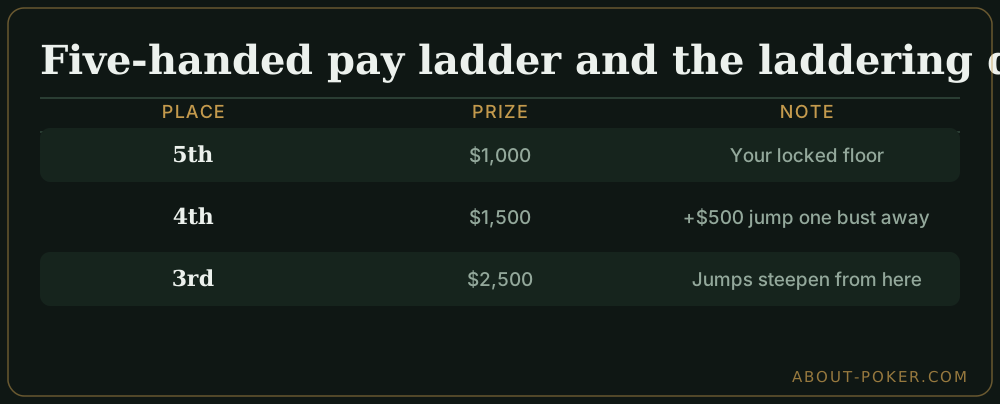
Five players left. Payouts: 5th = $1,000, 4th = $1,500, 3rd = $2,500, and it keeps climbing steeply toward 1st. You have 8bb — the second-shortest stack. Another player has 4bb and is about to be forced all-in by the blinds within an orbit or two.
You pick up A-8 offsuit under the gun and are tempted to jam. Consider the ladder first. If you fold and the 4bb player busts before you’re forced in, you jump from a locked $1,000 to $1,500 — a guaranteed $500 with zero risk. If you jam A8o now, you might double, but you also risk busting in 5th and handing that $500 jump to someone else.
Because a real jump ($500, half a min-cash) is one bust away and a shorter stack is likely to go first, the correct play is often to fold A8o and fold your way toward the jump — then loosen up again once the 4bb player is gone. That’s laddering in action: you traded a marginal double-up for a near-certain pay increase.
The bubble is the extreme case
The money bubble is pay-jump pressure turned up to maximum: the “jump” from bustout to min-cash is the difference between zero and a real payout, so survival equity spikes harder than at any later point. This is where the big-stack edge is most brutal. If you’re the chip leader on the bubble, you can open almost every button and attack every short stack, because busting is catastrophic for them and merely annoying for you. Short and medium stacks fold far too much, and those folds are your profit.
The flip side: being an average stack on the bubble is a trap. You feel safe, but there’s often a big stack to your left punishing you, and you can bleed away a cash by defending too little. The fix is to identify the true short stacks — the players who genuinely can’t call — and target them, not the covering stacks. Attack down, fold to pressure from above.
Common pay-jump mistakes
- Laddering when you’re the big stack. Survival caution is for short stacks. If you’re covering the table, tightening up throws away the exact edge the pay jumps hand you.
- Treating early-money jumps like final-table jumps. A few percent between 20th and 18th is not worth folding a strong hand; save the discipline for the steep late jumps.
- Folding into oblivion. Laddering means passing marginal spots, not every spot. If you blind down from 8bb to 2bb dodging all-ins, you’ve traded a playable stack for one pay jump and no fold equity left.
- Ignoring the stack to your left. A big stack behind you can force pay-jump caution on you. Factor in who covers you, not just who you cover.
Combine pay jumps with position and reads
Pay jump strategy layers on top of everything else you know. You still shove wider from late position and tighten from early position — you just skew tighter overall when a jump is imminent and you’re not the big stack. Track the stacks around you, watch the payout ladder, and let the size of the next jump dial your aggression up or down. For the full mechanics of climbing the ladder, see laddering and pay jumps, and study the shape of the prizes in reading the payout structure.
Frequently asked
What is a pay jump in a tournament?
A pay jump is the increase in prize money that happens when players bust and you move up a spot in the payout ladder. Later in a tournament these jumps get much larger, so folding to survive into the next pay tier can be worth more than accumulating chips.
When should I play to ladder up?
Laddering matters most when a big pay jump is close and you are one of the shorter stacks, especially near the final table. If busting costs you a large prize increase and other short stacks are at risk, tightening up to outlast them can be the highest-EV play.
Do pay jumps ever mean I should play more aggressively?
Yes. If you are a big stack while others are laddering, you should attack relentlessly, because opponents folding to survive give you their blinds and antes cheaply. Big stacks profit from other players' pay-jump caution.