Progressive Knockout (PKO) Strategy
In a PKO, half of every bounty you win joins your own head. Learn how bounties reshape calling ranges, ICM, and covering opponents, with a worked spot.
On this page · 5 sections
Progressive knockout tournaments — PKOs — have become the most popular bounty format online, and for good reason: they’re wild, high-variance, and reward aggression. But the format quietly rewires the math that governs every all-in decision. Half of every bounty you collect gets bolted onto your own head, so the player who accumulates bounties becomes both richer and a bigger target. If you play a PKO with a standard tournament mindset, you’ll leave real money on the table. This page breaks down how bounties change your ranges, when to chase them, and a worked calling spot.
How the bounty math works
In a PKO, part of your buy-in funds the regular prize pool and part funds bounties. When you eliminate a player, you immediately win half their current bounty in cash, and the other half is added to your own bounty. So early knockouts compound: each elimination makes your head bigger, which makes you a more valuable scalp.
That extra cash isn’t in your chip stack, which is the whole point. Standard tournament equity is measured in chips (and adjusted by ICM). Bounty equity is measured in real money attached to covering and eliminating opponents. The single most important concept in PKO play flows from this: you only win a bounty if you cover the person you’re all-in against. If they cover you, you can’t collect — you can only be collected.
Coverage is everything
Because you must cover an opponent to claim their bounty, your effective stack relative to each opponent determines how much the bounty affects your decision.
- You cover a short stack: bounties widen your calling and shoving ranges dramatically. Their bounty is free money you can capture, so hands you’d fold in a freezeout become clear calls.
- A big stack covers you: bounties should make you tighter. You can’t win their bounty by getting all-in, but you can lose yours to them. Getting knocked out hands your head to someone else.
- Roughly even stacks: treat it closer to a normal spot, tilting slightly looser because the pot now contains bounty value.
This is a direct extension of short-stack push-fold logic, but with a second layer: it’s not just your stack, it’s whether you cover.
Widening your calling range vs shorts
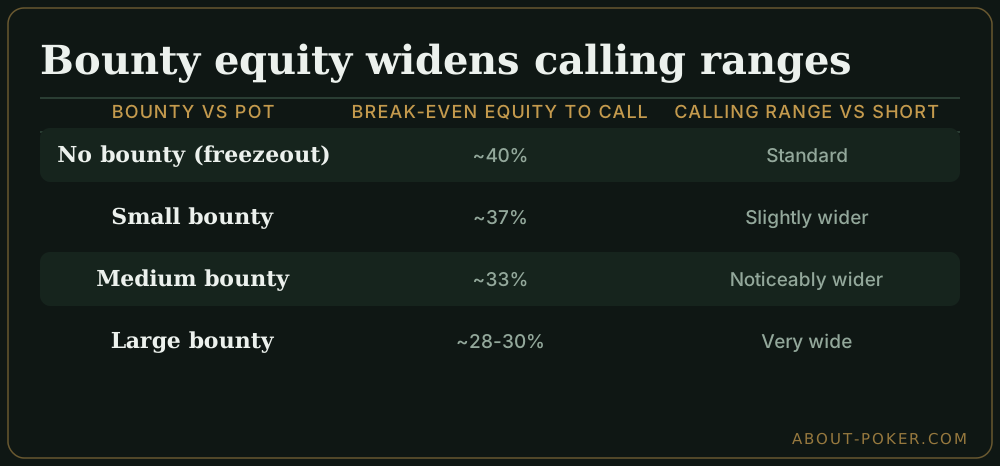
Here’s how bounty equity translates into range width. Bounties are worth extra pot odds, so the break-even equity you need to call a shove drops when you cover the shover and stand to win their bounty.
The table below shows the idea. As the bounty grows relative to the pot, the equity you need to profitably call falls, so your calling range widens.
A worked example
You’re in the big blind with A5o, 40 big blinds deep. A short stack with 9 big blinds shoves from the button. Their bounty is large — worth roughly another 6 big blinds of real-money equity if you eliminate them. It folds to you.
In a freezeout, A5o against a button shove is a marginal-to-fold call: you need about 40% equity given the pot odds, and A5o has roughly 42-45% against a wide button shoving range — close, often a fold if the range is strong. But in the PKO, the bounty adds the equivalent of extra chips to the pot. Now your break-even equity requirement drops from ~40% to closer to 33%, because winning the pot also wins you cash and grows your head.
A5o clears that lower bar comfortably against a 9bb button shove. So the same hand that’s a fold in a freezeout is a clear, profitable call in the PKO — purely because you cover the shover and the bounty sweetens the price. That single adjustment, made correctly a dozen times a tournament, is where PKO edges come from.
Don’t let bounties break your discipline
The most common PKO leak is bounty tunnel vision — calling off when you’re covered, or ignoring the still-larger chip prize pool deep in the money. Bounties are a bonus, not the whole game. Late in a PKO, ICM and pay jumps reassert themselves, and getting knocked out on the bubble to chase a small head is a disaster.
Play the format the way it’s built: hunt bounties aggressively when you cover short stacks, tighten up when bigger stacks can bust you, and never forget that the trophy still pays more than any single head.
Frequently asked
What is a progressive knockout tournament?
A progressive knockout (PKO) is a bounty tournament where each player has a price on their head. When you eliminate someone, you win half their bounty in cash and the other half is added to your own bounty. So knocking players out makes you a bigger and bigger target as your head grows.
How does a PKO change your strategy?
Bounties are extra chips of real value attached to covering and eliminating opponents. You call all-ins wider when you cover a short stack — winning their bounty adds equity that isn't in your chip stack. You also value position and coverage more, and you play tighter when you're the one at risk of being knocked out.
Should I only chase bounties in a PKO?
No. The chip prize pool is still the bigger long-run driver, especially deep. Bounties are worth chasing when you cover the opponent and the pot odds plus bounty equity justify the call. Overcommitting to bounties when you're covered or short is a classic PKO leak.