What Is a Freezeout
A freezeout is a tournament with no rebuys or re-entries: bust once and you're out. Learn what it means, how it compares to other formats, and how to play it.
On this page · 6 sections
A freezeout is a poker tournament with a single, simple rule: you buy in once, and when your chips are gone, you are out. There are no rebuys, no add-ons, and no re-entries. It is the original tournament format and still the standard for the most prestigious events, including the WSOP Main Event. That one rule — one life, no second chances — shapes every strategic decision you make, from how you treat an early coinflip to how you navigate the money bubble. This page explains exactly what a freezeout is and how it differs from the other formats you will encounter.
The single-life rule
In a freezeout, your buy-in purchases exactly one starting stack. Play it well and you accumulate chips; lose it all and your tournament is over. The term “single entry,” which you will often see on structure sheets, means the same thing. This is the format most people picture when they imagine a poker tournament, and it is prized precisely because there is no safety net.
That absence of a safety net gives chips an asymmetric value. The chips you win are worth slightly less than the chips you lose, because losing your last chip ends your tournament and forfeits all your future equity. That asymmetry is the intuition behind ICM — the idea that a tournament chip’s real cash value is not linear.
How a freezeout compares to other formats
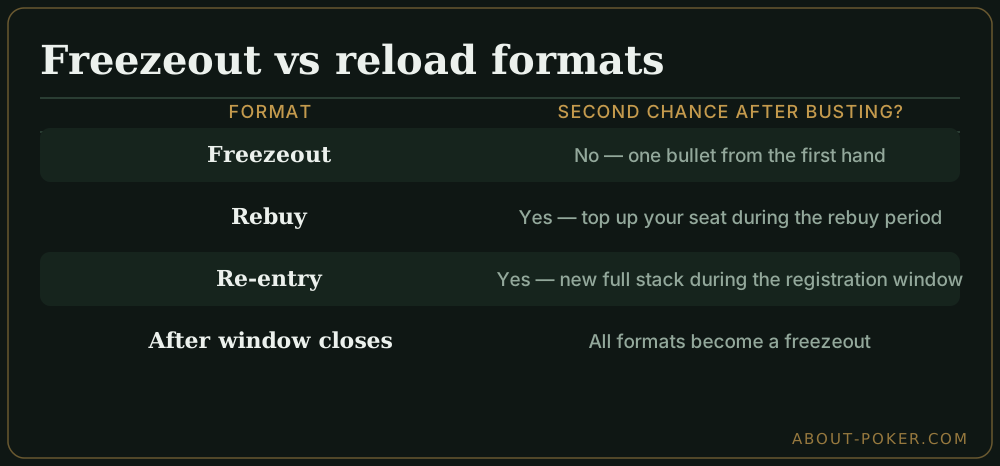
The freezeout is easiest to understand alongside the formats that break its single-life rule. The table below lays out the differences across the details that shape your decisions.
The short version: a rebuy or re-entry event gives you extra bullets during a defined window, so early busting is not fatal. A freezeout gives you one bullet from the very first hand, which makes early discipline far more valuable.
Why the format changes how you play
Because you cannot reload, a needless early bust is catastrophic in a way it simply is not in a rebuy. In a rebuy, taking a marginal all-in flip early is often correct — if you lose, you reload and keep building. In a freezeout, that same flip is a coin toss on your entire tournament life for a pot that barely dents the blinds. Disciplined freezeout players therefore avoid low-reward gambles early and let their skill edge work over many streets.
For the full tactical playbook — stage-by-stage adjustments, bubble play, and worked hands — see the dedicated freezeout strategy guide. This page is about understanding the format itself.
A worked example
It is Level 2 of a freezeout, blinds 100/200, and you hold pocket kings 150 big blinds deep. A player opens to 500 and one player calls. Shoving all-in here would be a serious error: you would be risking 150 big blinds to win about 1,200 chips, putting your whole tournament on the line for a tiny reward. The correct play is to raise to roughly 1,800 and keep the pot proportional to the blinds, using your position and postflop skill to win a bigger pot later. Now imagine the identical hand in an unlimited-rebuy event during the rebuy period — jamming becomes far more defensible, because a loss just means reloading. Same hand, opposite context, because of the single-life rule.
Stage awareness in a freezeout
Freezeout strategy tracks the stages of a tournament. Early, with deep stacks and small blinds, you play patient, positional poker and avoid needless risk. In the middle, as blinds and antes rise, you open up your stealing and pressure medium stacks — this is where most chips are made. Late and on the bubble, ICM and pay-jump pressure peak, and because there is no rebuy to fall back on, the survival premium is at its highest. A needless bust on the bubble of a freezeout costs you a guaranteed cash.
Bottom line
A freezeout is a single-entry tournament with no rebuys or re-entries: bust once and you are done. That one rule makes chip preservation more valuable, punishes reckless early gambles, and elevates ICM in the late stages. It is the purest test of tournament skill, which is why the game’s biggest titles are all freezeouts.
Frequently asked
What is a freezeout in poker?
A freezeout is a tournament with no rebuys, add-ons, or re-entries. You buy in once, receive your starting stack, and when your chips are gone you are eliminated. It is the original and purest tournament format, and it is what most people picture when they think of a poker tournament.
Is a freezeout the same as a single-entry tournament?
Effectively yes. 'Single entry' means you can only buy in once, which is the defining feature of a freezeout. The term freezeout emphasizes that there is no way back in once you bust, while 'single entry' is the phrase you will often see on a modern structure sheet.
How should freezeout strategy differ from a rebuy?
Because you cannot buy back in, survival matters more in a freezeout. In a rebuy you can gamble early knowing you can reload, but in a freezeout that same gamble ends your tournament. So freezeout play is more measured early and leans harder on chip preservation and ICM in the later stages.