What Is a Sit and Go Satellite
A sit and go satellite is a single-table game that awards a seat, not cash. Learn how it works, why survival beats chips, and how to fold your way in.
On this page · 6 sections
A sit and go satellite is a single-table sit and go whose prize is a seat into a larger, more expensive tournament instead of cash. It fills up, starts on its own schedule, and instead of paying the usual top three finishers, it hands identical seats to the top one or two. Finishing first wins you the same seat as scraping into the last qualifying spot — and that single fact rewrites how you should play every hand.
What “sit and go satellite” actually means
Break the name into two halves. A sit and go is a tournament with no scheduled start time: it begins the moment enough players register to fill the table, usually 6 or 9 or 10 seats. A satellite is any tournament that pays out entries to a bigger event rather than money. Stitch them together and you get a self-starting, single-table qualifier for a target tournament — a Main Event, a Sunday major, a high roller.
The economics are the whole story. In a normal single-table sit and go the payouts are graded: first might take 50 percent of the prize pool, second 30, third 20. In a satellite the prize is flat. If the game awards one seat, only that seat matters and everything below it is worth zero. If it awards two seats, the top two win the same thing and third place goes home empty. There is no reward for accumulating chips beyond the amount you need to be safe. That is the opposite of nearly every other format, and it is why satellite strategy plays so differently from regular tournament poker.
How the seats and buy-in math work
The number of seats is set by the buy-in ratio. Suppose a $12,000 Main Event and a $1,000 sit and go satellite with 12 entrants. The pool is $12,000 — exactly one seat — so one player qualifies. Now imagine 24 entrants at $1,000 each: $24,000 buys two seats, and often a small cash remainder for the odd chips. The lobby always tells you how many seats are up for grabs, and you should read it before you register, because “one seat” and “three seats” call for very different aggression.
Any prize pool left over after the seats are covered is usually paid as cash to the next finisher. If two seats and $2,400 of leftover money exist, third place might collect that $2,400. That changes the bubble: the player who busts in third here still wins something, so the pain of finishing “first loser” is softened compared with a pure single-seat game.
A worked example on the bubble
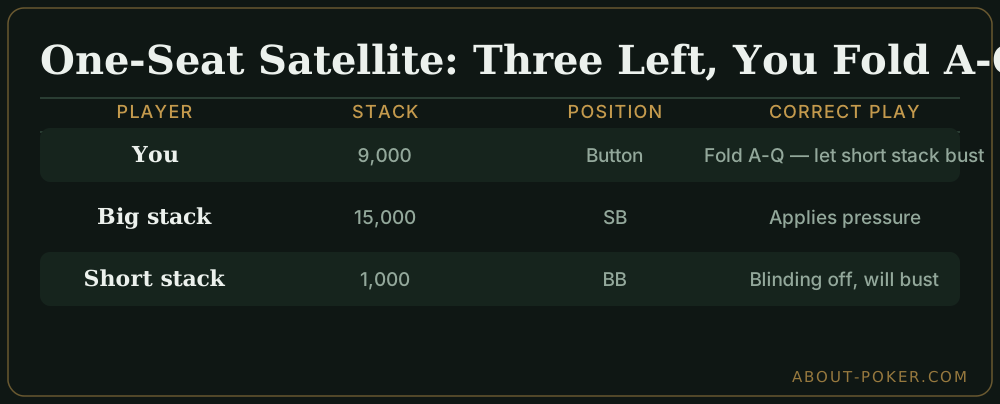
Say it is a one-seat, 10-handed satellite and three players remain. Blinds are 400/800. You have 9,000 chips, another player has 15,000, and the short stack has 1,000 — barely more than one big blind. You are dealt A-Q offsuit on the button.
In a cash-graded sit and go you would raise or shove this hand instantly. In a satellite you should almost certainly fold. The short stack is about to be blinded off; if you simply pass, they will likely bust within an orbit and hand you the seat for free. Calling or shoving A-Q risks a coin-flip that could cripple you against the big stack and let the short stack double. When you are not the shortest stack and someone else is on life support, your best weapon is patience. You are not trying to win chips — you are trying to outlast one specific player. This survival-over-chips logic is covered in depth in the satellite bubble strategy guide.
Common mistakes players make
The biggest error is playing a satellite like a regular sit and go — calling all-ins with premiums when you are already comfortably safe. A-K is a monster hand normally, but if folding it guarantees your seat, calling is a straight-up mistake because the chips you win are worthless and the chips you lose can bust you.
The mirror-image mistake is folding too much when you are the short stack yourself. If you are the one who will bust first, patience does nothing for you; you have to gamble to build a survivable stack. Correct short-stack play here leans on push-fold ranges tightened for the flat payout. Finally, players forget to count seats: a two-seat game with three left is a very different bubble from a one-seat game with three left, and treating them the same costs equity.
How play shifts by stack and stage
Early on, before the bubble, a sit and go satellite plays close to normal — steal blinds, build a stack, avoid marginal all-ins. The distortion intensifies as you approach the number of remaining players that equals the number of seats plus one. That is the true bubble.
As a big stack near the bubble, you become a bully: shove relentlessly into medium stacks who cannot call without risking their own seat. As a medium stack, you tighten dramatically and let the short stacks fight. As a short stack, you shove first and pray, because folding only delays your death. The comfortable middle stack that is not the shortest is the safest place to be — you can fold into a seat while others eliminate each other.
Quick checklist before you register
- Confirm how many seats the game awards and what the leftover cash prize is, if any.
- Decide your target: you want to reach a safe stack, not the chip lead.
- Play close to normal until you near “seats plus one” players left.
- Once safe, fold almost everything and let short stacks bust.
- If you are the shortest stack, abandon patience and shove to survive.
- Never call off a comfortable stack with a premium when folding locks the seat.
Frequently asked
What is a sit and go satellite?
It is a single-table sit and go whose prize is a seat into a bigger event rather than cash. The game starts as soon as the table fills, and the top finishers each win an identical seat, so first place and the last qualifying spot are worth exactly the same.
How many seats does a sit and go satellite award?
Usually one or two, depending on the buy-in ratio. A 10-handed table with a buy-in one-tenth of the target event typically awards one seat; larger fields or cheaper targets can award more. The lobby always states the exact number before you register.
Is a sit and go satellite easier than a regular sit and go?
Strategically it is different, not easier. Because every seat pays the same, chips beyond what you need to qualify are nearly worthless, so tight survival play has a huge edge over opponents who keep gambling as if chip leading matters.