What Is the WSOP Main Event
The WSOP Main Event is poker's world championship: a $10,000 No-Limit Hold'em freezeout. Learn its buy-in, structure, payouts, and why it plays so slow.
On this page · 7 sections
The World Series of Poker Main Event is the closest thing poker has to a world championship. It is a $10,000 buy-in No-Limit Hold’em tournament held each summer in Las Vegas, and the winner is widely regarded as the world champion for that year. Thousands of players enter, the prize pool climbs into the tens of millions, and the eventual winner takes home a bracelet, a multimillion-dollar first prize, and a permanent place in the game’s history. This page explains what the Main Event actually is, how it is structured, and why it plays so differently from the tournaments most players are used to.
What the Main Event is
At its core the Main Event is a large-field, deep-stack freezeout. “Freezeout” means single entry: you pay your $10,000, you receive your starting stack, and when those chips are gone your tournament is over. There is no re-entry and no rebuy, which is unusual for a modern flagship event and a big part of why the title carries so much weight.
The format is No-Limit Texas Hold’em, the most widely played variant in the world. The field routinely exceeds several thousand entrants — in recent years it has drawn well over 8,000 players — which puts it squarely in the category of a large-field tournament where you must survive an enormous crowd before the money even begins.
Buy-in, satellites, and prize pool
The headline number is the $10,000 buy-in. That is a serious sum, so most amateurs do not pay it directly. Instead they win their seat through satellites — smaller, cheaper tournaments whose top finishers receive a Main Event entry instead of cash. Chris Moneymaker famously turned a small online satellite into the 2003 title, and the “satellite path” has been feeding the field ever since.
Because thousands of players each contribute $10,000, the prize pool is massive. The organizers take a small fee for staff and overhead, and the rest is paid out to roughly the top 15% of the field. First place is typically several million dollars, while a min-cash returns a modest multiple of the buy-in.
The structure that makes it special
The defining feature of the Main Event is its slow, deep structure. Players start with a large chip stack — in modern years 60,000 chips — relative to small opening blinds, and blind levels last two hours. That combination produces one of the deepest, most patient tournaments in the world.
The slow structure explained
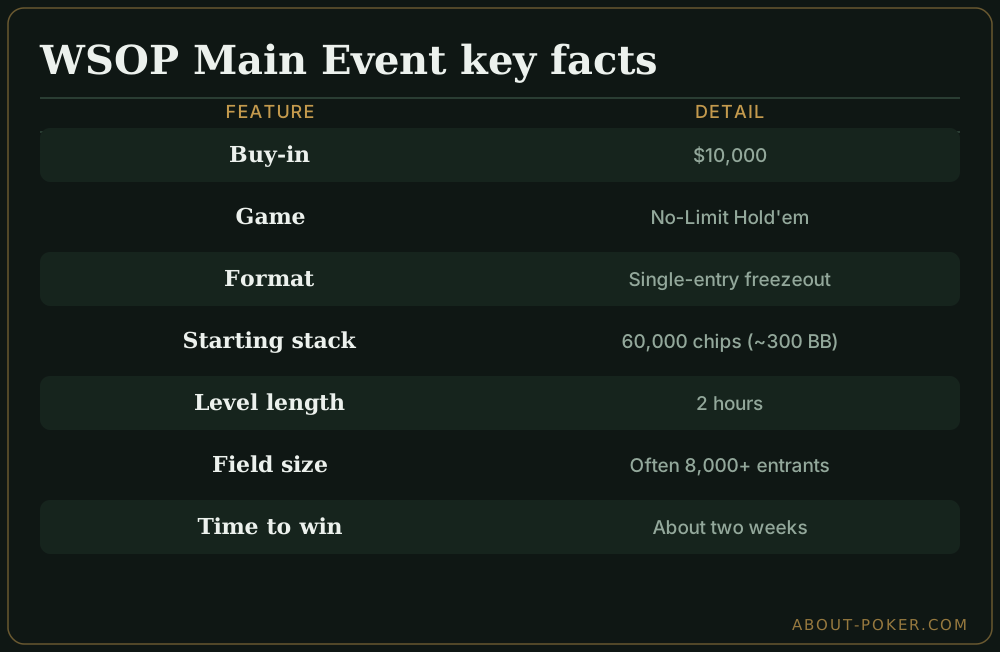
Here is why the numbers matter. Starting with 60,000 chips against blinds of 100/200, you begin 300 big blinds deep. In a typical online turbo you might start 50 big blinds deep with 5-minute levels. That difference is enormous. With 300 big blinds and two-hour levels, there is no early pressure to gamble; skill has room to express itself over many streets and many hours. This is why the Main Event rewards a patient, postflop-heavy deep-stack approach rather than the push-or-fold play that dominates faster events.
A worked example of how deep it plays
Suppose it is Level 1, blinds 100/200, and you hold pocket kings on the button with your full 60,000 stack. A player opens to 500 and gets one caller. You could shove all-in, but that would be a mistake here: you are 300 big blinds deep, and jamming 300 blinds to win 1,200 risks your entire tournament to pick up a tiny pot. The correct play is to raise to around 1,800, keep the pot proportional to the blinds, and use your positional and skill edge on later streets. Contrast that with a short-stack spot 12 big blinds deep, where shoving kings is standard. The Main Event’s depth is precisely what turns simple decisions into rich ones.
Why it takes two weeks
Because the field is so large, the event cannot start everyone at once. It runs multiple starting flights over several days, with survivors combining into one field. From there the tournament grinds through daily sessions of roughly ten to twelve hours, and it takes about two weeks to go from thousands of hopefuls to a single champion holding the bracelet.
Bottom line
The WSOP Main Event is poker’s marquee event: a $10,000 single-entry No-Limit Hold’em freezeout, deep-stacked, slow-structured, and open to anyone who can find a seat by cash or satellite. Its combination of prestige, prize money, and patient structure is exactly why it remains the tournament every serious player dreams of winning.
Frequently asked
How much is the WSOP Main Event buy-in?
The buy-in is $10,000. That figure has been the standard since the modern era of the event, and it grants a single entry into a freezeout — there are no re-entries in the Main Event. Many players reach it through cheaper satellites rather than paying the full amount directly.
Is the WSOP Main Event a freezeout?
Yes. The Main Event is a single-entry freezeout: you buy in once, and when your chips are gone you are eliminated. This is part of what makes it the most prestigious title in poker — every decision carries your whole tournament life, with no reload safety net.
How long does the WSOP Main Event take to win?
Winning the Main Event typically takes around two weeks. Play is spread across multiple starting flights, then daily sessions of roughly 10-12 hours as the field narrows from thousands of entrants down to a final table and eventually one champion.