Moving Up in Stakes Safely
A safe, repeatable system for moving up in stakes: the bankroll and win-rate triggers, a move-down rule that protects you, and a worked progression.
On this page · 6 sections
Moving up in stakes is where careers are made and rolls are wrecked. Do it on readiness and a full bankroll, and it is the natural way to compound your edge into real money. Do it on a heater, on tilt, or on a roll that only just touches the threshold, and you hand back months of work in a weekend. The difference is not courage — it is having a system, and following it even when your gut wants to jump early.
The three triggers that make a move safe
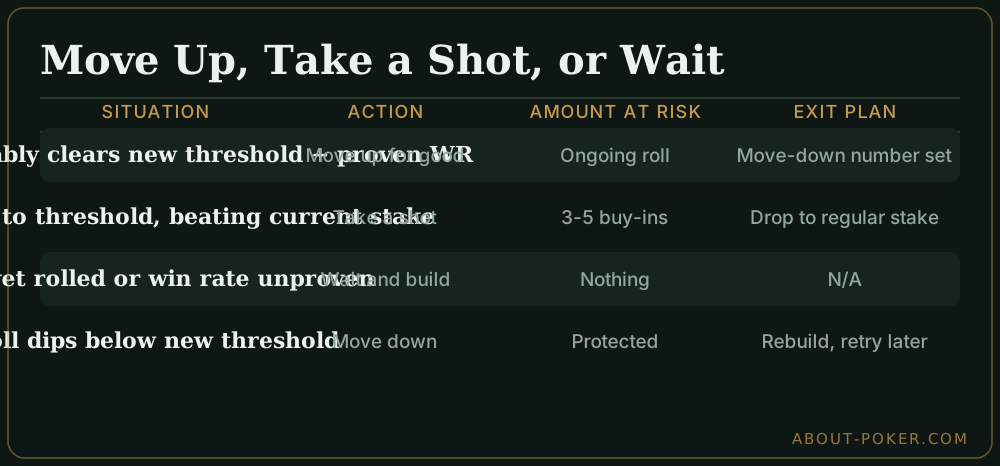
A safe move up requires all three of these at once. Any one alone is a trap.
Bankroll readiness. You hold the full buy-in requirement for the new stake, with cushion — not just enough to sit down. If NL100 asks for 40 buy-ins, that is a $4,000 roll before you belong there, layered on the same principles as your current stake’s requirements.
A proven win rate. You are actually beating your current stake over a meaningful sample — tens of thousands of hands online, a long stretch of sessions live. A month of running good is not proof. You want evidence your edge is real before you pay tougher opponents to test it.
The right reason. You are moving up because you are ready, not because you are bored, chasing a loss, or trying to prove something. The wrong reason is the single most common cause of blown rolls.
Why a move-down rule is the real safety net
Here is the counterintuitive part: the thing that makes moving up safe is a firm plan for moving down. Before you sit at the higher stake, decide the exact bankroll number that sends you back. Typically it is the buy-in threshold for the new level — if your roll dips below it, you drop down, no discussion.
This removes ego from the decision at the exact moment ego is most dangerous. Without a pre-set trigger, a losing run at higher stakes tempts you to “win it back at the level where I lost it,” which is precisely how a manageable downswing becomes a busted account. A clear move-down rule turns a scary situation into a routine one: drop, rebuild, try again. Players who move up and down fluidly outlast players who only ever move up.
Shot-taking as the gentle on-ramp
You do not always have to commit fully. A shot lets you test the higher stake while risking only a small, pre-set slice of your roll — usually 3 to 5 buy-ins of the new level, or roughly 10-15% of your bankroll. If you lose the shot fund, you drop straight back to your regular stake, intact and unshaken. If you run it up, you have both money and evidence you can compete. This is the safest possible way to move up, and it is covered in depth in shot-taking. Full commitment is best saved for when your roll comfortably clears the threshold and your shots have already gone well.
Worked example: a clean progression
Say you are a $10,000 bankroll grinding NL100 ($100 buy-in), which at a 40-buy-in rule is $4,000 required — you are well over, so you belong. You want NL200, which needs $8,000 at the same rule. You are not there yet, so you do not simply sit down at NL200.
Instead you take a shot: you set aside 5 buy-ins ($1,000) for NL200 and keep the other $9,000 as your working roll. Your stop-loss is those 5 buy-ins. Scenario A — the shot goes well and you finish up $600; your roll is now $10,600, and after a few successful shots you push toward the full $8,000-NL200 threshold and move up for good. Scenario B — you lose all 5 buy-ins; you are back to $9,000, still fully rolled for NL100, and you take another shot next month. Either way you never risked the career. Notice what you avoided: sitting at NL200 with a $6,000 roll, losing 8 buy-ins, and being both under-rolled and tempted to chase.
Common mistakes when moving up
- Touching the threshold and jumping. Reaching the number for one hour is not the same as holding it. Move up when you comfortably clear it.
- No move-down rule. Without a pre-set exit, a normal downswing at the new stake turns into a bust.
- Moving up on a heater. A hot week inflates your roll and your ego at once. Let sample size, not variance, decide.
- Skipping the shot. Full commitment when you are barely rolled is the riskiest path. Shot first.
- Comparing to others. Someone else’s stakes are irrelevant to your roll and win rate. Race no one.
A quick move-up checklist
- Do I hold the full bankroll for the new stake, with cushion?
- Have I proven a win rate over a large sample at my current stake?
- Am I moving up out of readiness, not boredom or a loss to chase?
- Have I set the exact move-down number before I sit?
- Would a shot be the smarter first step than a full commitment?
Move up on all five, and you climb for good. Skip any of them, and you are gambling with your career, not building it.
Frequently asked
When is it safe to move up in stakes?
When three things line up: your bankroll meets the full buy-in requirement for the new stake, you have a proven win rate over a large sample at your current stake, and you are moving up out of readiness rather than boredom or the urge to win money back.
How many buy-ins do I need before moving up?
Move up only when you hold the complete bankroll for the higher stake, not just enough to sit down. For cash that is often 30-50 buy-ins of the new level; for tournaments, 100+. Reaching the threshold is the green light, not just touching it.
Should I move up all at once or take a shot first?
For most players a shot is the safer on-ramp. You risk a small, pre-set number of buy-ins at the higher stake while keeping your regular roll intact, then commit fully only once you've shown you can hold your own.
What if I lose after moving up?
Have a move-down rule set in advance. If your roll falls back below the threshold for the new stake, drop down without ego, rebuild, and take another run later. The move-down rule is what makes moving up safe.