The Poker Bankroll Challenge
A poker bankroll challenge means building a roll from a tiny start using strict rules. Here's a step-by-step plan and a worked example from $50 up.
On this page · 9 sections
A poker bankroll challenge is a self-imposed project: start with a tiny roll and grow it to a target using strict bankroll rules — moving up only when your buy-in count clears the next stake, and moving down the moment a downswing pulls you back. Done right, it’s less about the money and more about proving you can follow the discipline that separates long-term winners from busted players.
What a bankroll challenge really tests
The appeal is obvious: turn $50 into $5,000 through skill alone. But the real value isn’t the profit — it’s the rule-following. A challenge forces you to:
- Play only the stake your roll covers at a fixed buy-in count.
- Move up slowly and move down instantly.
- Resist the urge to jump stakes to “speed things up.”
Master those three habits on a small roll and they’ll protect a large one for the rest of your playing life. That’s why a challenge is a training ground first and a money-maker a distant second.
The rules that define a challenge
Pick your parameters before you start and write them down:
- Starting stake: a small, defined amount you’re happy to lose.
- Buy-in count: 25–30 buy-ins for cash, tighter than usual because a small roll can’t absorb bad luck.
- Move-up trigger: move up only once your roll fully covers the next stake at your chosen buy-in count (e.g. 25 buy-ins). If you want an extra safety margin, wait for a small cushion beyond that before jumping.
- Move-down trigger: drop a level the instant you fall below your current stake’s count.
- Withdrawal rule: no cashing out until you hit your target, so the roll compounds.
The move-down rule is the one people quietly abandon — and abandoning it is how nearly every challenge dies.
Worked example: a $50 challenge
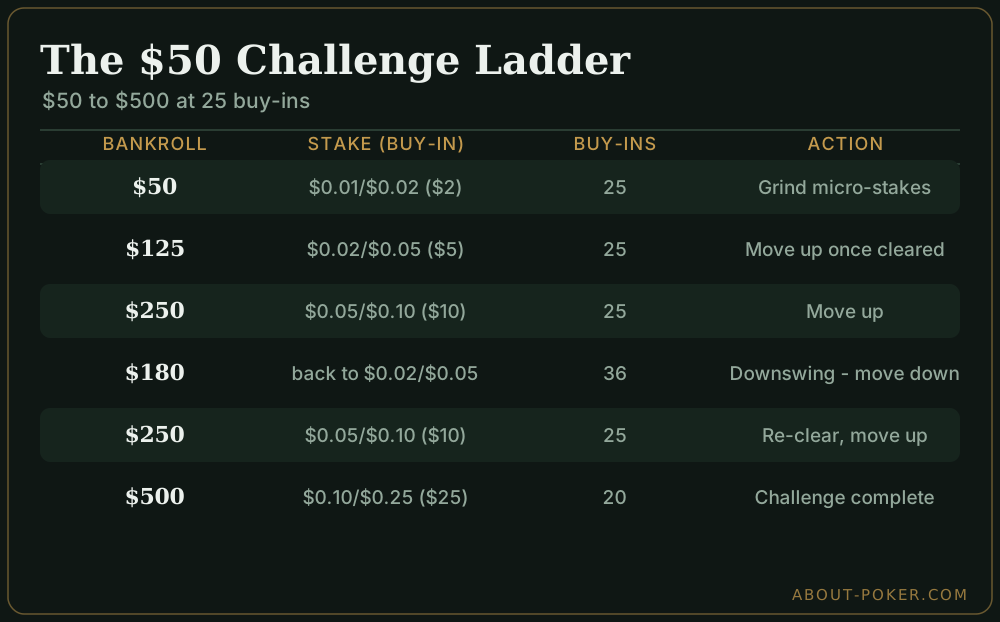
Start with $50 and a target of $500, using 25 buy-ins for cash:
| Stage | Bankroll | Stake (buy-in) | Buy-ins | Action |
|---|---|---|---|---|
| Start | $50 | $0.01/$0.02 ($2) | 25 | Grind micro-stakes |
| Grow | $125 | $0.02/$0.05 ($5) | 25 | Move up once cleared |
| Grow | $250 | $0.05/$0.10 ($10) | 25 | Move up |
| Setback | $180 | back to $0.02/$0.05 ($5) | 36 | Downswing — move down |
| Recover | $250 | $0.05/$0.10 ($10) | 25 | Re-clear, move up again |
| Target | $500 | $0.10/$0.25 ($25) | 20 | Challenge complete |
Notice the setback row. Downswings aren’t a failure of the plan — they’re built into it. The player moves down to $0.02/$0.05, protects the roll, rebuilds, and moves back up. That single dip is where most challenges collapse, because it’s tempting to stay put and “wait it out.” Don’t. Move down.
Where a starting stake comes from
You don’t always need to deposit much. Common sources for a small starting roll:
- A modest deposit you’re comfortable losing — $20 to $50 is plenty for micro-stakes.
- Free-roll tournaments, which cost nothing to enter and pay small prizes.
- No-deposit sign-up offers, where they exist and where you meet the terms.
Whatever the source, the moment you have a roll, the rules above take over. The beginner’s bankroll guide covers starting from the very bottom in more depth.
The two things that quietly slow a small roll
Before you obsess over win rate, account for rake — the cut the site takes from each pot (or tournament entry). At micro-stakes it is proportionally brutal: with tiny pots, a fixed rake cap eats a large share of every hand, and it’s the single biggest reason so many micro players hover near break-even despite playing well. It’s why beating $0.01/$0.02 is often harder than the stake above it, and why volume alone doesn’t guarantee growth. Choosing softer games and, where offered, earning rakeback or reward-tier credits back can matter as much as your edge.
If you run a tournament (MTT) or sit-and-go challenge instead of cash, the buy-in math changes. Tournament variance is far higher than cash, so the usual guidance is a much larger cushion — commonly 50–100 buy-ins for single-table SNGs and 100+ for larger-field MTTs, versus the 25–30 used for cash above. Your “stake” is the buy-in level (e.g. $1 → $2 → $5 tickets), and you move up only when your roll clears that higher count. Freerolls fit naturally here: they seed a roll at zero cost, after which the same move-up and move-down discipline applies.
Why patience is the whole game
At micro-stakes, edges are real but pots are tiny, so growth is slow and downswings feel disproportionately large. A challenge is measured in months, not days, and long flat stretches are guaranteed.
Put concrete numbers on it. A solid winning regular at the lowest stakes might sustain a win rate of roughly 4–6 bb/100 hands over a large sample (many players run closer to break-even, and rates fall as you climb). At $0.01/$0.02, one big blind is just $0.02, so 5 bb/100 is about $0.10 profit per 100 hands. Growing the $50 start to $125 — a $75 gain — therefore takes on the order of 70,000–80,000 hands of winning play, before variance is even counted. Even multi-tabling a few thousand hands a day, that’s weeks of grinding for a single move-up, which is exactly why the timeline is measured in months.
The players who finish aren’t the most talented — they’re the ones who kept following the rules when the graph went sideways. That mental steadiness is the real prize, and it’s exactly what the mental game hub helps you build.
Tracking progress without obsessing
A challenge lives or dies on honest record-keeping, but there’s a trap: checking your graph after every session turns normal variance into an emotional roller-coaster. The fix is to track diligently but review on a schedule — after a set number of hands or once a week — rather than reacting to every swing. What you’re watching for isn’t the day-to-day balance but two things: whether your buy-in count still clears your current stake, and whether your win rate over a real sample is genuinely positive. If both hold, the plan is working even when the graph dips.
Set a realistic checkpoint structure, too. Rather than fixating only on the final target, mark intermediate milestones — doubling the starting roll, clearing each stake for the first time — so the long micro-stakes grind has smaller wins along the way. Momentum in a bankroll challenge is as much psychological as financial.
Common ways challenges fail
- Skipping the move-down. Staying at a stake your shrinking roll no longer covers is the number-one killer.
- Impatience. Jumping two stakes on a hot streak, then getting wiped when it ends.
- Under-rolling from the start. Beginning at a stake your $50 can’t cover at 25 buy-ins.
- Withdrawing early. Pulling profit before the target stops the compounding that makes the whole thing work.
The point of it all
A bankroll challenge turns abstract rules into a game you can win by following them — and the discipline you build scales to any stake you’ll ever play. Set clear parameters, honor the move-down rule, and treat downswings as part of the plan. When you’re ready to think about the transitions in detail, see when to move up in stakes, and anchor the whole approach in the bankroll management hub.
Frequently asked
What is a poker bankroll challenge?
A bankroll challenge is a self-set project to grow a small starting roll to a target using strict bankroll rules — moving up in stakes only when your buy-in count allows, and moving down when it doesn't. It's a discipline exercise as much as a money one.
Can you build a poker bankroll from nothing?
Almost — you need a small starting stake, sometimes as little as $20–$50, and micro-stakes patience. Some players start from free-roll tournaments or no-deposit bonuses, then apply strict bankroll rules to grow it.
How long does a bankroll challenge take?
There's no fixed timeline. Growth depends on your win rate, volume, and variance, and downswings will stall you for weeks. Treat it as a long project measured in months, not a get-rich scheme.
What stakes should I start a challenge at?
Start at the lowest micro-stakes your roll covers at 25–30 buy-ins — often $0.01/$0.02 or $0.02/$0.05 online. The whole point is to never over-extend, so begin far lower than feels exciting.