Best Poker Cash Game Books & Study Path
The best poker cash game books depend on your level. A short reading ladder plus the review loop that actually turns pages into a winrate.
On this page · 4 sections
There is no universal “best” poker cash game book — the right one is aimed at the leak costing you money right now. A beginner overplaying weak hands needs a fundamentals text on position, ranges, and pot odds. An intermediate player who keeps missing value needs a book on bet sizing and board texture. Buy for the hole in your game, not for the title everyone recommends.
A reading ladder
The durable classics still map onto this progression well: the Harrington on Cash Games volumes and Ed Miller’s fundamentals work sit in the lower-middle rungs, and Matthew Janda’s theory-heavy titles sit near the top.
- Just starting: NL hold’em cash fundamentals — position, starting hands, pot odds. You’re fixing “too many hands, too many calls.”
- Improving: bet sizing, board texture, value-versus-bluff balance. You’re fixing missed value and bluffs into calling stations.
- Intermediate: range-based thinking, 3-bet pots, hand reading. You’re learning to stop playing just your two cards.
- Advanced: solver concepts and exploitative adjustments. You’re fixing predictability against strong regulars.
Specific books, mapped to the ladder
Below are widely respected cash-game titles slotted onto the rungs above. “Best” is genuinely contested, so treat this as a shortlist by leak and stakes rather than a strict ranking — buy the one that matches where you’re stuck.
| Book (author) | Best for | What it teaches |
|---|---|---|
| Crushing the Microstakes — Nathan Williams | Just starting (online micros) | Tight-aggressive fundamentals, value betting, and beating passive low-stakes pools. |
| The Course — Ed Miller | Just starting → improving (live) | A stakes-by-stakes skill progression for live $1/$2 and up: reads, sizing, and river decisions. |
| Harrington on Cash Games, Vol. 1 & 2 — Dan Harrington & Bill Robertie | Improving | Bet sizing, pot geometry, and hand-by-hand reasoning; a classic, but refresh its preflop ranges. |
| Poker’s 1% — Ed Miller | Improving → intermediate | Frequency-based thinking — how often to bet, call, and fold — as the bridge to range-based play. |
| The Grinder’s Manual — Peter Clarke | Intermediate (6-max online) | Range construction, 3-bet pots, and a complete modern online cash framework. |
| Applications of No-Limit Hold’em — Matthew Janda | Advanced | Balanced betting theory and combinatorics — the “why” behind balanced lines. |
| Modern Poker Theory — Michael Acevedo | Advanced | Solver-based GTO concepts and how to apply equilibrium ideas to real spots. |
If you play mostly live, weight The Course and Harrington; if you grind online 6-max, start with Crushing the Microstakes then The Grinder’s Manual. Editions matter less than era: any pre-2015 title predates modern solver ranges, so read those for concepts and pull current frequencies from the preflop GTO hub.
Two cautions. First, any book from before the solver era carries dated preflop ranges and some too-passive lines, because modern games run more aggressive — read those books for concepts, then refresh your opening and 3-betting frequencies from a current chart or the preflop GTO hub. Second, a solver-heavy theory book is wasted on someone who still opens too many hands under the gun. Theory explains why a line is balanced; at low and mid stakes the money comes from exploiting mistakes, not from equilibrium play. Learn the “why,” then deviate to punish the leaks in front of you.
Books or a course?
Books are cheaper and better for building a mental model at your own pace. Courses add structured video, worked-hand walkthroughs, and often a coach or community to catch your blind spots — worth it once you know which leak you’re targeting. Most winning players read first, then buy a course only after a database review tells them exactly where they lose.
The part that actually raises your winrate
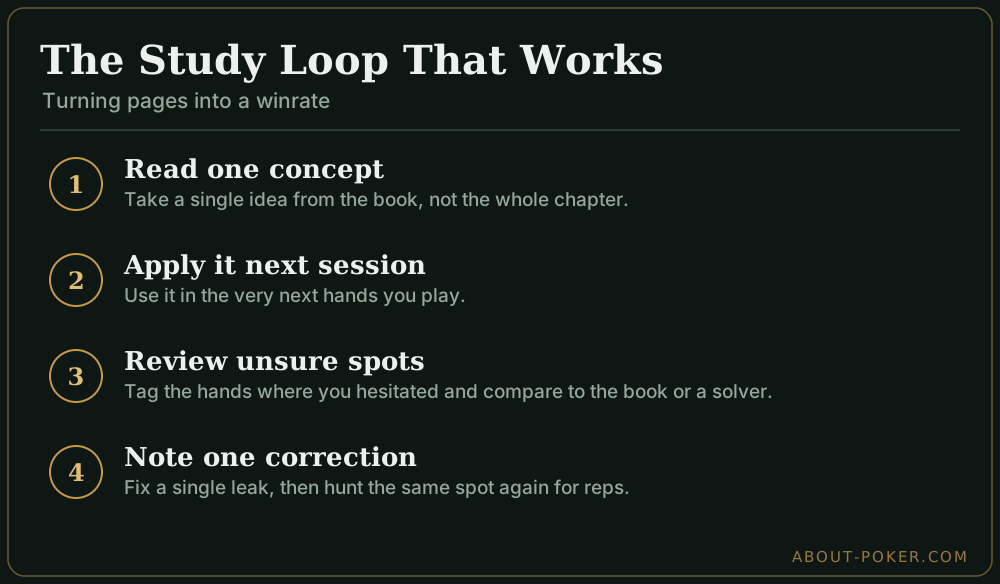
Reading is the easy tenth. The rest is a tight loop: read one concept, apply it in your very next session, and afterward review the hands where you were unsure. Tag those spots, compare your line to the book or a solver, note the one correction, and hunt for the same spot next time. A concept becomes an instinct through reps, not re-reads.
Rotate the free guides — beating micro-stakes cash games and cash game preflop strategy — as reinforcement between chapters, and consolidate everything into the core poker cash game strategy guide.