How to Beat Micro-Stakes Cash Games
Micro-stakes cash games reward value betting, volume, and rake awareness — not bluffs. A worked hand and a leak checklist for beating 2NL through 25NL.
On this page · 8 sections
To beat micro-stakes cash games — roughly 2NL through 25NL online — you value bet relentlessly, bluff rarely, respect the rake, and play enough volume to convert a small per-hand edge into real money. Fancy plays lose here. The field calls too much and folds too little, so your profit comes almost entirely from getting paid with strong hands.
Your opponent is a calling station
Micro fields are full of recreationals who chase draws without odds, pay off with second pair, and refuse to fold a made hand. That single tendency writes most of your strategy for you:
- Value bet thin and often — they’ll pay you off with worse.
- Bluff rarely — you cannot fold out someone who never folds.
- Size up for value — big bets don’t scare them, so charge them.
This is the online cousin of the soft live game; the same value-heavy logic runs through beating low-stakes cash, just scaled to a faster, higher-volume environment.
What to open, and from where
Value comes from strong hands, so the first job is entering pots with a raise and a range that plays well post-flop. These are tight, beginner-friendly opening ranges for a full-ring or 6-max table with no one in yet — open to about 3bb (add 1bb per limper). Tighten early, widen on the button:
| Position | Open range (approx.) | % of hands |
|---|---|---|
| UTG / early | 77+, AQ+, KQs, AJs | ~9% |
| Middle | 55+, AJ+, KQ, KJs, ATs, suited broadways | ~14% |
| Cutoff | 22+, A9+, KTs+, QTs+, suited connectors 65s+ | ~22% |
| Button | 22+, any A, K9s+, most suited/offsuit broadways, 54s+ | ~40% |
| Small blind | 55+, ATo+, KQ, suited-ace/broadway raises | ~15% |
Against limpers, isolate wide with a raise rather than limping behind — a limped multiway pot is exactly the raked, capped spot micro-stakes punishes. Facing a raise, 3-bet a tight linear range (QQ+, AK, and AQs/JJ against loose openers) for value; at these stakes, skip the light “balancing” 3-bet bluffs almost entirely, since folds are rare.
Bet sizing and frequency
Because the field is inelastic — it calls the same whether you bet small or large — you exploit it by sizing up with value and firing thin, not by hitting textbook percentages. A simple framework:
- C-bet selectively, not universally. Aim for roughly a 50–65% c-bet frequency, favoring boards that hit your range (A-high, K-high, paired). On wet, low, coordinated boards versus a station, check your air and give up — you can’t fold them out anyway.
- Size for value. Use ~33% pot on dry boards where you’re mostly value-betting or giving up cheaply, and 66–100% pot on wet boards and with your strong hands. Stations don’t fold to size, so charge draws and worse pairs the maximum.
- 3-barrel your value, not your bluffs. With a genuine value hand, keep betting turn and river; the biggest single winrate boost at micro is getting all three streets in with the best hand.
- Bluff-catch, don’t bluff. When a station suddenly raises or leads big on the river, believe it and fold marginal hands — passive players rarely turn a made hand into a bluff.
The rake is a second opponent
At these stakes the house’s cut is proportionally brutal — a few cents off every small pot adds up to a big share of the money and can drag a marginal winner down to break-even. Beat it by playing fewer, better, bigger pots: enter with a raise rather than a passive limp, skip the raked multiway junk, and prioritize spots where a full stack is on the line instead of a small capped pot.
Volume, variance, and the roll
Micro pots are tiny, so even a strong winrate produces small hourly profit in dollars. Winrate is measured in big blinds per 100 hands (bb/100). A solid, beatable target at micro is 5–10 bb/100; the very best regulars manage more, but expect the number to shrink as you move up and the fields toughen. Put that in dollars at 5NL ($0.05 big blind): 7 bb/100 is $0.35 per 100 hands. A single table online deals roughly 60–100 hands per hour, so a lone table earns cents; four tables at ~75 hands each is ~300 hands/hour, or about $1/hour — which is exactly why volume, not any single session, is the plan.
That volume also means more variance. That’s why a healthy cushion matters: a practical guideline is 30–50 buy-ins for your level, not because of the money at risk per session but because you’ll ride out downswings across tens of thousands of hands. The bankroll management hub covers sizing the roll for those swings.
Worked hand: getting paid
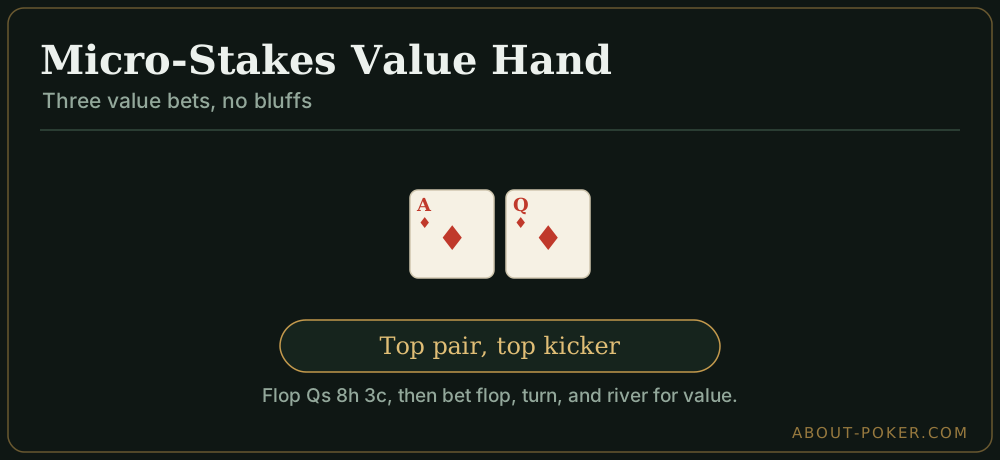
You raise A♦ Q♦ from the button and one recreational player calls. Flop Q♠ 8♥ 3♣ — top pair, top kicker.
- Flop: bet ~60% pot. A station calls with worse queens, eights, and floats.
- Turn
5♦: bet larger, ~75% pot. You’re value betting; stations don’t punish size, so charge them. - River
2♣: bet again — many micro opponents pay off with any pair or even ace-high.
Three value bets, no bluffs, no fancy lines. That is how micro profit is actually made.
Worked hand: the marginal spot
Not every hand is top pair. You raise A♣ J♠ from the cutoff and the big blind calls. Flop J♥ 9♥ 7♠ — top pair, decent kicker, but a wet, draw-heavy board on which a station will call with flush draws, straight draws, and worse jacks.
- Flop: bet ~66% pot. This is value and protection — you’re charging the many draws that will call, not trying to fold anyone out.
- Turn
2♦: a blank. Bet ~66% again for value; worse jacks and busted-but-hopeful draws still call. - River
Q♥: the front-door flush comes in and a straight completes. Now check. A♣J♠ is a bluff-catcher here, not a value hand: a station leading or raising big on this river almost always has the flush, straight, or two pair, and will rarely bet worse. Check, and fold to a large bet.
The lesson: value-bet the streets where worse hands call, but recognize when your top pair has become a bluff-catcher and stop firing. Discipline on the river saves more than heroics win.
Before you move up
Kill these leaks first:
- Bluffing calling stations — the number-one bankroll killer. For when a bluff is worth it (a thinking regular, a credible board, a hand with backup equity), see when bluffing actually works — then use it sparingly.
- Limping into raked pots instead of raising.
- Playing too many hands out of position.
- Slow-playing hands that a straightforward bet would have gotten paid.
- Ignoring table quality — table and seat selection shows you how to sit where the weak players are.
Master this unglamorous style and the habits scale up cleanly. The rest of the system lives in the cash game strategy hub.
Frequently asked
What are micro-stakes cash games?
Micro-stakes are the lowest online cash stakes, typically from 2NL ($0.01/$0.02 blinds) up through 25NL ($0.10/$0.25). They're populated mostly by recreational and beginner players, which makes them beatable but slow-moving in real dollar terms.
Why is rake such a big deal at micro-stakes?
Rake is a percentage of each pot, so at tiny stakes it eats a large share of small pots and can turn a marginal winner into a break-even player. Playing fewer, larger, higher-quality pots and avoiding rake-heavy limp-fests protects your winrate.
How big a bankroll do I need for micro-stakes?
A common guideline is at least 30–50 buy-ins for the level you play. The extra cushion absorbs the variance of grinding tens of thousands of hands against unpredictable opponents who will call you down with anything.