5-Card PLO vs 4-Card PLO: Key Differences
5-card PLO vs 4-card PLO: how the extra card changes equities, ranges, and study, plus what solvers like MonkerSolver reveal and how to adapt.
On this page · 6 sections
5-card PLO and 4-card PLO run on the same skeleton — pot-limit betting and the strict two-card rule — but the extra hole card changes almost everything about equity, ranges, and study. With five cards you hold ten two-card combinations instead of six, so you hit the board far more often and the nuts wins less. The upshot is a game where discipline about nut potential matters even more, and where solver work is essential but much heavier to run.
Solving 5-card PLO in MonkerSolver: setup and workflow
MonkerSolver is the standard desktop CFR solver for Omaha, and it does support 5-card PLO natively — you pick the game type when you build the tree. The reason people search for it specifically is that 5-card trees are enormous, so the practical question isn’t whether it works but how to configure it so a run finishes on real hardware. Here is a concrete starting point.
Hardware and RAM. MonkerSolver is a RAM solver: the entire abstracted tree lives in memory. For 5-card PLO, plan around the tree size rather than a fixed number:
| Study type | Realistic RAM | Notes |
|---|---|---|
| Preflop range building (6-max, coarse buckets) | 32–64 GB | Doable on a strong desktop |
| Single flop, postflop with tight abstraction | 16–32 GB | Fastest way to learn |
| Full postflop, fine abstraction, 3-way | 128 GB+ | Often pushed to a cloud/dedicated box |
If a build exceeds your RAM, MonkerSolver either refuses to allocate or crawls — so size the tree down first, not the hardware up.
Abstraction and bucketing. This is the lever that makes 5-card feasible. Key settings:
- Card abstraction (bucketing). Reduce the number of turn/river buckets. Coarse clustering (fewer buckets) shrinks the tree dramatically at the cost of resolution; keep the flop finer than the river, since river detail matters less for the heuristics you’re extracting.
- Bet-size tree. Limit sizings — one or two flop sizes (e.g. 33% and pot) and a single turn/river size — instead of a full grid. Each extra sizing multiplies the tree.
- Rake and stack depth. Match the game you actually play (e.g. 100 bb, cash rake) so ranges aren’t distorted.
Accuracy target. Don’t chase zero. Run to a max exploitability of roughly 0.5–1% of the pot for study-grade ranges; the last fractions of a percent cost enormous extra time and rarely change the takeaways.
Example run times. These vary wildly with abstraction and CPU, but as a rough calibration: a single-flop postflop 5-card solve with tight buckets can finish in minutes to a couple of hours, while a full 6-max preflop range build can run overnight or longer. Coarsen the abstraction if a run won’t converge to your target in the time you have.
Step-by-step for a first 5-card study:
- Create a new tree, choose 5-card PLO as the game and set stack depth, positions, and rake.
- Build the bet-size tree with minimal sizings to keep it small.
- Set card abstraction — start coarse, verify it fits in RAM, then refine only if you have headroom.
- Run the solve to your ~1% exploitability target, not to zero.
- Browse ranges by node; export the strategy (or save the tree) so you can reload it later without re-solving.
- Optionally node-lock a villain tendency and re-solve to study the exploit.
The takeaways below explain what those solves actually reveal once they finish.
The math the extra card creates
The jump from four to five cards is not linear. The two-card combinations available to you are C(4,2) = 6 in four-card PLO and C(5,2) = 10 in five-card. That is a 67% increase in the ways your hand can touch the board: you flop more sets, more flush draws, and — most importantly — far more wraps, because more connected cards are in play. Equities run even closer than in four-card PLO, so a hand that would be a clear favorite there is often a coin flip in five-card. The rule itself never moves: exactly two hole cards plus exactly three board cards, whether you hold four cards or five.
How ranges and stack-offs shift
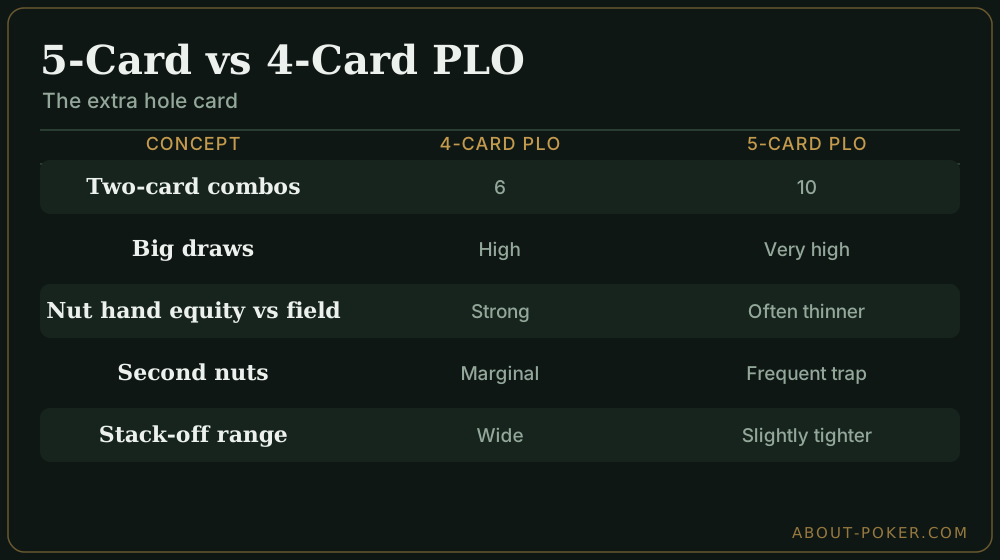
Because everyone makes strong hands more often, the value of any single strong hand drops.
| Concept | 4-card PLO | 5-card PLO |
|---|---|---|
| Two-card combos | 6 | 10 |
| Frequency of big draws | High | Very high |
| Nut hand equity vs field | Strong | Often thinner |
| Reward for the second nuts | Marginal | Frequently a trap |
| Preflop range width | Wide | Slightly tighter for stack-offs |
You still see plenty of flops in five-card, but you tighten what you’re willing to get all-in with. A non-nut flush or the ignorant end of a straight becomes a much bigger liability. It is the same nut-first discipline covered in our 5-card PLO strategy guide, dialed up further, and it starts with the hand shapes in the 5-card Omaha starting hands chart.
What MonkerSolver reveals
Once a solve finishes, what you actually pull out of it matters more than the run itself. The catch is scale:
- Range trees explode. With ten combinations per hand, preflop and flop abstractions are far larger, so runs take longer and lean on coarser bucketing.
- You study patterns, not answers. Nobody plays 5-card by recall — you extract heuristics: which shapes to three-bet, how much nut equity you need to commit, when blockers justify a bluff.
- Node-locking earns its keep. Locking opponent tendencies teaches you to exploit the loose stack-offs common in live 5-card games.
Don’t chase a “solved” answer here; the trees are too big for clean convergence in most home setups. Use the solver to build ranges and sanity-check instincts, then let reads do the rest. Whether the game can be solved at all is taken up in our is PLO solved? explainer.
Blockers count for more, not less
With five cards you hold more blockers, so your bluffs and value bets carry more information. Holding the ace of the flush suit means far fewer opponents can have the nut flush — a big deal when nut hands are the only ones worth stacking off light against. The mechanics of using blockers to size bluffs and read draws are the same as in four-card, just amplified; see PLO blockers and draws.
Which one should you play?
New to Omaha? Master 4-card PLO first. The fundamentals — nut potential, connectivity, position, blockers — transfer directly, and the smaller trees make each concept easier to isolate. Move to 5-card once you can fold the second nuts without flinching and read wraps quickly. The rest of the family lives in the Omaha and PLO hub.
Frequently asked
What is the main difference between 5-card and 4-card PLO?
The extra hole card. Five hole cards create ten two-card combinations instead of six, so hands make the nuts far more often. The two-card rule is unchanged: you still play exactly two hole cards and three board cards.
Are hands stronger in 5-card PLO?
Yes, much stronger. Draws are bigger, sets and flushes appear more often, and the nut hand wins less because so many players hold near-nut equity. You have to tighten your standards for what's worth stacking off.
Can solvers like MonkerSolver handle 5-card PLO?
MonkerSolver supports 5-card PLO, but the abstraction is heavier because the range trees are enormous. Most players use it for range construction and node-locked studies rather than expecting perfect real-time solutions.
Should a 4-card PLO player switch to 5-card?
Only after your 4-card fundamentals are solid. The concepts transfer, but the higher equities and bigger draws punish loose stack-offs even harder.
Do you use more than two hole cards in 5-card PLO?
No. Regardless of holding five cards, you make your hand with exactly two hole cards plus exactly three board cards. The extra card only widens your pool of two-card combinations.