PLO Rundowns
PLO rundowns are four connected cards that make big straights and wraps. Learn which rundowns are strongest, how gaps hurt them, and how to play them.
On this page · 6 sections
A rundown is one of the signature starting-hand shapes in Pot-Limit Omaha: four cards that run in sequence, like JT98 or KQJT. Because Omaha forces you to use exactly two of your four hole cards, connectivity is worth far more than it is in Hold’em. A rundown can flop straight draws with more outs than a full deck of Hold’em gives you, and the best versions do it while also carrying flush equity. If you want a single hand type to master early, this is it.
What makes a rundown strong
The value of a rundown comes from how many straight combinations it can make and how often those straights are the nuts. Four consecutive cards near the top of the deck cover the most premium straights. KQJT is the gold standard because every straight it makes is either the nuts or close to it, and it dominates lower rundowns on connected boards. Compare that to a low rundown like 5432, which makes the same number of straights but is constantly making the low end of them, leaving you drawing to non-nut hands in a game where the nuts get there often.
Suitedness multiplies the value. A double-suited rundown carries two separate flush draws, so on many flops you are drawing to a straight and a flush at once. This is why JT98 double-suited is considered one of the most profitable hands you can hold. For a broader picture of how these fit into a full opening range, see our PLO starting hands guide.
The nut-wrap payoff
The reason rundowns matter is the wrap. A wrap is a straight draw that uses your connectivity to hit from multiple sides, often giving 13, 17, or even 20 outs. A hand like JT98 on a Q76 flop makes a monster: any 8, 9, T, J, plus the existing gutshot cards combine into a wrap with far more equity than a Hold’em open-ender. That kind of draw is frequently a favorite over a made top pair or even a made straight that is not the nuts.
A worked example
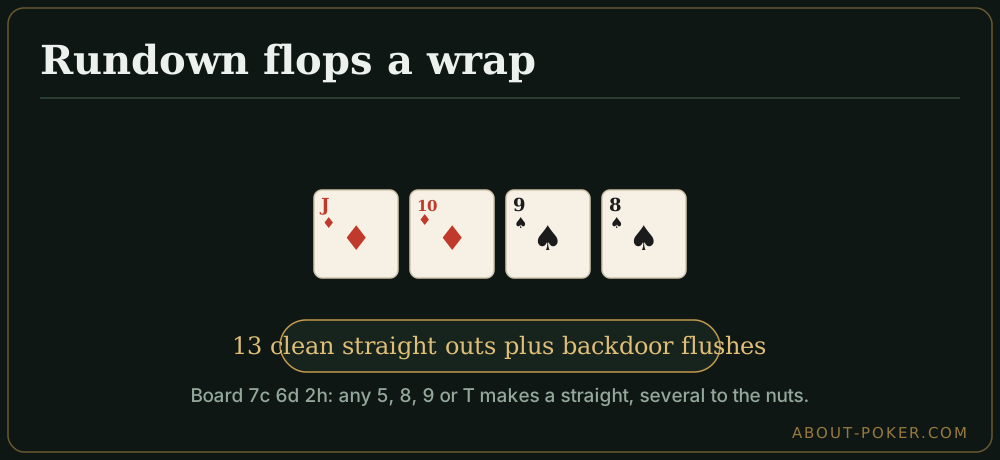
Say you hold Jd Td 9s 8s (double-suited) and the flop comes 7c 6d 2h. You have flopped a wrap: any 5, 8, 9, or T gives you a straight, and several of those straights are the nuts. That is 13 clean straight outs before counting backdoor flushes. Against a made hand like top set of sevens you are roughly a coin flip to slightly ahead by the river, and against one pair you are a large favorite. In PLO, where pots are contested aggressively, getting money in with a hand this strong on the flop is exactly what rundowns are built to do. Note how the double-suit adds backdoor flush equity on top, nudging you further ahead.
How gaps change the hand
Not every four connected cards are equal. A single gap can be harmless or even helpful when it lands at the top. QT98 has a gap between the queen and the ten, but that gap lets it make higher straights than a pure T987, so its wraps are often the nut end. The danger is low, gapped structures. Something like 8532 double-suited looks connected at a glance but flops far fewer clean wraps and constantly draws to the low end. As a rule, prize high, tightly-connected rundowns and be skeptical of hands with two gaps or a wide spread between top and bottom card.
Position and multiway play
Rundowns thrive in multiway pots because their draws hit hard and the equity is realized when several opponents pay you off. In position, you can play a wider range of them and use pot control when you flop only a piece. Out of position, tighten toward the premium high rundowns that flop the nut end more often. For exact opening frequencies, our PLO preflop ranges breakdown shows how rundowns slot in alongside the ace-high and paired hands.
Be disciplined about non-nut straights. A rundown that keeps making the low end of the straight will bleed money against opponents holding the top end. When the board pairs or a fourth straight card comes, reassess whether your straight is still good, since redraws and higher straights are common.
Quick checklist for playing rundowns
- Prefer high, tightly-connected cards; KQJT and JT98 lead the pack.
- Value double-suited versions far above single-suited or rainbow ones.
- One top gap is acceptable; two gaps or a low structure is a downgrade.
- Aim to make the nut end of straights, not just any straight.
- Get money in aggressively when you flop a big wrap, especially with backdoor flush equity behind it.
Master rundowns and you have learned the core of what makes PLO a different, richer game than Hold’em.
Frequently asked
What is a rundown in PLO?
A rundown is a Pot-Limit Omaha starting hand made of four connected or near-connected cards, such as JT98 or KQJT. The connectivity lets the hand flop straights, wraps, and multi-way draws that a Hold'em hand simply cannot make.
Are double-suited rundowns the best PLO hands?
Double-suited rundowns are among the strongest playable hands in PLO because they combine straight equity with two flush draws. A hand like JT98 double-suited flops a huge range of nut and second-nut draws and plays profitably from any position.
Do gaps ruin a rundown?
A single well-placed gap (like QT98) is fine and can even help by adding higher-end straight coverage. Two gaps or a low, disconnected structure sharply reduce how often you flop the nut wrap, so treat those hands with caution.