Why Is It Called Omaha Poker? Name & History
Omaha poker has no documented Nebraska origin — the name spread through 1980s casinos. Here's the history, the myths, and the defining rule.
On this page · 7 sections
Omaha poker isn’t reliably named after Omaha, Nebraska — despite the common assumption. The name is a casino label that spread through American card rooms in the early-to-mid 1980s, the same way many house games picked up city or regional names without a documented birthplace. What does define Omaha, and always has, is its signature rule: four hole cards, of which you use exactly two. Here’s the honest history, the myths worth retiring, and why the rule matters more than the name.
The short answer
There is no confirmed, documented reason the game is called Omaha. What we can say with confidence:
- The game spread through U.S. casinos in the 1980s and was popularized on the Las Vegas felt during that era.
- Early versions circulated under other names before “Omaha” became standard.
- The name likely followed the informal casino convention of tagging games with American place names.
Anyone claiming a precise, verified origin story is almost certainly repeating folklore. The honest historian’s answer is: the name caught on, and its exact source isn’t documented.
The names that came before
Before “Omaha” was universal, the four-hole-card, use-exactly-two game reportedly circulated under several house names. Treat these as poker folklore, not verified history — they’re passed down in card-room lore and repeated in poker forums and reference sites, but none carries a documented paper trail:
| Early name (per lore) | What the story says |
|---|---|
| Nugget Hold’em | Said to reference a casino that spread an early version |
| Twobie / Two-by-Three | A descriptive nickname for the “two hole, three board” rule |
| Oklahoma / Omaha Hold’em | Regional labels attached to the game in the 1980s |
Notice the pattern: several of these names either point at a casino or literally describe the two-and-three rule. Whatever their accuracy, they reinforce the real point — that rule, not the geography, is the game’s true identity.
The origin theories worth knowing
If you search for the name’s history, you’ll run into a few claims repeated far more often than others. None is confirmed, but these are the ones actually worth knowing:
- The Golden Nugget / Vegas-spread theory. The most-cited account credits poker executive Robert Turner with bringing the game to the Golden Nugget in Las Vegas around 1982, where Bill Boyd reportedly spread it. In this telling “Omaha” is simply the label the casino used, which then followed the game as it spread across the felt.
- The “descended from an earlier game” theory. Many writers note the game didn’t appear from nowhere — it’s widely described as an evolution of earlier community-card and split-hand games, with the four-hole-card, use-exactly-two format being the innovation that set it apart.
- The Nebraska-city theory. The intuitive assumption that the game was invented in Omaha, Nebraska is the one with the least support — there’s no reliable evidence tying its creation to the city.
Take all three with a grain of salt: they circulate widely, but the honest bottom line remains that the name’s exact source isn’t documented.
What actually defines Omaha
Whatever you call it, Omaha is defined by one non-negotiable rule:
You must make your five-card hand using exactly two of your four hole cards and exactly three of the five community cards.
Not one, not three, not four hole cards — always exactly two. This is the rule that separates Omaha from every other flop game and the one that beginners break most often. For the complete ruleset, see our rules of Omaha guide and the beginner-friendly how to play Omaha walkthrough.
Why the rule, not the name, is what to remember
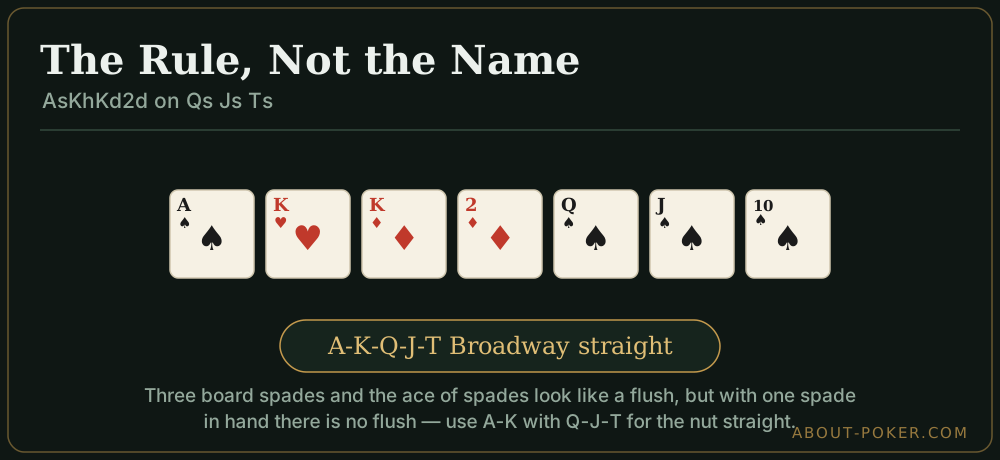
One quick example shows why the two-card rule is the game’s real identity. Say you hold A♠ K♥ K♦ 2♦ and the board is Q♠ J♠ T♠ 4♣ 3♥. A hold’em player sees three spades and one A♠ in hand and thinks flush — but with only one spade in your hand and no way to use a single hole card, you have no flush at all. Use exactly two hole cards, A♠ and K♥, with Q♠ J♠ T♠, and what you actually hold is an A-K-Q-J-T Broadway straight. That gap between what looks true and what the rule allows is the whole point of the name debate: Omaha is defined by how you build the hand, not by any city.
Omaha’s place among poker variants
Omaha is a member of the community-card family, alongside Texas Hold’em. It later spawned its own branches: Pot-Limit Omaha (the most popular betting form), Omaha Hi-Lo (a split-pot version), and five-card variants. To see where it sits relative to the wider poker world, browse the other poker variants hub. And if you’re coming from hold’em, our Omaha vs. hold’em comparison explains exactly how the four-card deal rewires strategy.
Practical takeaways
- The name “Omaha” has no verified origin; it’s a 1980s casino label, not a documented Nebraska invention.
- The most-cited story credits Robert Turner with bringing it to the Golden Nugget around 1982, but even that is unconfirmed lore.
- Reported earlier names (Nugget Hold’em, Twobie) are folklore, though several described the two-hole-cards rule directly.
- The game’s real identity is the exactly-two-hole-cards rule, not its geography.
Ready to play the game behind the name? Start with how to play Omaha and explore the full library in the Omaha and PLO hub.
Frequently asked
Why is it called Omaha poker?
There is no confirmed origin for the name. The game spread through American casinos in the early-to-mid 1980s, and 'Omaha' stuck as its label the way many casino games acquire city or regional names. It is not documented to have been invented in Omaha, Nebraska.
Was Omaha poker invented in Omaha, Nebraska?
There's no reliable evidence tying the game's invention to the city. The name is best understood as a casino label that caught on, similar to how Texas Hold'em carries a state name without a precisely documented birthplace.
What was Omaha poker originally called?
Early forms circulated under names like 'Nugget Hold'em' and 'Twobie' in various casinos before 'Omaha' became the standard name in the 1980s. The defining feature — four hole cards, use exactly two — was the constant.
How is Omaha different from Texas Hold'em?
Omaha deals four hole cards instead of two, and you must use exactly two of them with three board cards. Hold'em deals two hole cards that you may use in any combination with the board. That single rule change transforms the strategy.