2-7 Single Draw Rules: Deuce-to-Seven Lowball
2-7 single draw is one-draw lowball where the best hand is 7-5-4-3-2. Aces play high and straights and flushes count against you. Rules and strategy.
On this page · 4 sections
Picture 7♣ 4♦ 3♠ 2♥ K♠ in your hand. Four of those cards are a dream lowball hand; the king is the only flaw. Toss it, catch a five or six, and you have a monster. That single decision — how many cards to swap, and whether to swap at all — is nearly the whole game of 2-7 single draw.
Deuce-to-seven single draw is a one-draw lowball game where the lowest hand wins, the ace is always high, and straights and flushes count against you. Those two twists mean the best possible hand is 7-5-4-3-2 unsuited — five low cards that don’t line up into a straight. You get exactly one draw to build it, and most rooms spread it as no-limit.
Reading a low: highest card down
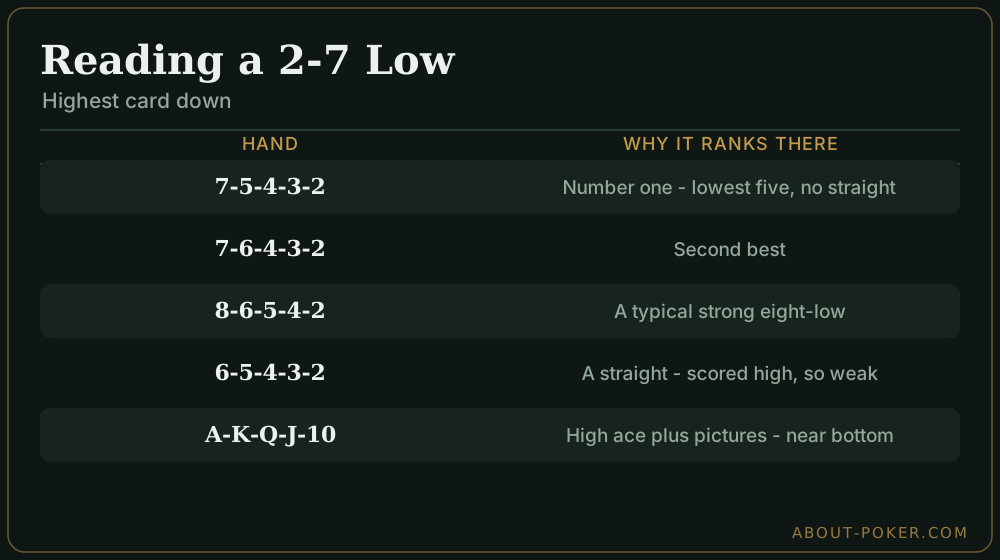
Standard high rankings are read backward here — the worst high hand is the best low hand, and an ace never plays as a one.
| Hand | Why it ranks there |
|---|---|
| 7-5-4-3-2 | Number one — lowest five cards, no straight |
| 7-6-4-3-2 | Second best |
| 8-6-5-4-2 | A typical strong eight-low |
| 6-5-4-3-2 | A straight — scored as a high hand, so it’s weak |
| A-K-Q-J-10 | High ace plus two picture cards — near the bottom |
Compare from the top card down. A seven-low always beats an eight-low, and among sevens, 7-5-4-3-2 beats 7-6-4-3-2 because the five undercuts the six.
The sequence of a hand
- Blinds posted, Hold’em style.
- Deal — five cards face down to each player.
- First betting round, left of the big blind.
- The draw — in turn, discard 0–5 cards for replacements. This happens once.
- Second betting round.
- Showdown — lowest hand takes the pot.
Draw order follows the same seat rotation as the betting: the first active player to the left of the button acts first, and the button draws last, exactly as in five-card draw. That ordering is why position matters so much — the button sees how many cards everyone else took before deciding whether to draw or stand pat. When a player stands pat, the dealer simply skips them and moves on; if the deck runs low with many players drawing, the burn card and discards are reshuffled to complete the draw.
Pat or draw one?
With a single draw, your strategy collapses into that one choice. Back to 7♣ 4♦ 3♠ 2♥ K♠: drawing one and pitching the king, 12 of the 47 unseen cards (any 5, 6, or 8) hand you a made seven or eight — about a one-in-four shot at a premium. Any 5 makes the nut 7-5-4-3-2, any 6 makes 7-6-4-3-2, and any 8 makes 8-7-4-3-2; a second 7 or a paired deuce, trey, or four whiffs, as does anything nine or higher.
Now compare standing pat with a made eight like 8♠ 6♦ 4♣ 3♥ 2♠. You can’t improve, but you can’t get worse either, and in no-limit you get to bet it hard while a one-card drawer is still guessing what they’ll catch.
Betting and sizing in a no-limit game
Because it’s no-limit, sizing works much like No-Limit Hold’em: you can move all-in on any street, and the same open-raise math applies. A typical pre-draw open is about 2.5–3x the big blind from the button, larger from early seats. If the pot holds 6 big blinds after the draw, a pot-sized bet (6 BB) asks the drawer to call 6 to win 12 — laying them 2-to-1 — while a half-pot bet (3 BB) offers 3-to-1. Since a one-card draw to a smooth low hits a made hand only about a quarter of the time, a pat player betting pot is charging the drawer far more than their raw draw is worth, which is exactly the pressure that makes the pat/bluff dynamic pay. The two betting rounds are asymmetric: the pre-draw round is small relative to stacks, and the post-draw round is where the stack-threatening bets land, so save your leverage for after the cards are swapped.
Starting-hand thresholds
One draw leaves little room to fix a bad start, so entry standards are tight. A rough guide:
- Pat hands (raise/stand pat): any made eight-low or better — from 8-6-5-4-2 down to the 7-5-4-3-2 nuts. Weaker made eights are marginal from early position but fine to open on the button.
- One-card draws: draw only to a smooth low — four cards to a seven or a smooth eight, ideally including a deuce.
7-4-3-2,7-5-3-2, and8-6-4-2are strong;8-7-6-2is rough and often best folded out of position. - Fold: two-card draws, any four cards to a rough eight, and anything containing an ace, a face card, or a pair. Drawing two even to
4-3-2is a losing habit — you’ll pair or catch high far too often.
Loosen these on the button, where you draw last and can steal; tighten them from the blinds and against a raise, where a pat hand may already have you beaten.
How it differs from triple draw
The scoring matches 2-7 triple draw exactly, but the feel is different:
- One draw, not three. Far less room to repair a hand, so you need a made hand or a strong one-card draw to a smooth low just to enter.
- No-limit, not fixed-limit. Triple draw is usually limit; single draw’s no-limit format brings stack-threatening rivers and snap-offs.
- Position is huge. Acting last, you watch how many cards everyone drew before you decide to draw or stand pat.
The habitual errors are drawing two to a rough low, playing hands with aces or picture cards, chasing 6-5-4-3-2 (that’s a straight), and never once repping a pat hand in a no-limit format built for bluffing.
Once the one-draw math is automatic, add the extra streets in 2-7 triple draw, see how an ordinary draw game flows in five-card draw, or browse the variants hub.
Frequently asked
What is the best hand in 2-7 single draw?
The best hand is 7-5-4-3-2 of mixed suits, known as 'number one' or 'the wheel.' Because straights and flushes count against you and aces are high, 7-5-4-3-2 unsuited is the nut low that beats every other holding.
Is 2-7 single draw played no-limit?
Usually, yes. No-limit 2-7 single draw is a staple of high-stakes mixed rotations and has its own bracelet event at the World Series of Poker. A fixed-limit version exists but is far less common.