Bomb Pot Poker Rules: How Bomb Pots Work
Bomb pot poker rules: everyone antes, preflop betting is skipped, and the flop is dealt straight away. How single and double-board bomb pots work.
On this page · 5 sections
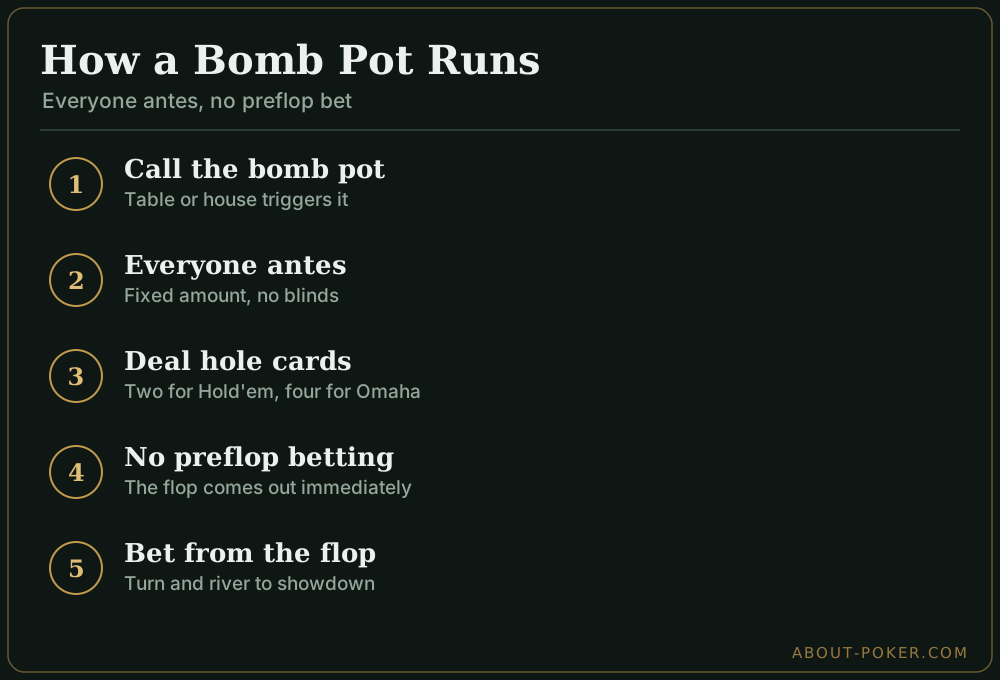
Here’s a bomb pot in one table, before the prose:
| Step | What happens |
|---|---|
| 1 | The table (or house) calls a bomb pot |
| 2 | Everyone antes a fixed amount — no blinds |
| 3 | Hole cards are dealt: two for Hold’em, four for Omaha |
| 4 | No preflop betting — the flop comes out immediately |
| 5 | Betting starts on the flop, runs through turn and river to showdown |
That’s the whole idea. A bomb pot skips the preflop round entirely: every player antes, gets dealt in, and sees a flop with the full field already in the pot. It’s become a fixture of live cash games and cardroom promotions because it manufactures a big, multiway pot on demand. Bomb pots are almost always played as Hold’em or Omaha, so if you know the Omaha rules you already know everything that happens once the flop lands.
Why the ante replaces the blinds
The forced ante is doing two jobs. It seeds the pot before a single bet is made, and it removes the need for blinds — nobody has positional-cost pressure preflop because there’s no preflop betting at all. Each player typically antes the size of the big blind, though some rooms use a set multiple of it.
One thing that genuinely changes is the order of action after the flop. With no blinds and no preflop round, the “first to act” position is set by house rule rather than by who posted the big blind. Most rooms have the first active player to the dealer’s left act first on every street, with the button acting last as usual — but this varies, so confirm the order before your first bomb pot rather than assuming.
What triggers a bomb pot
Bomb pots don’t just happen at random — each room has a mechanic that fires one off. The four common triggers:
| Trigger | How it fires | Typical use |
|---|---|---|
| Button milestone | A bomb pot runs every time the button passes a marked seat (often seat 1) — so once per orbit | Scheduled, predictable cadence |
| Timer | The floor or dealer calls one on a fixed clock, e.g. every 30 minutes or on the hour | High-volume promo periods |
| Table vote | Players agree to run one, usually by unanimous or majority table consent | Player-driven cash games |
| Dealer change | A bomb pot is dealt on every dealer push (dealer down) | Rooms tying it to the rotation |
The button-milestone and dealer-change methods keep the cost predictable — you can budget one ante per orbit or push. Timer-based bomb pots are less predictable but concentrate the action. Whatever the trigger, the ante is mandatory for everyone dealt in; you can’t opt out of a bomb pot the way you’d fold a normal hand.
Betting caps and straddles
The betting structure follows whatever game the bomb pot is built on. A Hold’em bomb pot almost always runs no-limit — any bet from the minimum up to your whole stack is legal on every street. An Omaha bomb pot is usually pot-limit (PLO), which quietly matters here: because the antes have already seeded the pot, the very first flop bet can be as large as the current pot. Six players anteing one big blind each build a 6 BB pot before a card is bet, so the first PLO bet can be up to 6 BB — bigger than a typical no-limit open — and each raise grows the ceiling further.
Some rooms also let players straddle a bomb pot, or stack a bomb pot on top of a straddled orbit. A straddle is an extra blind bet, but since a bomb pot has no preflop round, a “bomb pot straddle” just functions as a larger forced ante for the straddler (and sometimes everyone), inflating the flop pot even more. Straddle-plus-bomb combos are a house option, not a standard rule, so check whether your room allows them before posting.
Single board versus double board
Bomb pots come in two main shapes, and the board format changes the entire feel of the hand.
| Feature | Single-board | Double-board |
|---|---|---|
| Boards dealt | One | Two, side by side |
| Streets | Flop, turn, river | Two flops, turns, rivers |
| Winner | Best hand on the board | Best hand on each board splits |
| Scoop | Whole pot to the best hand | Only by winning both boards |
| Typical game | Hold’em | Omaha or Hold’em |
In a double-board bomb pot the pot normally splits in two — one half for the best hand on each board. Your hole cards play against both boards independently, so you can win one half, both (a scoop), or neither. Double boards create more ties and more split pots, which spreads the money around and keeps more players live all the way to the river.
Why the hands get big
Two features of the format inflate every bomb pot. First, a full field sees the flop — since nobody folds preflop, the pot starts five, six, or more players deep, so more hands connect and more callers stick around on later streets. Second, the ante has already seeded a pot worth fighting over before anyone bets, which pulls players toward aggression on the flop.
The combination means marginal one-pair holdings that would take down a normal heads-up pot get run over constantly in a six-way bomb pot. Straights, flushes, and full houses carry the day. If your hand rankings are rusty, it’s worth a refresh, because the winner in a bomb pot is usually sitting near the top of the chart.
A double-board Omaha bomb pot, played out
Six players ante one big blind each into a double-board Omaha bomb pot. You hold A♠ K♠ Q♥ J♥ — coordinated and strong. Two flops appear:
- Board 1:
T♠ 9♠ 2♦ - Board 2:
Q♦ J♣ 4♥
Remember the Omaha rule: you must use exactly two of your four hole cards plus exactly three board cards. On Board 1 that gives you the nut flush draw — your A♠ K♠ need just one more spade to join the T♠ 9♠ — plus an open-ended straight draw, since Q♥ J♥ complete a straight with any king or eight. On Board 2 your Q♥ J♥ pair the Q♦ J♣ for top two pair, queens and jacks. You’re live to win both halves, so you bet aggressively.
The turn and river bring the 3♠ on Board 1 and blanks on Board 2. Board 1 now gives you the nut flush — A♠ K♠ with T♠ 9♠ 3♠ — while your queens-and-jacks two pair holds up on Board 2. Win both boards and you scoop the entire inflated pot — the payoff that makes double-board bomb pots such a draw.
How the pot gets split at showdown
Physically, the dealer treats the two boards as two separate pots. At showdown the total pot is pushed into two equal halves, and each half is awarded to the best hand on its own board:
                 ┌─────────────── TOTAL POT ───────────────┐
                 │                                          │
        ┌────────┴────────┐                        ┌────────┴────────┐
        │   HALF #1 (50%)  │                        │   HALF #2 (50%)  │
        │  best on Board 1 │                        │  best on Board 2 │
        └────────┬────────┘                        └────────┬────────┘
   Board 1: T♠ 9♠ 2♦ 3♠ x                     Board 2: Q♦ J♣ 4♥ x x
   You: A♠ K♠ nut flush  ✓ win           You: Q♥ J♥ two pair (Q+J) ✓ win
                 │                                          │
                 └──────────────► both halves to you ◄──────┘
                              = SCOOP (whole pot)
If a different player had held the best hand on Board 2, the pot would simply be cut down the middle: half to your flush, half to their winning Board 2 hand. When two players tie for the best hand on the same board, that half is split again between them — which is why double boards produce so many quarters and chopped pots.
Confirm the house rules first
Bomb pots are a house feature, not a standardized variant, so the details differ from room to room. Before you play, get straight on the ante size (one big blind is common, but some rooms use larger multiples), whether it’s single or double board and Hold’em or Omaha, which trigger the room uses and how often it fires, whether straddles are allowed, and who acts first postflop.
Really, a bomb pot is a supercharged betting format layered on top of Hold’em or Omaha rather than a game of its own. If you like the faster, higher-variance action, you’ll probably also enjoy short deck poker, another modern format built for action, and the poker variants hub has plenty more.
Frequently asked
Can you fold in a bomb pot before the flop?
No. Once a bomb pot is called everyone has already posted the ante and there's no preflop action to fold to. Every dealt-in player sees the flop, which is why bomb pots produce such large multiway fields.
What is a double-board bomb pot?
It deals two full community boards at once — two flops, two turns, two rivers. The pot is split between the best hand on each board, and a player who wins both boards scoops the whole thing.