Pineapple OFC Strategy
Pineapple OFC strategy: how the three-cards-pick-two format changes card placement, when to chase Fantasyland, discard priorities, and worked examples.
On this page · 8 sections
Why the discard changes everything
Pineapple OFC keeps the three-row structure of open-face Chinese poker but hands you three cards each turn instead of one, of which you place two and discard one. That single extra card of choice transforms the game. In standard OFC you are often forced to place a card you did not want; in Pineapple you almost always have an out. Hands run stronger, fouls are rarer, and Fantasyland is reachable far more often. If the base game is new to you, read the open-face Chinese poker rules first, then use this guide for the Pineapple-specific decisions.
The hand structure
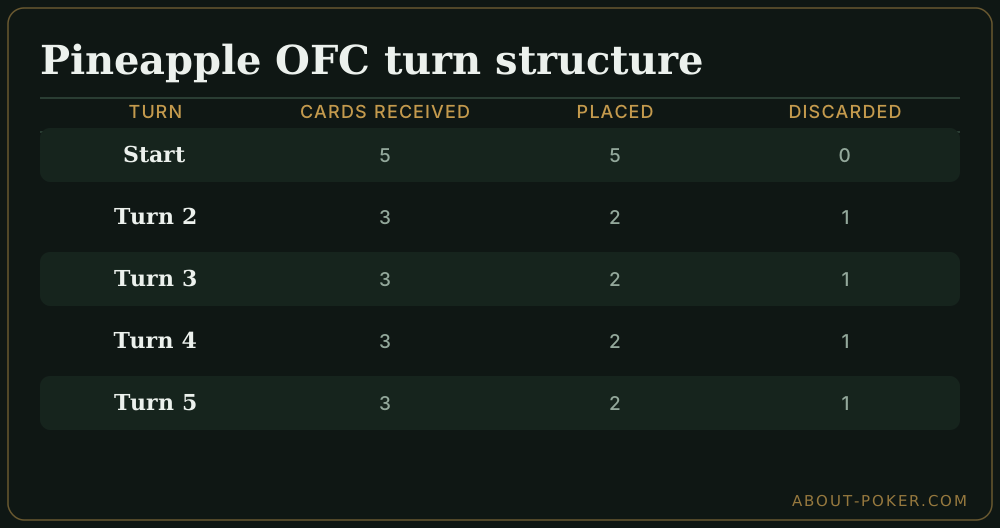
You start with five cards and place all five, one at a time. Then across four more turns you receive three cards, place two, and discard one, ending with 13 placed cards and four discards. Because you keep two of every three, your board quality is much higher than in single-card OFC. That raises the bar for what counts as a good middle and bottom, and it means playing too safe leaves points on the table.
Set the bottom to win the row
With more card selection, the bottom row becomes a real contest. Aim your strongest holdings there and protect your ability to make a flush or straight. Early, keep suited cards flexible: if your first five include three spades, leaning the bottom toward a spade flush is reasonable because the discard lets you shed off-suit clutter over the next turns. A bottom that finishes as merely two pair will often lose the row in Pineapple, whereas in single-card OFC it might have held.
Prioritize the top for Fantasyland
Fantasyland, entered with a pair of queens or better up top, drives Pineapple strategy because you reach it so often. When early cards give you a queen, king, or ace, keep the door open by not burying pairs in the middle unnecessarily. The discard is your friend here: you can hold a lone king waiting to pair while discarding a card that would have crowded your top row. For the full logic of the bonus round and how to repeat it, see the Fantasyland walkthrough fundamentals and plan your top row around QQ+.
Discard priorities
When choosing which of three cards to throw, work down this order:
- Discard the card that helps no row and does nothing for Fantasyland.
- Keep pairs and high cards aimed at the top row.
- Keep suited and connected cards that extend a live bottom draw.
- Break ties by keeping the card that preserves the most future flexibility, not the one worth the most in isolation.
A worked turn
You are mid-hand. Your bottom row shows Ah Kh 7h (three hearts, a live flush draw), your middle has a pair of nines, and your top has a lone queen. You are dealt Qs, 4h, 2c. Walk it through: Qs pairs your top row and puts you on the doorstep of Fantasyland, so it is a keep. The 4h completes progress toward your heart flush on the bottom, another keep. The 2c helps nothing, so it is the discard. You place Qs up top and 4h on the bottom, and pitch the deuce. That single turn advances both a Fantasyland entry and a flush, exactly the kind of double progress the format rewards.
Common mistakes
- Discarding a live flush card to fill a row you could have completed later, killing your best royalty.
- Playing for a safe legal board and never chasing QQ+ up top, giving up the format’s biggest edge.
- Committing the middle row too early, then fouling when the bottom cannot climb above it.
- Keeping the highest single card out of habit when a suited connector preserved more equity.
Foul avoidance still comes first
The extra card makes fouling less common, not impossible. Bottom must beat middle, and middle must beat top, every time. If chasing QQ up top would force an illegal order you cannot fix with future discards, take the clean board instead. For how ordering and blocking work across all three-row games, the Chinese poker strategy guide is a useful companion. Play the discard actively, aim the bottom to win, keep the top pointed at Fantasyland, and never break a legal board for a royalty you might not complete.
Frequently asked
How is Pineapple OFC different from regular OFC?
In Pineapple OFC you are dealt three cards on each turn after the initial five, place two, and discard one. Regular OFC deals one card per turn. The extra card and the discard give you far more control over your board, so hands are stronger and fouls are less common.
How many cards do you place each turn in Pineapple OFC?
You start with five cards placed one at a time, then on each of the next four turns you receive three cards, place two, and discard one. That yields the 13 cards needed to fill all three rows, with four cards discarded over the hand.
What should you discard in Pineapple OFC?
Discard the card that least improves your rows or your Fantasyland chances. Keep pairs, high cards for the top, and suited or connected cards that extend a bottom-row flush or straight draw. When two cards are equally useful, keep the one that preserves the most future flexibility.
Is Fantasyland easier in Pineapple OFC?
Yes. Because you see three cards per turn and discard one, you reach QQ+ up top far more often than in single-card OFC. Chasing Fantasyland is a bigger part of Pineapple strategy, and the payoff of setting 14 cards in secret is the same or larger.