What Is Middle Position in Poker?
Middle position sits between the early seats and late position. Learn where MP is, how wide to open, and how to play it in and out of position.
On this page · 8 sections
Middle position is the block of seats between the early positions and late position — the players who act in the middle of the pre-flop betting order. At a full 10-handed table it typically means the two seats after under the gun and UTG+1, sitting just before the lojack. You have fewer opponents behind you than the early seats, so you open wider, but late position still acts after you, so you play a disciplined, value-weighted range.
Where middle position sits
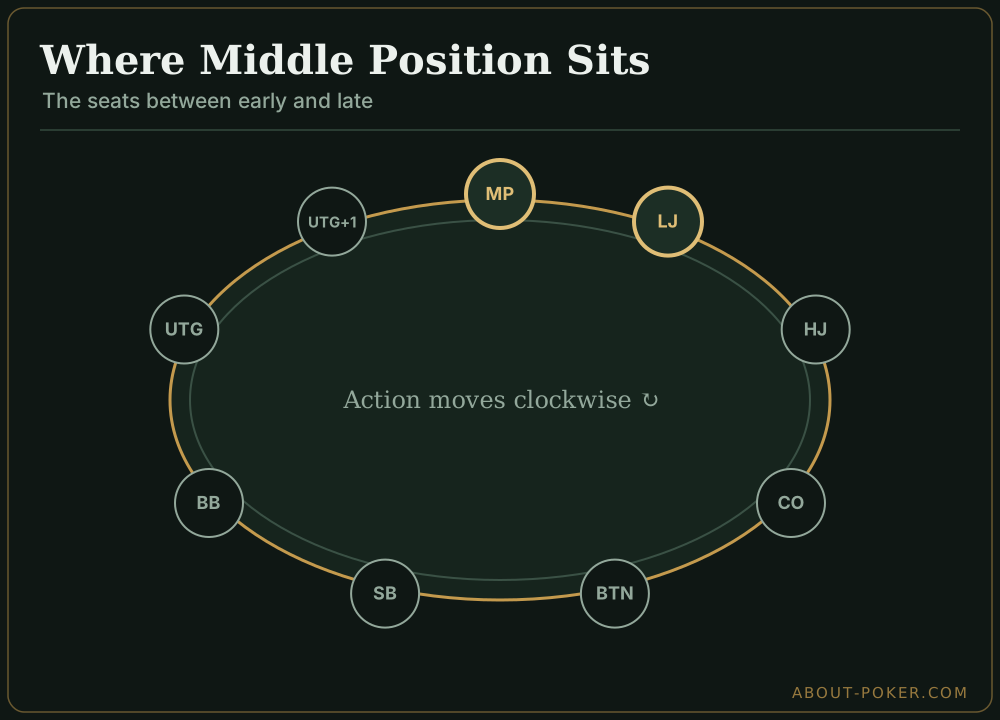
Poker seats are defined by how many players act after you. Going clockwise around a full-ring table, the run looks like this:
| Order | Seat | Group | Players behind (pre-flop) |
|---|---|---|---|
| 1 | Under the gun | Early | 7 + blinds |
| 2 | UTG+1 | Early | 6 + blinds |
| 3 | MP | Middle | 5 + blinds |
| 4 | MP+1 | Middle | 4 + blinds |
| 5 | Lojack | Late | 3 + blinds |
| 6 | Hijack | Late | 2 + blinds |
| 7 | Cutoff | Late | 1 + blinds |
| 8 | Button | Late | 0 (blinds only) |
Middle position is the handoff zone: you’re past the tightest early seats but not yet in the blind-stealing late seats. That in-between status is exactly why its range and strategy sit in between too.
Seeing it on the felt makes the “middle” clearer. Here’s the same 10-handed table as a seat map. Deal starts left of the button and moves clockwise; the bracketed chairs are the middle seats:
BTN
CO            SB
HJ                BB
LJ                UTG
[MP+1]        UTG+1
[MP]
Reading clockwise from the button: SB, BB, UTG, UTG+1, then [MP] and [MP+1] — the middle block — then the lojack, hijack, cutoff, and back to the button. The two bracketed chairs sit exactly between UTG+1 and the lojack, with the entire late group still to act behind them.
Middle position at 6-max, 7-, 8-, and full ring
At a 6-handed table there is essentially no true middle position. Stripping away the early and middle chairs leaves the order under the gun, hijack, cutoff, button, small blind, big blind — the game jumps straight from the first seat to the late group. Middle position is a full-ring concept, so if you play mostly 6-max you rarely sit in a pure middle seat.
Between 6-max and a full ring, the middle block fills in one chair at a time. As seats are added, they slot into the early/middle gap — the late seats (lojack, hijack, cutoff, button) and the blinds stay fixed:
| Table size | Middle seats | Where MP sits |
|---|---|---|
| 6-handed | None | UTG runs straight into the hijack |
| 7-handed | MP (one seat) | Between UTG and the hijack |
| 8-handed | MP (one seat) | Between UTG and the lojack |
| 9-handed | MP (one seat) | Between UTG+1 and the lojack |
| 10-handed (full ring) | MP and MP+1 | Between UTG+1 and the lojack |
So the single “MP” chair first appears at 7-handed, and you only get a two-seat middle block (MP and MP+1) once the table is full at ten. The fewer players at the table, the fewer act behind your middle seat — which is why you can open a touch wider at 7- or 8-handed than in a packed full ring. See the full breakdown of the three groups in early, middle, and late position.
A middle-position opening range
From middle position you open wider than under the gun but tighter than the lojack and the seats past it. A workable full-ring range is about 12–16% of hands:
| Category | Open |
|---|---|
| Pairs | 55+ (mix 22–44) |
| Suited aces | A9s+ (mix A5s) |
| Broadways | AJo+, KQ, KJs, QJs, JTs, KQo |
| Suited connectors | T9s, 98s |
Fold the loose gappers and weak offsuit broadways you’d happily open on the button — hands like KTo and J9s are behind your threshold here. With four or more players still to act, the extra strength earns its keep.
Worked example: the seat sets the decision
It folds to you in middle position with A♥ J♦.
- The read: AJo is a standard middle-position open — a strong broadway that dominates the weaker aces and jacks that call, and flops top pair often.
- Now shift the seat: move that same hand to under the gun and it’s a marginal fold at a tough table, because five or six players can still wake up with a bigger hand. Move it to the lojack or cutoff and it’s an even more comfortable, aggressive open.
- The lesson: AJo lives right on the border, and middle position is where it graduates from “sometimes” to “standard.” The seat, not just the cards, sets the play — the core idea behind why position matters.
Playing middle position after the flop
When you open from middle position, a later seat that calls will have you out of position for the rest of the hand — the lojack, hijack, cutoff, and button all act after you. So value-bet your strong hands confidently (your range is tighter than the late seats’, so you hold the top more often), continuation-bet selectively on boards that favor your range, and don’t overplay marginal top pairs against a caller who acts after you every street. When only the blinds call, you’re often up against weak ranges and can barrel more freely.
Adjusting your middle-position range
The 12–16% guideline is a starting point, not a rule. Because so many players still act behind you, the biggest factor is how they play: tighten against aggressive 3-bettors behind you (drop weak suited aces and small pairs), and widen suited, playable hands against loose-passive callers. Deeper stacks favor suited and connected hands that flop well; short-handed tables push the whole range wider.
Defending when you get 3-bet
Opening from middle position and getting 3-bet by a late seat is common, because those players know you’re often out of position. Don’t reflexively fold, and don’t call with your whole opening range — split it into three buckets:
| Response | Hands | Why |
|---|---|---|
| 4-bet for value | QQ+, AK | Strong enough to get stacks in and dominate a 3-betting range |
| 4-bet as a bluff (sparingly) | A5s (an ace-blocker already in your open) | Blocks their AA/AK/AQ value hands, and can still make a wheel or nut flush |
| Call | JJ–TT, AQ, KQs, and the suited broadways/connectors that flop well when you’ll be in position | Enough equity and playability to see a flop profitably |
| Fold | Weak offsuit broadways, small pairs, weak suited aces (the bottom of your open) | Reverse-implied and hard to play out of position |
As a rough calibration, continue with roughly the top third to half of your opening range against a standard 3-bet, and lean toward the folding end when the 3-bettor is tight or you’ll be out of position for the whole hand. Against a habitual, wide 3-bettor, add more 4-bet bluffs and defend a little looser.
Common middle-position mistakes
- Opening a late-position range. Four-plus players sit behind you; a 30–40% range gets punished by 3-bets and cold-calls.
- Playing it like early position. Too tight and you leave blind-stealing and thin-value profit on the table. Middle position should open wider than UTG.
- Calling raises out of position. Cold-calling from the middle with players still behind invites squeezes and multiway pots where you act first.
Put it together
Middle position is exactly what its name says — a middling seat that rewards a solid, value-leaning game. Open wider than the early seats, tighter than the late ones, and remember you’ll usually be out of position after the flop. See how it hands off to the lojack and the rest of the late seats in the poker positions hub, and lock in your ranges with pre-flop strategy.
Frequently asked
What is middle position in poker?
Middle position is the group of seats between the early positions and the late positions. At a full 10-handed table it usually means the two seats after under the gun and UTG+1 — the players who act in the middle of the pre-flop order, with several opponents still behind them.
Which seats are middle position?
At a 10-handed table the classic middle seats are MP and MP+1 (sometimes labeled UTG+2), sitting between UTG+1 and the lojack. At 6-max there is effectively no true middle position — the table jumps from under the gun straight to the late seats.
How wide should you open from middle position?
Wider than under the gun but tighter than the lojack, hijack, and cutoff. A common full-ring middle-position opening range is about 12–16% of hands: most pairs, strong broadways, and the better suited aces and connectors.
Is middle position good or bad in poker?
It's a middling seat, hence the name. You have fewer players behind you than early position, so you can open a bit wider, but late-position players still act after you, so you'll often be out of position after the flop. Play solid, value-leaning hands.