PokerStars Spin and Go Strategy: A Winning Plan
PokerStars Spin & Go strategy: read the multiplier, exploit the pool's tendencies, and shove accurately — with a worked button example.
On this page · 7 sections
Winning at PokerStars Spin & Gos comes down to three things: read the multiplier, exploit a soft recreational pool, and shove with precision. A PokerStars Spin & Go is a three-handed hyper-turbo with a randomized prize pool — a multiplier wheel spins before the cards, setting the payout — and the games blitz through fast-rising blinds until one player has all the chips. The format itself is standard; what makes the PokerStars version beatable is who you’re playing against.
Read the multiplier first
The multiplier drawn before the hand quietly changes your strategy. It sets both the size and the shape of the prize pool.
| Multiplier tier | Payout shape | Adjustment |
|---|---|---|
| Common low (2x–6x) | Winner-take-all | Play wide-open, chase first place |
| Mid | Winner-take-all | Same — pure first-place hunt |
| Top jackpot | Pays all three players | Add ICM, tighten calls slightly |
Most spins you play are low multipliers and effectively winner-take-all, so aggression is nearly free. On the rare top-tier draw where second and third place actually pay, ICM survival pressure kicks in and you should tighten your bubble calls. That’s the same logic covered in our ICM hub.
The frequencies are lopsided by design. Across PokerStars’ published multiplier tables the small 2x payout is by far the most common — it hits the clear majority of games (roughly two out of three, though PokerStars tweaks the exact odds by stake and over time) — while the life-changing top multipliers land only a few times per million games. The takeaway for strategy: build your win rate on the flood of 2x and other low spins, because that’s where almost every game you play actually lives. The big multipliers are upside you can’t count on and shouldn’t chase differently for.
The PokerStars format at a glance
- Stakes: buy-ins run from about $0.25 up to $100 (occasionally higher during promotions), so there’s a ladder to move up as your roll grows.
- Starting stack: 500 chips at 25 BB, blinds starting at 10/20 and rising every couple of minutes — hyper-turbo speed.
- Rake: built into the buy-in at roughly 5–7% on most stakes (lower at the highest buy-ins). It’s a meaningful drag, which is another reason your edge has to come from out-playing a soft pool, not from coin-flips.
- Payouts: the drawn multiplier sets everything; low multipliers are winner-take-all, only the biggest jackpots split across all three players.
Exploit the PokerStars pool
The single biggest edge in PokerStars Spin & Gos isn’t a range chart — it’s the opponents. The pool is thick with recreational players, and they cluster into two exploitable types:
- The nit who folds far too much. Steal every button relentlessly; they hand you the blinds for free.
- The station who calls too wide. Shove your value hands hard and cut out the light bluffs against them.
Because the games are so short, position and reads compound fast. One correctly identified opponent type can decide the whole game. This exploit-first mindset is the core of our general spin & go strategy, and it pays double on a soft platform.
The three stack zones
The mechanics are standard hyper-turbo. You start around 25 big blinds and drop fast, so you’ll move through three zones:
Opening zone (20–25 BB)
You have room to raise and see a flop. From the button, open to 2–2.2 BB (a min-raise is fine and keeps the pot manageable), and open around 40–50% of hands — most suited aces and kings, all pairs, broadways, suited connectors. When you get to a flop in position with the initiative, a single small continuation bet of one-third to half the pot takes it down often enough against a pool that folds too much; give up when you whiff and get resistance rather than barreling off a stack you’ll need for the pressure zone.
Out of position and in a raised pot, keep it simple: play strong made hands and good draws, and don’t build big pots with marginal holdings — at 20–25 BB you can’t stack off light and still have a workable stack if it goes wrong. Deep play won’t last, so treat this zone as a chance to accumulate cheaply, not to gamble.
Pressure zone (10–20 BB)
Where most of the game lives. Open-raise wide and, when facing a raise, prefer a three-bet shove to flat-calling out of position. Fold equity is the weapon.
Push/fold zone (under 10 BB)
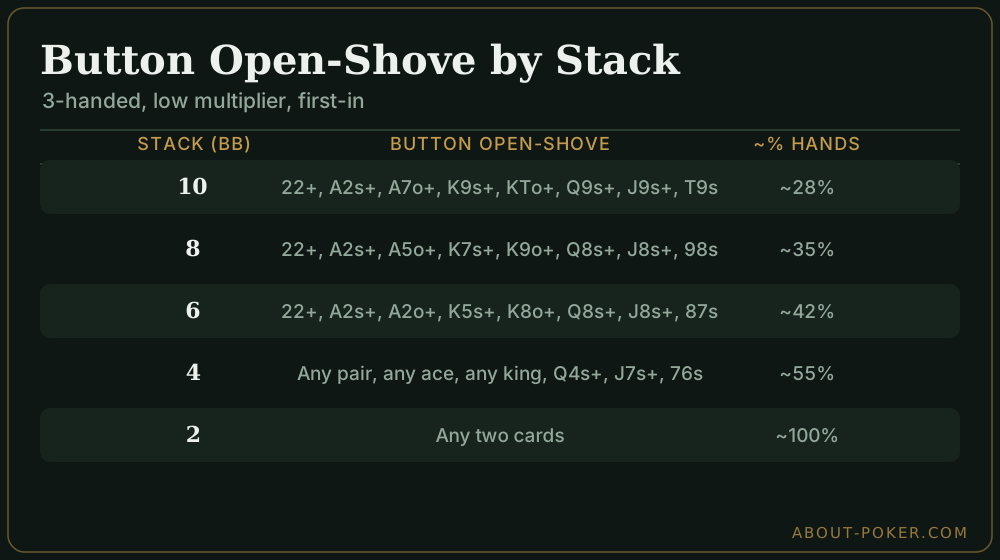
Pure shove-or-fold. From the button first-in you can open-shove a huge range — any pair, any ace, most suited hands, most broadways. From the small blind heads-up, wider still.
Here’s a concrete button open-shove chart, first-in, three-handed, low multiplier (effectively winner-take-all, so these lean a touch wider than a top-three SNG bubble). Ranges are approximate Nash-style baselines — widen them further against blinds that over-fold:
| Stack (BB) | Button first-in open-shove range | ~% of hands |
|---|---|---|
| 10 | 22+, A2s+, A7o+, K9s+, KTo+, Q9s+, QJo, J9s+, T9s | ~28% |
| 8 | 22+, A2s+, A5o+, K7s+, K9o+, Q8s+, QTo+, J8s+, T8s+, 98s | ~35% |
| 6 | 22+, A2s+, A2o+, K5s+, K8o+, Q8s+, QTo+, J8s+, T8s+, 97s+, 87s | ~42% |
| 4 | Any pair, any ace, any king, Q4s+/Q8o+, J7s+/JTo, T7s+, 96s+, 86s+, 76s | ~55% |
| 2 | Any two — almost nothing folds profitably | ~100% |
At 2 BB the blinds and ante are more than half your stack, so open-shoving any two cards is standard. Above 10 BB, back off toward the pressure-zone plan and use three-bet shoves rather than blind open-jams.
Worked example: a button open-shove
Three-handed, blinds 200/400 with a 400 big-blind ante, low multiplier. You’re on the button with 9 big blinds holding A♣ 5♣, and both blinds are recreational players who fold a lot.
There’s roughly 1,000 chips of blinds and ante to win uncontested, your stack is only 9 BB, and your fold equity against two tight-passive opponents is high. Folding A5-suited here would be a real leak.
Shove. The blinds fold often enough that the immediate pickup shows a profit, and when called A5s holds up reasonably with an ace, a flush draw, and wheel-straight potential. This is the bread-and-butter PokerStars spin decision — small edges, taken repeatedly, against a pool that folds too much.
Heads-up: how you close the game
Every Spin & Go becomes heads-up the moment the first player busts, and that’s where the money is decided. In HU, the small blind acts first preflop and has the button — position and the initiative both belong to the SB, so play the SB relentlessly and defend the big blind carefully.
Two rules do most of the work:
- SB (button) open-shoving, short: at 8 BB or less, open-shove roughly the top 55–65% of hands; at 5 BB and under, closer to 75%+; at 2–3 BB, any two cards. The SB’s positional edge plus fold equity makes light jams profitable.
- BB calling a shove: you’re getting a price and there’s no third player to ladder past, so call wider than instinct says. Rough calling ranges versus an all-in:
| Your stack (BB) | BB call-a-shove range | ~% of hands |
|---|---|---|
| 10 | 22+, A2s+, A7o+, K9s+, KTo+, QTs+, QJo, JTs | ~24% |
| 6 | 22+, A2s+, A2o+, K5s+, K8o+, Q8s+, QTo+, J8s+, T8s+ | ~40% |
| 3 | Any pair, any ace, any king, Q6s+/Q9o+, J8s+/JTo, T8s+, 97s+ | ~58% |
Because most spins are winner-take-all, there’s no min-cash to protect — every chip you win in HU goes toward the only prize that pays. Call and shove wider than you would deep in a top-three-paying SNG.
Bankroll matters more here
The randomized prize pool creates savage variance. Most of your profit hides in rare big multipliers, so a long run of low draws and coolers can carve deep into your roll even while you’re playing well. Keep a wider buy-in cushion than you would for standard SNGs: a practical rule of thumb is at least 100 buy-ins for the stake you play, and 150–200+ if you’re a recreational player or grinding higher, where the swings are brutal. If you sit down with 30 or 40 buy-ins, a normal cold stretch of low multipliers can bust you before your edge ever shows up. Move up only after you’ve built a full cushion at the new level, and drop back down the moment the roll dips. See our SNG bankroll management guide for the full framework.
Put it together
PokerStars Spin & Go strategy is aggression plus adjustment: read the multiplier, exploit a soft pool, shove accurately, and bankroll for the swings. Reinforce the format fundamentals in our spin & go strategy guide, protect against variance with SNG bankroll management, and head back to the sit-and-go strategy hub to see how spins fit alongside every other SNG format.
Frequently asked
What is a PokerStars Spin & Go?
A PokerStars Spin & Go is a three-handed hyper-turbo sit & go with a randomized prize pool. A multiplier wheel spins before the cards are dealt and sets the payout, ranging from twice the buy-in up to thousands of times it. Most are winner-take-all; only the very largest multipliers pay all three players.
What is the best PokerStars Spin & Go strategy?
Play a loose-aggressive, push/fold-heavy style. Stacks start around 25 big blinds and blinds rise fast, so steal blinds relentlessly, shove accurately when short, and exploit the many recreational players in the PokerStars pool who fold too much or call too wide.
How do multipliers change PokerStars Spin & Go strategy?
On the biggest multipliers the top three prizes are more spread out, so ICM matters and you tighten up slightly. On the common low multipliers it's effectively winner-take-all, so you shove and call as wide as the math allows to grab first place.
Is bankroll management important for PokerStars Spin & Gos?
Very. The randomized prize pool creates huge variance — most of your profit comes from rare big multipliers. Keep a deep buy-in cushion so a long stretch of low multipliers and coolers doesn't wipe you out.