Sit & Go Bankroll
How big a bankroll do sit & gos need? Buy-in guidelines by format, variance, moving up and down, and a worked buy-in count example for safe grinding.
On this page · 6 sections
Bankroll management is the difference between a sit & go player who survives variance and one who goes broke during a normal downswing. SNGs have a thin edge and real swings, so you need enough buy-ins to ride out the bad runs that happen to everyone. This page gives concrete buy-in requirements by format and shows how to move up and down without risking ruin. For the deeper mechanics, our SNG bankroll management guide expands on the framework here.
Why sit & gos need a bankroll buffer
Every winning SNG player runs bad for stretches. You can play perfectly and still lose 15 or 20 games in a row, because in a single-table SNG only the top few players cash and finishing fourth pays nothing. That flat, top-heavy payout creates variance far larger than a cash game with the same edge. A bankroll buffer exists precisely so a normal cold streak does not end your poker.
The unit of measurement is buy-ins, not dollars. “50 buy-ins” means 50 times the total cost of entry including fees. This keeps the rule identical whether you play $2 or $200 games.
Buy-in requirements by format
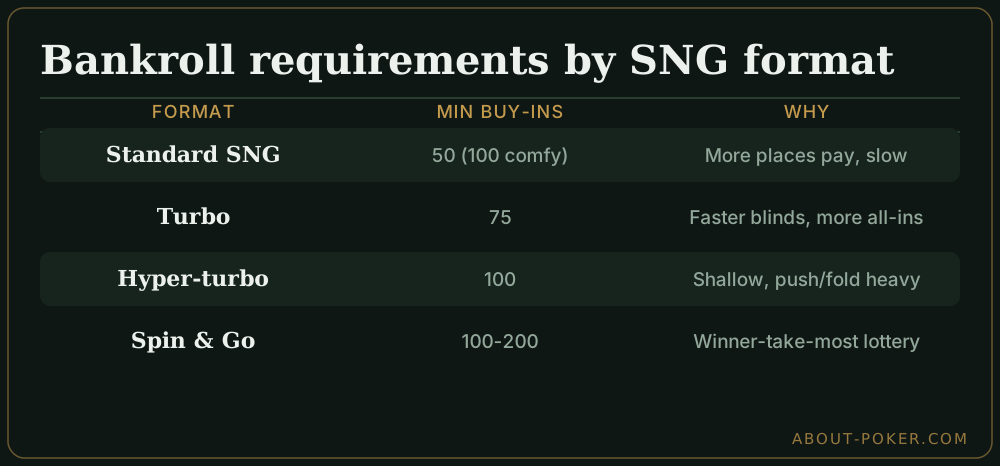
Different SNG formats carry very different variance, so they need different bankrolls:
- Standard single-table SNGs (9-10 handed): 50 buy-ins minimum, 100 comfortable. Lower variance because more places pay and structures are slower.
- Turbo SNGs: 75 buy-ins. Faster blinds mean more all-ins and more variance.
- Hyper-turbo SNGs: 100 buy-ins. Very shallow, push/fold heavy, high variance. See our hyper turbo SNG strategy for how the play itself changes.
- Spin & Gos / lottery SNGs: 100-200 buy-ins. Three-handed, winner-take-most, with rare giant multipliers. The lottery structure produces the biggest swings of any format.
- Multi-table SNGs: 50-100 buy-ins depending on field size; larger fields pay fewer runners and swing harder.
These are guidelines for players with a real edge. If you are still learning, err toward the higher end so your mistakes do not cost you your entire roll.
A worked buy-in example
You have a $600 bankroll and want to know what you can play safely.
For standard SNGs at the 50-buy-in minimum, $600 ÷ 50 = $12 per game, so $10 buy-ins (with fee, roughly $11 total) fit comfortably. For hyper-turbos at 100 buy-ins, $600 ÷ 100 = $6 per game, so you should stick to $5 or $6 buy-ins. For Spin & Gos at 150 buy-ins, $600 ÷ 150 = $4 per game — you belong at the $3 level, not higher, no matter how tempting the big multipliers look.
Notice how the same $600 supports very different stakes depending on format variance. Matching your buy-in to your format’s swing profile is the whole game.
Moving up and moving down
Move up only when two things are true: your bankroll fully covers the required buy-in count at the higher stake, and you have a proven positive win rate at your current level over a meaningful sample. A shot-taking approach is fine — set aside a few buy-ins for a higher level and drop back if you lose them — but never move up on a hunch.
Move down the instant your bankroll falls below the minimum buy-in count for your current stake. This is non-negotiable discipline. Dropping a level is how you preserve the roll so you can climb back. Players who refuse to move down are the ones who go broke.
Common bankroll mistakes
- Treating all SNGs the same. Applying a 50-buy-in rule to Spin & Gos is a recipe for ruin. Match buy-ins to format variance.
- Ignoring rake. Fees drag on your win rate. Count the full entry cost, and factor rake into your expected SNG ROI and win rate.
- Playing scared. A bankroll too small for your stake makes every decision fear-driven. Play a level where a lost buy-in does not matter emotionally.
- Not tracking results. You cannot know if you should move up without a real sample. Track every game.
Bankroll checklist
- Do I have at least the minimum buy-ins for my format’s variance?
- Am I counting the full entry cost including fees, not just the prize pool contribution?
- Will I move down immediately if my roll drops below the minimum?
- Is my stake low enough that one lost buy-in does not affect my decisions?
- Do I have a tracked win rate before considering a move up?
Nail those and variance becomes a temporary inconvenience instead of a threat to your poker.
Frequently asked
How many buy-ins do I need for sit & gos?
For standard single-table SNGs, 50 buy-ins is a safe minimum and 100 is comfortable. Turbos and hyper-turbos need more — 75 to 100 — and high-variance formats like Spin & Gos can require 100 to 200 buy-ins because of their lottery-style payout structure.
Why do Spin & Gos need a bigger bankroll?
Spin & Gos are winner-take-most, three-handed, and hyper-turbo, with occasional huge multiplier prizes. That combination produces enormous swings. You can go hundreds of games without hitting a big multiplier, so 100-200 buy-ins protects you through the downswings.
When should I move up in stakes?
Move up when your bankroll comfortably covers the required buy-in count at the higher level and you have a proven win rate at your current level. A common rule is having the full buy-in requirement for the next level before you take a shot.
When should I move down?
Move down the moment your bankroll drops below the minimum buy-in count for your current stake. Dropping a level protects your roll and your confidence — it is not a failure, it is discipline.